Telcos and other CSPs are rethinking their approach to enterprise
services in the era of advanced wireless connectivity - including their
5G, fibre and Software-Defined Wide Area Network (SD-WAN) portfolios.
Many consumer-centric operators are developing propositions for
“verticals”, often combining on-site or campus mobile networks with edge
computing, plus deeper solutions for specific industries or horizontal
applications. Part of this involves helping enterprises deal with their
data and overall cloud connectivity as well as local networks. (The
original MNO vision of delivering enterprise networks as "5G network
slices" partitioned from their national infrastructure has taken a back
seat. There is more interest currently in the creation of dedicated
on-premise private 5G networks, via telcos' enterprise or integrator
units).
At the same time, telecom operators are also becoming more data- and
cloud-centric themselves. They are using disaggregated systems such as
Open RAN and cloud-native 5G cores, plus distributed compute and data,
for their own requirements. This is aimed at running their networks more
efficiently, and dealing with customers and operations more flexibly.
There are both public and private cloud approaches to this, with
hyperscalers like Amazon and disruptors such as Rakuten Symphony and
Totogi promising revolutions in future.
As I've said for some time, “The first industry that 5G will transform is the telecom industry itself.”
This poses both opportunities and challenges. Telcos’ internal data
and cloud needs may not mirror their corporate customers’ strategies and
timing perfectly, especially given the diverse connectivity landscape.
If operators truly want to blend their own transformation journey
with that of their customers, what is needed is a much broader view of
the “networked cloud” and "distributed data", not just the “telco cloud” or "telco edge" that many like to discuss.
Networked data and cloud are not just “edge computing”
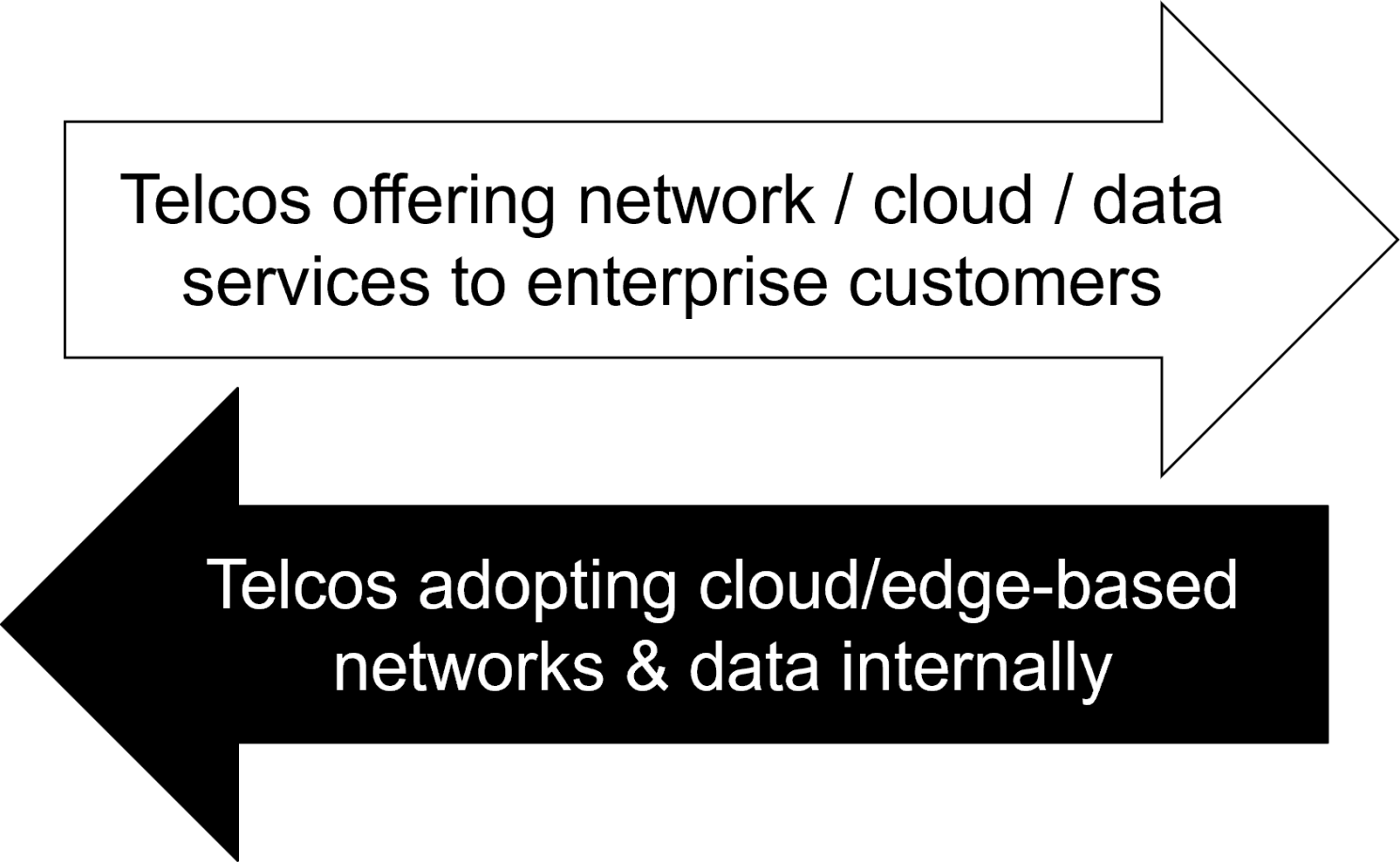
Telecom operators’ discussions around edge/cloud have gone in two separate directions in recent years:
- External edge computing: The desire by MNOs
to deploy in-network edge nodes for end-user applications such as V2X,
IoT control, smart city functions, low-latency cloud gaming, or
enterprise private networks. Often called “MEC” (mobile edge computing),
this spans both in-house edge solutions and a variety of collaborations
with hyperscalers such as Azure, Google Cloud Platform, and Amazon Web
Services.
- Internal: The use of cloud platforms
for telcos’ own infrastructure and systems, especially for cloud-native
cores, flexible billing, and operational support systems (BSS/OSS), plus
new open and virtualised RAN technology for disaggregated 4G/5G
deployments. Some functions need to be deployed at the edge of the
network (such as 5G DUs and UPF cores), while others can be more
centralised.
Of these two trends, the latter has seen more real-world
utilisation. It is linked to solving clear and immediate problems for
the CSPs themselves.
Many operators are working with public and private clouds for their
operational needs—running networks, managing subscriber data and
experience, and enabling more automation and control. While there are
raging debates about “openness” vs. outsourcing to hyperscalers, the
underlying story—cloudification of telcos’ networks and IT estates—is
consistent and accelerating. The timing constraints of radio signal
processing in Open RAN, and the desire to manage ultra-low latency 5G
“slices” in future 3GPP releases are examples that need edge compute. There may also be roles for edge billing/charging, and various security functions.
In contrast, telcos' customer-facing cloud, edge and data
offers have been much slower to emerge. The focus and hype about MEC has
meant operators’ emphasis has been on deploying “mini data centres”
deep in their networks—at cell towers or aggregation sites, or
fixed-operators’ existing central office locations. Discussion has
centred on “low latency” applications as the key differentiator for
CSP-enabled 5G edge. The focus has also been centred on compute rather than data storage and analysis.
Few telcos have given much consideration to "data at rest" rather than
"data in motion" - but both are important for developers.
This has meant a disconnect between the original MEC concept and the
real needs of enterprises and developers. In reality, enterprises need
their data and compute to occur in multiple locations, and to be used
across multiple time frames—from real time closed-loop actions, to
analysis of long-term archived data. It may also span multiple clouds—as
well as on-premise and on-device capabilities beyond the network
itself.
What is needed is a more holistic sense of “networked cloud” to tie
these diverse data storage and processing needs together, along with
documentation of connectivity and the physical source and path of data
transmission.
Potentially there are some real sources of telco differentiation
here - as opposed to some of the more fanciful MEC visions, which are
more realistically MNOs just acting as channel partners for AWS Outposts
and Azure's equivalent Private MEC.
An example of the “networked cloud”
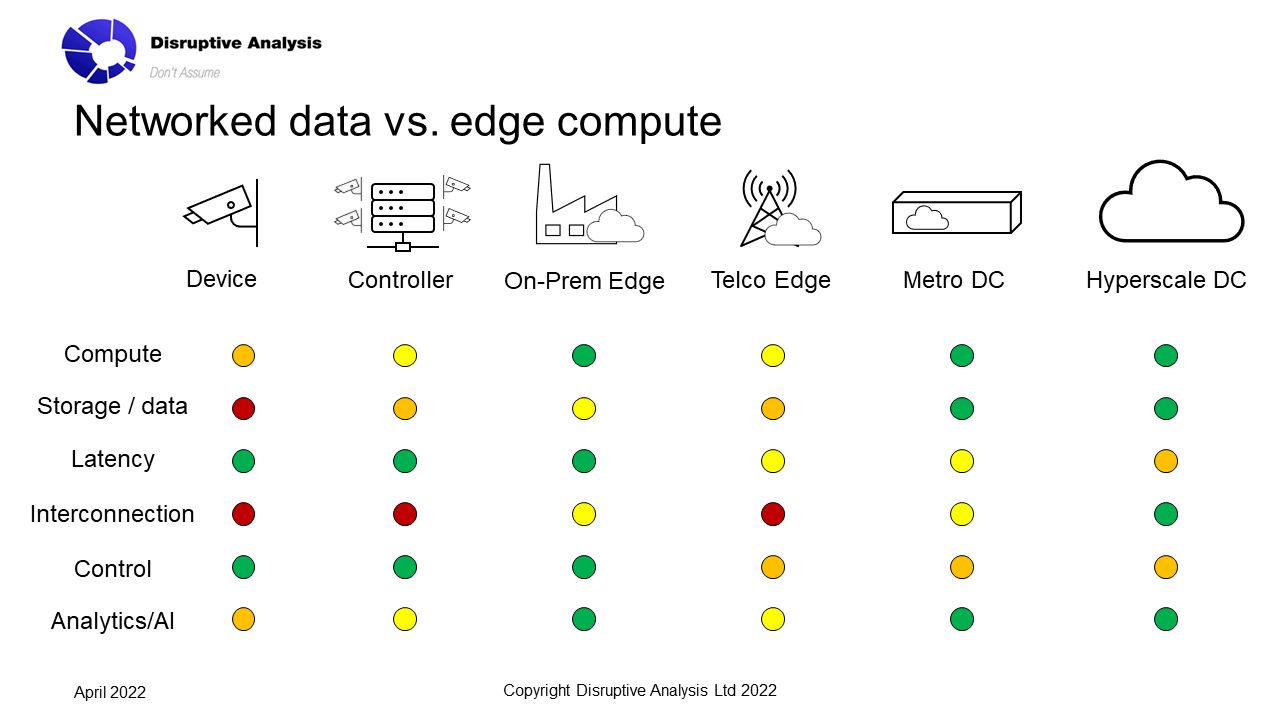
Consider an example: video cameras for a smart city. There are
numerous applications, ranging from public transit and congestion
control, to security and law enforcement, identification of free parking
spots, road toll enforcement, or analysing footfall trends for
retailers and urban planners. In some places, cameras have been used to
monitor social-distancing or mask-wearing during the pandemic. The
applications vary widely in terms of immediacy, privacy issues, use of
historical data, or the need for correlation between multiple cameras.
CSPs have numerous potential roles here, both for underlying connectivity and the higher-value services and applications.
But there may be a large gap between when “compute” occurs, compared
to when data is collected and how it is stored. Short-term image data
storage and real-time analysis might be performed on the cameras
themselves, an in-network MEC node, or at a large data centre, perhaps
with external AI resources or combined with other data sets. Longer-term
data for trend analysis or historic access to event footage could be
archived either in a city-specific facility or in hyperscale sites.
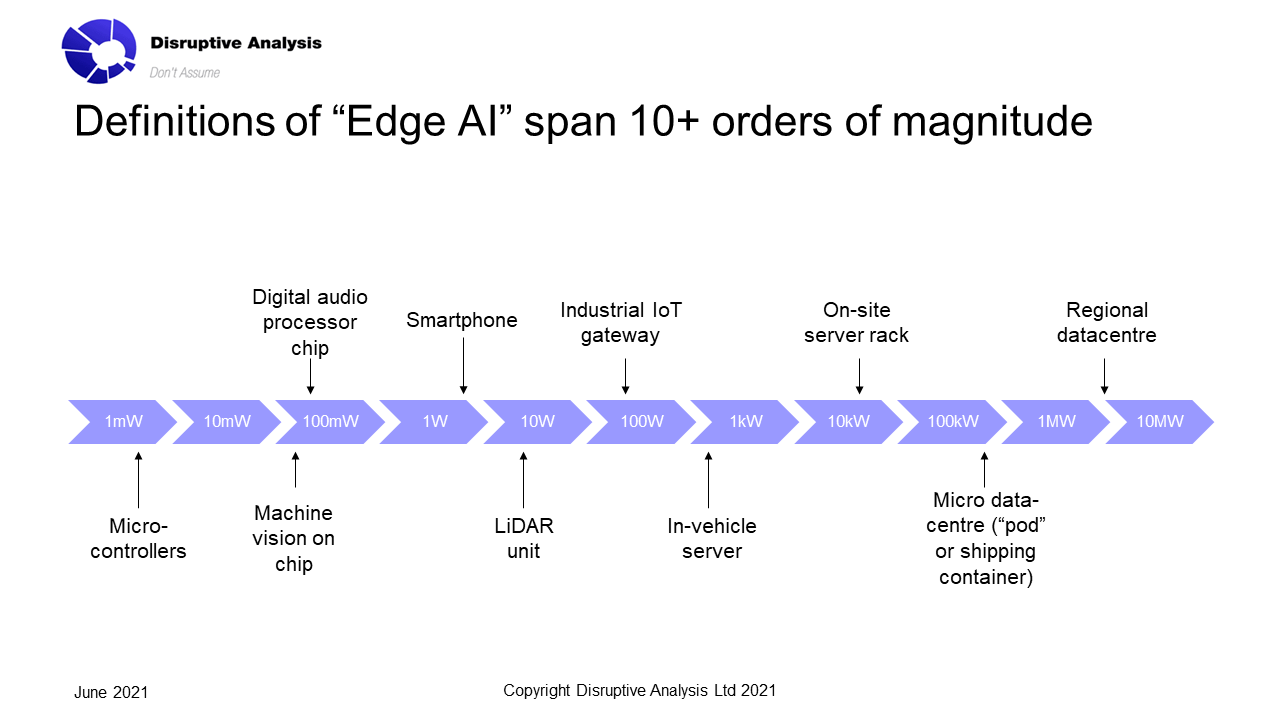
(I wrote a long article about Edge AI and analytics last year - see here)
For some applications, there will need to be strong proofs of
security and data custody, especially if there are evidentiary
requirements for law enforcement. That may extend to knowing (and
controlling) the specific paths across which data transits, how it is
stored, and the privacy and tamper-resistance compliance mechanisms
employed.
Similar situations—with both opportunities and challenges—exist in
verticals from vehicle-to-everything to healthcare to education to
financial services and manufacturing. CSPs could become involved in the “networked cloud” and data-management across these areas—but they need to look beyond narrow views of edge-compute. Telcos
are far from being the only contenders to run these types of services,
but some operators are taking it seriously - Singtel offers video
analytics for retail stores, for instance.
Location-specific data
As a result, the next couple of years may see something of a shift
in telcos’ discussions and ambitions around enterprise data. There will
be huge opportunities emerging around enterprise data’s chain-of-custody and audit trails—not
only defining where processing takes place, but also where and how data
is stored, when it is transmitted, and the paths it takes across the
network(s) and cloud(s).
(A theme for another newsletter article or LI post is on
enterprises' growing compliance headaches for data transit - especially
for international networks. There may be cybersecurity risks or
sanctions restrictions on transit through some countries or intermediary
networks, for instance. Some corporations are even getting direct
access into Internet exchanges and peering-points for greater control).
In some cases, CSPs will take a lead role here,
especially where they own and control the endpoints and applications
involved. Then they can better coordinate the compute and data-storage
resources. In other cases, they will play supporting roles
to others that have true end-to-end visibility. There will need to be
bi-directional APIs—essentially, telcos become both importers and
exporters of data and connectivity. This is especially true in the
mobile and 5G domain, where there will inevitably be connectivity
“borders” that data will need to transit. (A recent post on the need for telcos to take on both lead and support roles is here)
There may be particular advantages for location-specific data
collected or managed by operators. For example, weather sensors
co-located with mobile towers could provide useful situational awareness
both for the telco’s own operational purposes as well as to enterprise
or public-sector customers, such as smart city authorities or
agricultural groups.
Telcos also have a variety of end-device fleets that they directly
own, or could offer as a managed service—for instance their own
vehicles, or city-wide security cameras. These can leverage the
operator’s own connectivity (typically 5G) as well as anchor some of the
data origination and consumption.
Conclusion
Telecom operators should shift their enterprise focus from
mobile edge computing (MEC) to a wider approach built around "networked
data". Much of the enterprise edge will reside beyond the
network and telco control, in devices or on-premise gateways and
servers. Essentially no enterprise IT/IoT systems will be wholly run
"in" the 5G or fixed telco network, as virtual functions in a 3GPP or
ORAN stack.
They instead should look for involvement in end-point devices, where data is generated, where and when it is stored and processed—and
also the paths through the network it takes. This would align their
propositions with connectivity (between objects or applications) as well
as property (the physical location of edge data centres or network
assets).
There are multiple stages to get to this new proposition of “networked cloud”,
and not all operators will be willing or able to fulfil the whole
vision. They will likely need to partner with the cloud players, as well
as think carefully about treatment of network and regulatory
boundaries.
Nevertheless, the broadening of scope from “edge compute” to “networked cloud”
seems inevitable. The role of telcos as pure-play "edge" specialists
makes little sense and may even be a distraction from the real
opportunities emerging at higher levels of abstraction.
The original version of this article is at https://blog.cloudera.com/telco-5g-returns-will-come-from-enterprise-data-solutions/
I'll be speaking on an upcoming webinar with @cloudera about "Enterprise data in the #5G era" on May 4, 2022 - https://register.gotowebinar.com/register/3531625172953644816
#cloud #edgecomputing #5G #telecoms #latency #IoT #smartcities #mobile #telcos


An aggregation & marketplace tier for #ISPs, #AltNets and #infracos is emerging, among the UK fixed #broadband market's various groups:
- Incumbents with wholesale & retail units, although in theory separated - BT Retail & OpenReach, and VMO2 (Virgin) with its new wholesale JV Nexfibre (with Liberty Global & Infravia)
- AltNets with their own FTTP infrastructure solely for their own ISP retail services, eg Hyperoptic
- AltNets with FTTP for both inhouse ISP retail and wholesale to others
- Wholesale-only FTTP providers such as CityFibre
- Retail-only ISPs, such as Zen & TalkTalk, which buy wholesale fibre (and historically copper / FTTC)
The wholesale market is expanding rapidly, with infracos still building, Openreach accelerating (and trying to discount with its contentious Equinox 2 plan) and existing AltNets looking to supplement slow conversion of homes-passed to homes-connected by offering access to other ISPs.
But the patchwork quilt of wholesale FTTP is very messy. There is growing overbuild, lots of "passed" homes that need extra work to get to individual buildings (or inside them to flats), a mishmash of vendors and construction practices, variable-quality networks and processes - and ongoing consolidation and possible financial woes.
This brings a need for aggregation & simplification. There is both a "buy" and a "sell" side here.
Retail ISPs want access to well-defined and standardised wholesale fibre access, across multiple FTPP owners - both major players like Openreach and AltNets. They want to sell consistent products to end-customers, with promises on provisioning "live next Tuesday at 11am" or ways to deal with faults. They don't want 50 integration projects - but they do want good pricing.
The AltNets, meanwhile, want to be able to sell to those ISPs, even if they've built IT systems and processes that weren't originally designed for wholesale. They also need to conform to Ofcom's new one-touch-switching rules.
Maybe I'll think of a snappier term, but given that the #ConnectedNorth conference took place in Manchester, the term Open Access Solution as a Service, or #OASaaS, seems rather fitting...
There are already a number of OASaaS contenders. Some AltNets formed the Common Wholesale Platform | CWP in 2020. CityFibre is working on its own ecosystem, with Toob as its first partner. There's also The Fibre Café, Vitrifi & BroadbandHub - as well as TOTSCo which is purely focused on the one-touch switching process. Not all seem to focus equally on buy and sell sides.
I wonder if agreed standards or specs (or even regulation) are needed. Perhaps an equivalent to JOTS (Joint Operator Technical Specification) for shared/mobile infrastructure such as neutral host systems? We don't want OASaaS to look back in anger...