Speaking Engagements & Private Workshops - Get Dean Bubley to present or chair your event

Need an experienced, provocative & influential telecoms keynote speaker, moderator/chair or workshop facilitator?
To see recent presentations, and discuss Dean Bubley's appearance at a specific event, click here

Showing posts with label wireless. Show all posts

Friday, October 06, 2023

Indoor wireless & the need for unlicensed 6GHz

This post originally appeared on October 2 on my LinkedIn newsletter, which is now my main platform for both short posts and longer-form articles. It can be found here, along with the comment stream. Please subscribe / connect to me on LinkedIn, to receive regular updates (about 1-3 / week)


Note: This article has been commissioned by the Dynamic Spectrum Alliance, based on my existing well-known analysis and positions, which I have been discussing for many years both publicly and privately. I believe that in-building wireless - irrespective of technology - receives far too little attention from policymakers and regulators. 6GHz should be indoor-primary spectrum.


Abstract & summary: The vast bulk of wireless data traffic today is for indoor applications. In future, in-building wireless will become even more important. It is ideally-suited to 6GHz spectrum, made available on an unlicensed basis. A licensed model for 5G mobile in 6GHz would be unable to deliver coverage consistently for more than a small number of sites.

Indoor wireless is already critical & often overlooked

Industry estimates suggest that 60-80% of cellular data is delivered to indoor users, predominantly on smartphones. Additional statistics shows that smartphones also typically consume another 2-5x the cellular data volume on Wi-Fi, almost all of which is indoors or in vehicles. In other words, 90%+ of total smartphone data is consumed inside buildings.

In addition, residential fixed broadband traffic volumes are roughly 10-20x that of mobile broadband, with final delivery mostly over Wi-Fi, often to non-smartphone devices such as smart TVs, laptops, game consoles and voice assistants.

Outside the consumer market, a great deal of non-residential wireless connectivity is also indoors – healthcare, education, manufacturing, conventions, hospitality and office environments are all increasingly dependent on wireless, especially with the rise of industrial automation systems, IoT, robots, connected cameras and displays. These map to the rise in cloud- and video-based business processes.

Most wireless uses & devices are indoor-centric

This does not imply that outdoor wireless use is either trivial or unimportant. Most obviously, everyone uses their phones for calling, messaging, mapping and various transport and other apps while on-the-move. Vehicle connectivity is becoming essential, as well as wireless use for safety, utilities and smart-city infrastructure. Some sectors such as agriculture, logistics and construction are predominantly outdoor-oriented, albeit often at specific locations and sites.

But to a rough approximation, if 80%+ of wireless use is indoors, then 80%+ of economic and social benefit of wireless will accrue indoors as well. This applies irrespective of the technology involved – Wi-Fi, 4G/5G cellular, or even Bluetooth.

Future growth of indoor wireless

The demands for indoor connectivity are likely to grow in both scale and scope in coming years. There will be huge demand for high-throughput, low-latency access for both consumer and enterprise use-cases.

  • Gigabit broadband, especially delivered with fibre, is becoming the default for both residential and business premises. In the medium term, we can expect 10Gig services to become more common as well. In many cases, the bottleneck is now inside the building, and local wireless systems need to keep pace with the access network.
  • There is a growing array of demanding devices and applications connected inside homes and enterprises premises. 4K and 8K screens, automation systems, healthcare products, AR/VR systems, cameras for security and industrial purposes, robots and much more.
  • Wireless devices will increasingly be located in any room or space inside a building, including bedrooms, garages, basements, meeting rooms, factory-floors and hospital operating theatres.
  • The density of devices per-building or per-room will increase exponentially. While some will be low-traffic products such as sensors, ever more appliances and systems will feature screens, cameras and cloud/AI capabilities demanding greater network performance.
  • There will be growing emphasis on the efficiency of networks, in terms of both energy and spectrum usage. “Blasting through walls” with wireless signals will be viewed negatively on both counts.

Yet only some policymakers and regulators have explicit focus on indoor wireless in their broadband and spectrum policies. There has been some positive movement recently, with regulators in markets such as the UK, Germany, Canada and Saudi  Arabia addressing the requirements. But it is now time for all governments and regulators to specifically address indoor wireless needs – and acknowledge the need for more spectrum, especially if they eventually want to achieve “gigabit to each room” as a policy goal.

Wi-Fi can satisfy indoor requirements, but needs 6GHz

Almost all indoor devices discussed here have Wi-Fi capabilities. A subset have 5G cellular radios as well. Very few are 5G-only. This situation is unlikely to change much, especially with a 5-10 year view.

Yet Wi-Fi faces a significant limit to its performance, if it just has access to traditional 2.4GHz and 5GHz bands. Not only are these limited in frequency range, but they also have a wide variety of legacy devices, using multiple technologies, that must coexist with any new systems.

While mesh systems have helped extend the reach to all rooms in a home, and Wi-Fi 6 brings new techniques to improve performance and device density in consumer and enterprise settings, much more will be required in future.

Now, Wi-Fi 6E and 7 generations are able to use the 6GHz band. This adds up to 1.2GHz of extra spectrum, with almost no sources of interference indoors, and almost no risk of indoor use creating extra interference to incumbent outdoor users, especially at lower power levels.

6GHz Wi-Fi would be able to address all the future requirements discussed in the previous section, as well as reducing system latency, improving indoor mobility and providing greater guarantees of QoS / reliability.

6GHz 5G is unsuitable for indoor use, and of limited use outdoors

By contrast, 6GHz is a poor fit for indoor 5G. Most buildings will be unable to use outdoor-to-indoor propagation reliably, given huge propagation challenges through walls. This would be hugely wasteful of both energy and spectrum resource anyway. This situation will worsen in future as well, with greater use of insulated construction materials and glass.

That leaves dedicated indoor systems such as small cells or distributed antenna or radio systems. Current DAS systems cannot support 6GHz radios – most struggle even with 3.5GHz. It may be possible to upgrade some of the more advanced systems with new radio heads, but few building owners would be willing to pay, and almost no MNOs would. In any case, only a fraction of buildings have indoor cellular systems, especially beyond the top tier of shopping malls, airports and other large venues.

The industry lacks the human and financial resources to implement new 6GHz-capble indoor systems in more than a tiny proportion of the millions of buildings worldwide, especially residential homes and small businesses.

Enabling public 5G services to work reliably indoors with 6GHz is therefore a decade-long project, at least. It would likely be the mid-2030s before 5G (or 6G) devices could routinely use 6GHz inside buildings. Lobbyist estimations of the notional GDP uplift from IMT use of the band ignore both the timing and the practical challenges for indoor applications. A very heavy discount % should be applied to any such calculations, even if the baseline assumptions are seen as credible.

Private 5G systems in factories or warehouses could theoretically use 6GHz licensed cellular, but most developed countries now have alternative bands being made available on a localised basis, such as CBRS, 3.8-4.2GHz or 4.9GHz. Many countries also have (unused) mmWave options for indoor private 5G networks. In theory, 5G systems could also use an unlicensed 6GHz band for private networks, although previous unlicensed 4G variants in 5GHz never gained much market traction.

It is worth noting that there are also very few obvious use-cases for outdoor, exclusive-licensed 6GHz for 5G either, beyond a generic increment in capacity, which could also be provided by network densification or other alternative bands. Most markets still have significant headroom in midband 3-5GHz spectrum for 5G, especially if small cells are deployed. The most-dense environments in urban areas could also exploit the large amount of mmWave spectrum made available for cellular use, typically in the 24-28GHz range, which is already in some handsets and is still mostly unused.

Conclusions

Regulators and policymakers need to specifically analyse the use and supply/demand for indoor wireless, and consider the best spectrum and technology options for such applications and devices. Analysis will show that in-building wireless accounts for the vast bulk of economic and social benefits from connectivity.

This is best delivered by using Wi-Fi, which is already supported by almost all relevant device types. With the addition of 6GHz, it can address the future expected growth delivered by FTTX broadband, as well as video, cloud and AR/VR applications.

The ultra-demanding uses that specifically require cellular indoors can use existing bands with enhanced small cells and distributed radios, neutral-host networks, or private 5G networks in the 3-5GHz range. There is also the ample mmWave allocations for 5G.

A final fundamental element here is timing. 6 GHz Wi-Fi chipsets and user devices are already shipping in their 100s of millions. Access points are widely available today and becoming more sophisticated with Wi-Fi 7 and future 8+ versions. By contrast, 5G/6G use of the band for indoor use is unlikely until well into the next decade, if at all.

Indoor wireless is critically important, growing, and needs Wi-Fi.

And Wi-Fi needs 6GHz.


Sunday, July 24, 2022

New Report on Enterprise Wi-Fi: No, 5G is not enough

(Initially posted on LinkedIn, here. Probably best to use LI for comments & discussion)

Published this week: my full STL Partners report on Enterprise Wi-Fi. Click here to get the full summary & extract.

Key takeout: Telcos, MNOs & other service providers need to take Wi-Fi6 , 6E & (soon) 7 much more seriously. So do policymakers.

5G is not enough for solving enterprises' connectivity problems on its own. It has important roles, especially in Private 5G guise, but cannot replace Wi-Fi in the majority of situations. They will coexist.

Wi-Fi will remain central to most businesses' on-site connectivity needs, especially indoors, for employees, guests and IoT systems.

Telcos should support Wi-Fi more fully. They need a full toolkit to drive relevance in enterprise, not just a 5G hammer & pretend everything is a nail. CIOs and network purchasers know what they want - and it's not 5G hype or slice-wash.

Newer versions of Wi-Fi solve many of the oft-cited challenges of legacy systems, and are often a better fit with existing IT and networks (and staff skills) than 5G, whether private or public. 


Deterministic latency, greater reliability and higher density of devices make 6/6E/7 more suitable for many demanding industrial and cloud-centric applications, especially in countries where 6GHz spectrum is available. Like 5G it's not a universal solution, but has far greater potential than some mobile industry zealots seem to think.

Some recommendations:

- Study the roadmaps for Wi-Fi versions & enhancements carefully. There's a lot going on over the next couple of years.
- CSP executives should ensure that 5G "purists" do not control efforts on technology strategy, regulatory engagement, standards or marketing.
- Instead, push a vision of "network diversity", not an unrealistic monoculture. (Read my recent skeptical post on slicing, too)
- Don't compare old versions of Wi-Fi with future versions of 5G. It is more reasonable to compare Wi-Fi 6 performance with 5G Release 15, or future Wi-Fi 7 with Rel17 (and note: it will arrive much earlier)
- 5G & Wi-Fi will sometimes be converged... and sometimes kept separate (diverged). Depends on the context, applications & multiple other factors. Don't overemphasise convergence anchored in 3GPP cores.
- Consider new service opportunities from OpenRoaming, motion-sensing and mesh enhancements.
- The Wi-Fi industry itself is getting better at addressing specific vertical sectors, but still needs more focus and communication on individual industries
- There should be far more "Wi-Fi for Vertical X, Y, Z" associations, events and articles.
- Downplay clunky & privacy-invasive Wi-Fi "monetisation" platforms for venues and transport networks.
- Policymakers & regulators should look at "Advanced Connectivity" as a whole, not focus solely on 5G. Issue 6GHz spectrum for unlicenced use, ideally the whole band
- Support Wi-Fi for local licensed spectrum bands (maybe WiFi8). Look at 60GHz opportunities.
- Insist Wi-Fi included as an IMT2030 / 6G candidate.

See link for report extract & Exec Summary


Thursday, January 06, 2022

Private 4G/5G: Three Markets, Not One

Private 5G segmentation: Introduction & Overview

Private 4G and 5G networks are rapidly becoming mainstream. This isn’t news.

But from recent conversations, client engagements and events, it’s becoming increasingly clear that many don’t quite grasp how private cellular use-cases are segmented – and why it’s going to get even more complex in the next 2-3 years.

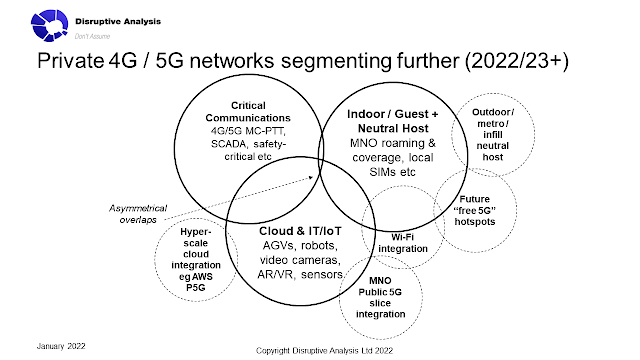
In reality, this isn’t really “a market” in a singular sense. It’s currently at least three separate and distinct markets, with only minimal overlap at present. The main common thread is the deployment of cellular (3GPP 4G/5G) networks by non-MNOs.


A common fallacy involves talking about “vertical industries” as the main way to divide up the sector. But that doesn’t really work, as any given vertical has dozens of sub-categories and hundreds of potential applications and deployment scenarios. For instance, the “energy vertical” covers everything from a gas station, to an offshore windfarm, a 1000km pipeline or an oil-futures trading floor in a financial district.

Verticals are useful ways to divide up sales and marketing efforts, and make sense for cohesive reports, papers or webinars, but also blend together elements of three very different markets for private 4G/5G:

  •        Critical communications networks
  •        Indoor mobile phone networks
  •        Cloud and IT/IoT networks
No alt text provided for this image

It is worth discussing each of these in turn.

Critical communications networks

These have made up the bulk of major private network deployments over the last 5-10 years. They are typically deployed for utilities, oil & gas, mining, public safety, airports and military purposes. Often, they are used in rugged environments, for human communications (typically push-to-talk), as well as in-vehicle gateways and specific automation systems such as remote sensors and monitoring systems. The specialised GSM-R system for railways fits in this category as well.

Usually, they are replacing alternatives such as private mobile radio (PMR), TETRA and microwave fixed-links. They have typically been packaged and deployed by specialist integrators for sectors like oil-rigs or field-deployment by military units. There is limited “replicability”. They vary widely in size, from a single portable network for public safety, up to a national network for a utility company.

There is little need for interconnection with public mobile networks; indeed it may be specifically avoided in order to maintain isolation for optimal security and “air-gapping” for critical applications.

Most are 4G, reflecting mission-criticality and its frequent need for proven, mature technology and wide product availability. 5G is however used in certain niches and is being tested widely, although the most useful features will only arrive when Release 16/17 versions are commercialised in the next few years.

Indoor mobile phone networks

This includes some of both the oldest and newest deployments. Early local private 2G/3G networks essentially used GSM phones and thin slices of light-licensed/unlicensed spectrum to replace DECT cordless phones in a few markets – notably the UK, Netherlands and Japan.

They could also work with multi-SIM phones to blend public and private modes. I first saw an enterprise-grade GSM picocell in 2001, and an on-premise core network box in 2005. There are still several thousand such networks around, including ones updated to 4G and some that run on ships or onboard private jets.

More recently, there has been growing interest in using private 4G/5G to create neutral host networks for in-building, or on-campus coverage. There are multiple models for neutral host (I’ve counted around 10-15 variations), with some needing a full local network with its own spectrum and core, and others just relying on the tenant MNOs’ active equipment. In the US, CBRS-based options may turn out to be among the more sophisticated.

Whether used to support public MNOs more effectively than alternative indoor systems such as DAS (distributed antenna systems), or perhaps for linking to a UC / UCaaS system for enterprise voice, the main use-cases are for phones. They are almost always deployed for a single building or campus.

This segment is the most likely to require interconnection with the public mobile infrastructure, as well as supporting normal “phone calls” rather than push-to-talk voice.

Cloud and IT/IoT network

This category of private cellular is probably receiving the greatest attention from many newcomers to the sector, as well as external observers such as analysts and journalists.

It ties in with many of the newest trends around cloud and edge-computing, AI and machine vision in factories, robots and AGVs in warehouses, security cameras and more general IoT / smart building use-cases. It aligns with many of the "transformation" projects in IT, plus some parts of the OT (operational technology) space such as smart manufacturing.

As such, it tends to be viewed as a complement – or alternative – to other IT-type network technologies like Wi-Fi and fibre-based ethernet. And given that many of the use-cases have a heavy cloud (or at least multi-site WAN) orientation, there is more acceptance of virtualisation of cores and perhaps in future the RAN.

This is currently the area with the greatest amounts of experimentation and innovation – although actual large-scale operational deployments are still relatively few. There is more focus on 5G than 4G, although that might change as executives learn more about the practicalities and economics. Vendors often orient on the soundbite that "private 5G should be as easy as Wi-Fi".

There is a major focus on automation, replicability and ease-of-use. This was exemplified by the recent AWS Private 5G announcement, which seems squarely aimed at this segment.

However, there is perhaps a divide opening between the IT-type scenarios (where it can be seen as a sort of enterprise Wi-Fi-on-steroids vision) and OT deployments in which it gets embedded into larger industrial automation or other systems, such as factory robots or dockside cranes. In the latter scenarios we can see companies like Siemens integrating cellular into their wider systems, just as they have historically used Wi-Fi/WLAN and fibre.

Although the main focus is on building / campus networks for this model, it may also extend to larger domains such as smart cities, as well as multi-location users such as retail chains.

There is some overlap with the critical communications segment, but that is fairly rare at the moment, especially given the lesser role (and trust) of public cloud in many of those areas.

In addition, there is a fair amount of talk about interconnection with the public mobile network (especially where telcos are acting as vendors), but in reality, that's a secondary consideration that doesn't go much beyond a PowerPoint slide for now. There are certain exceptions which are interesting, but they're far from typical.

Conclusions and the Future of Private Networks Segmentation

At present, the "private 5G market" is actually at least three separate markets. And it's mostly about private 4G rather than 5G. Critical communications networks, indoor mobile phone networks and cloud/IT/IoT networks are largely distinct in terms of motivations, channels, economics, devices and applications. There is much less overlap than many observers expect.

(There are also smaller adjacent sectors such as community networks, 4G/5G-based FWA and other specialities).

But over the next 1-2 years, we can expect the three bubbles on the Venn diagram to overlap more – although asymmetrically. Critical and cloud/IoT networks will start to become hybridised. Critical 4G/5G networks in mines or utility sites will start to support extra IT-like applications, for instance (although that probably won't need formal network slicing).

Some enterprise private cellular networks will examine adding neutral-host and inbound roaming or interconnect from public MNOs' subscribers – although there are assorted regulatory and security/operational hurdles to address.

There won't be much overlap between critical networks and neutral/guest cellular, though. Nobody's smartphone will be roaming from their normal consumer 5G network onto the utility company's private infrastructure, I think. A few employees' devices might have special arrangements though.

But we will also see the emergence of a number of additional bubbles on the chart, some of which are more like "quasi-private" models, such as outdoor neutral host networks, selling wholesale capacity to MNOs. There will be various forms of Wi-Fi integration (but probably less than many expect / want). And we will undoubtedly see maturity of both cloud-delivered private cellular like AWS's, and (belatedly) some sort of MNO-based network slice integration.

And if you want an "outlier" to ponder, consider the potential for grassroots private "consumer-grade" 5G. There's a lot of hype about things like Helium's decentralised and blockchain-based model, but I'm deeply sceptical of this (that's for another post, though). More likely is the emergence of a true Wi-Fi hotspot approach, where we start to see lightweight "free 5G" options, using unlicensed (or maybe CBRS GAA) spectrum, with a cheap core and small cell. Scan the QR code next to the barista to download your eSIM, and you're good to go….


The bottom line is that the private 4G/5G market is complex and nuanced. Market statistics frequently combine everything from a nationwide utility's or railway's critical infrastructure, to a few small-cells connecting up digital signs in a mall car-park. It's easy to assume it's all about millisecond-latency robots zipping about factories, rather than a security guard with a handheld radio, or indoor network coverage for a hotel.

Operators, vendors, enterprises and governments need to delve a bit more deeply than just talking about "verticals" for private cellular, or else they risk making errors with their product portfolios or regulatory direction.

Dean Bubley (@disruptivedean) is a wireless technology analyst & futurist, who advises a broad range of companies and institutions active in the 5G, Wi-Fi and cloud marketplaces. He has covered private cellular networks for more than 20 years. He is a regular speaker and moderator at live and virtual events. Please get in touch on LinkedIn or via information AT disruptive-analysis DOT com for advisory or speaking requests.

#Private5G #Private4G #CriticalCommunications #5G #IoT #IIoT #Cloud #WiFi #verticals

Sunday, November 07, 2021

No, the Metaverse is not the killer app for 5G

(This article was initially published on my LinkedIn Newsletter - click here to see the original, plus comment thread. And please subscribe!)

Let's stop the next cliche before it even starts.

Most knowledgeable people now roll their eyes in derision whenever they hear the words 5G and autonomous driving (or robotic surgery) mentioned in the same sentence. But the mobile industry's hypesters are always casting around for some new trope - and especially the mythical "killer app" that could help to justify the costs and complexity.

And as if on cue, the Metaverse - essentially a buzzword meaning a hybrid of AR/VR with the social web, collaboration and gaming - has captured the headlines.

No alt text provided for this image

The growing noise around Metaverse technologies - and especially Facebook's recent rebrand to Meta - is attracting a whole slew of bandwagon-jumpers. The cryptocurrency community has been the first to trumpet its assumed future role - perhaps unsurprisingly, since they tend to be even more fervent and boosterish than the mobile sector. But we're also seeing the online shopping, advertising and gaming worlds hail the 'Verse as the next big thing.

Next up - I can pretty much guarantee it - will be the 5G industry talking about millisecond latency and buying a "Metaverse network slice". We'll probably get the edge-computing crowd popping up shortly afterwards too. I've already seen a few posts hailing the Metaverse as the possible next big thing for MNOs (mobile network operators).

They're wrong.

The elephant in the room

If you've found this article without knowing my normal coverage themes, you might be surprised to read that the single biggest issue for connecting Metaverse devices and users will be real, physical walls.

If you go through Mark Zuckerberg's lengthy video intro to Meta and his view of future technologies, you'll notice that a high % of scenarios and use-cases are indoors. Gaming from your sofa. Virtual living rooms. Hybrid work environments blending WFH with in-person meetings, and so on.

This shouldn't be a huge surprise. The more immersive a technology is - and especially if it's VR rather than AR based - the more likely people will take part while seated, or at least not while walking around an outdoor environment with obstacles and dangers. Most gaming, and most business collaboration takes places indoors too.

And indoor environments tend to have particular ways that connectivity is delivered to devices. Generally, Wi-Fi tends to be used a lot, as the access points are themselves indoors, at the end of broadband connection or office local area network.

Basically, wireless signals at frequencies above 2-3GHz don't get inside buildings very well from outside, and the higher the performance, the worse that propagation tends to be. Put simply, 5G-connected headsets and other devices will generally not work reliably indoors, especially if they have to deliver consistent high data speeds and low latencies which need higher frequencies. We can also expect the massive push for Net Zero in coming years to mean ever-better insulated buildings, which will make matters even worse for wireless signals as a side-effect.

For sure, certain locations will have well-engineered indoor 5G systems that will work effectively - but software developers generally won't be able to assume this. Airports, big sports venues, shopping malls and some industrial sites like factories will be at the top of the list for these types of solutions. For those locations, 5G Metaverse connections may well be widely used and effective. However, those are the exceptions - and it will take many years to deploy new in-building systems, or upgrade existing infrastructure anyway.

In particular, most homes and offices will have patchy or sometimes no 5G coverage, especially in internal rooms, elevators or basements. (There might be a 5G signal or logo displayed on the device, but that doesn't mean that the famously-promised gigabit speeds or millisecond latencies will actually be deliverable).

In those locations, expect Metaverse devices to use Wi-Fi as a baseline - and increasingly the Wi-Fi 6/6E/7 generations with better capabilities than previous versions.

What the Meta video tells us

I'm aware that the Metaverse is more than just Facebook / Meta, but the 1h17 video from Zuck (link) is not a bad overview of what to expect in terms of experiences, devices and business models. Obviously there will be different views from Epic Games, Microsoft's various initiatives around Hololens and Mesh, plus whatever Apple is quietly cooking up, but this is a decent place to start.

The first thing to note is the various Horizon visions that Meta is pitching - Home, Worlds and Workrooms. These are (broadly) for close social interaction, gaming/larger-scale social and business collaboration - especially hybrid work.

Mostly, the demos and visions are expected to take place from the participant's home, office, school or similar venue. There's a couple of outdoor examples of enhanced sports, or outdoor art/advertising as well. Virtual desktops, avatars that mimic eye and facial movements and so on.

In terms of devices, there's a large emphasis on headsets (obviously the Oculus Quest, and also the new high-end Cambria device promised for 2022) as well as discussions of AR glasses, from the RayBan Stories recently launched, to a forthcoming project called Nazare.

The technology discussion is all around the functional elements, not the connectivity. Optics, sensors, batteries, displays, speakers, cameras and so on. There are developer tools for hand and voice interaction, and presence / placement of objects in the virtual realm. There's lots of discussion around creators, advertising and the ability to own (and interoperate) virtual avatars, costumes and furniture. There are also nods to privacy, as would be expected.

There's no mention of connectivity, apart from noting that Cambria will have radios of some sort. The section on the "Dozen major technological breakthroughs for next-gen metaverse" doesn't mention wireless, 5G or anything else.

No alt text provided for this image

It's worth noting that Oculus devices and the RayBan glasses today use Wi-Fi. We can also expect the gesture-control in future will likely lean on UWB sensors. Outside of Facebook / Meta essentially all of today's dedicated AR/VR headsets connect with Wi-Fi or a cable, to a local network or broadband line. (That might be 5G fixed-wireless to the building for a few % of homes, but that will still use Wi-Fi on the inside).

Where cellular 4G/5G takes a role in XR is where the device is tethered to a phone or modem, or is experienced actually on the smartphone itself - think Pokemon Go, or the IKEA app that lets you design a room with virtual furniture.

We can expect the same with the Metaverse. If you're using a smartphone to access it, then obviously 5G will play a role, just as it will for all mobile apps in 3-4 years time when penetration has increased.

Will Cambria and future iterations feature 5G built-in? Maybe but I doubt it, not least because of the extra cost and engineering involved, as well as multiple versions to support different regional frequency options. Would a future Apple AR/Metaverse headset feature cellular, like some versions of the Watch? Again, that's possible but I wouldn't bet on it.

In the second half of the decade, later versions of 5G (Release 17 & 18) will have useful new features like centimetre-accuracy positioning that could be useful for Metaverse purposes - but again, that's reliant on having decent coverage in the first place. There will likely be some useful aspects outdoors though - for instance accurate measurement of vehicles on roadways.

Facebook Connectivity becomes Meta too

One other thing I noticed is a reference on LinkedIn to Facebook's often-overlooked Connectivity division, which does all sorts of interesting programmes and initiatives like TIP (which does OpenRAN and other projects), Terragraph 60GHz mesh, Express Wi-Fi and the low-end Basics "FB-lite" platform for developing markets with limited network infrastructure.


No alt text provided for this image

Apparently it's now being renamed Meta Connectivity - partly I guess because of the reorganisation and rebranding of the group overall, but also as a longterm part of the Metaverse landscape.

To me, that also indicates that the Metaverse is going to use multiple wireless (and wired) technologies - which aligns with Zuckerberg's view that it's more of a reinvention of the Internet/Web overall, rather than a particular app or experience.

Bandwidth-heavy? Or perhaps not....

One other thing needs to be considered around the Metaverse and connectivity. The immediate assumption is that such a "rich" environment, either full-virtual or overlaid onto a view of the real world, will need lots of data - and therefore the types of bandwidths promised by 5G. If we all use Metaverse devices to project "virtual TV screens" onto virtual surfaces, it will use lots of capacity, supposedly.

But it strikes me that avatars (even photo-realistic ones) & 3D reconstructions of real-world scenes will likely need less bandwidth than actual video. Realtime rendering will likely be done on-device in most cases, just sending the motion/sensor data or metadata about objects over the network.

Clearly this will depend on the exact context and application, but if your PC or phone or headset has a model of your friend's virtual house, or your virtual conference room - and all the objects and people/avatars in it - then it doesn't actually need realtime 4K video feeds to show different views.

In addition, the integration of eye-tracking allows pre-emptive downloads or actions, so "pseudo-latency" can seem very low, irrespective of the network's actual performance. If the headset sees you looking at a football, it can start working on the trajectory of a kick 10's or even 100's of milliseconds before you move your virtual leg.

That said, the sensor data uplink & motion control downlink will need low latency, but I suspect that will be more about driving localised breakout and peering rather than genuine localised compute. If you're in a hybrid conference with distant colleagues, the main role for edge-computing is to offload your data to the nearest Internet exchange with as few hops as possible.

(Some of the outdoor scenes in the Meta video from Connect seem rather unrealistic. They show groups of people playing table tennis and a virtual basketball match with "friends on the other side of the world", which would involve some interesting issues with the speed of light and how that would impact latency.)

Conclusion

In a nutshell - no, the Metaverse isn't the killer app for 5G.

The timelines align between the two, so where 'Verse apps are used on smartphones they'll increasingly use 5G if it's available and the user is out-and-about. But that's correlation, not causation. Those smartphones will typically be connected via Wi-Fi when at home, school or work. I suspect the main impact on smartphones will be on the need for better 3D graphics capability and enhanced sensors and cameras, rather than the network side.

Will we see some headsets or glasses with built-in cellular radios, some with 5G support? Sure, there will certainly be a few emerging in coming years, especially for enterprise / private network use. I'd expect field-workers, military, or industrial employees to exploit various forms of AR and VR in demanding situations well-suited to cellular, although many will tether a headset or glasses to a separate modem / module to reduce weight.

Many devices will also include various other wireless technologies too - Wi-Fi, Bluetooth, maybe Thread/Matter, UWB and so on.

But if anything, I suspect that the Metaverse may turn out to be the killer app for WiFi7, especially for home and office usage. That doesn't mean that 5G won't benefit as well - but I don't see it as a central enabler, given the probable heavy indoor bias of the main applications. (I don't think that cryptocurrency or edge-computing are key enablers either, but those are debates for another day)

(This article was initially published on my LinkedIn Newsletter - click here to see the original, plus comment thread. And please subscribe!)

#Metaverse #Facebook #Meta #AugmentedReality #VirtualReality #5G #WiFi #MixedReality #Mobile #Wireless #Devices #Gaming #Collaboration #HybridWorking

Wednesday, September 08, 2021

Drawing flawed conclusions from public misconceptions about wireless

(Cross-posted from my LinkedIn Newsletter - see original + comment thread here)

In the last couple of weeks, I’ve come across several clear examples of general confusion about connectivity and wireless technologies – including among smart and otherwise tech-savvy people.

  • A recent survey came up with the remarkable result that over a million people in the UK think they already have “satellite broadband”. The real number is likely under 100k. But many still associate the telecom brand Sky with its early involvement with satellite TV. (Expect Dish to face the same issue in the US).
  • On a client workshop discussing future devices, a user-interface expert referred to “Wi-Fi towers”, rather than mobile/cellular towers. I've also heard someone talk about "satellite Wi-Fi" when referring to things like LEO constellations.
  • A friend posted a photo of mobile antennas in London, in black enclosures to match the structure they were mounted on. One comment was that they were “definitely 5G” with no explanation why they distinguished them from 4G (or indeed, multi-radio RAN units as I suspect they were). Another confidently asserted they were definitely “boosters”, whatever that means.
  • A fascinating Nokia-produced podcast, with a visionary from Disney, covered a huge amount about AR/VR, branding and new experiences. The only problem was the assertion that this would all depend on 5G – even indoors on the sofa, where we can expect essentially all headsets and most smartphones to be connected to Wi-Fi.
  • Another podcast referenced Mavenir's acquisition of cPaaS provider Telestax, with the farcical suggestion that it tied in with B2B uses of 5G. Instead, it's more about platforms for enterprise messaging and calling. Getting an automated dentist-appointment reminder or automating a call-centre process doesn't depend on 5G (or any other G, or even wireless).
  • I've lost count of the people who think 5G enables 1 millisecond latencies everywhere.

At one level, we can just shrug and say this is just normal. People often fail to grasp distinctions between categories of similar things that are obvious (and important) to experts involved in their production or classification. 


Source: https://pixabay.com/users/peterdargatz-5783/

 How many people confuse bulldozers and excavators, a flan vs. a quiche, or even a spider and insect? Yet we don’t pay much attention to the exasperated sighs and teeth-grinding of civil engineers, chefs or arachnologists. We in the industry don’t help much either – how many Wi-Fi SSID access names are called “5G” instead of “5GHz”?

Yet for connectivity, these distinctions do matter in many real ways. They can lead to poor decision-making, flawed regulation, misled investors and wasted effort. In some cases there is real, physical harm too – think about all the crazy conspiracy theories about 5G (especially "60GHz mmWave 5G" - which doesn't even exist yet), or previously Wi-Fi.

Think too about the huge hyping by politicians about 5G – despite many of the use-cases either working perfectly well on older 4G, or in reality more likely to use fibre or Wi-Fi connections. That can feed through to poor policy on spectrum, competition – and as seen in many places recently, vendor diversification rules which ignore the vibrant ecosystem of indoor and private cellular suppliers.

Think too about the ludicrous assertions that LEO satellite constellations like SpaceX’s Starlink could replace normal home broadband or terrestrial mobile, despite the real practicalities meaning endpoint numbers will be 100x fewer, even with optimistic projections.

This all puts a new angle on a common refrain in telecoms “users don’t care what network they’re connected to”. In reality, this could be more accurately rephrased as “users don’t understand what network they're connected to…. although they really should”.

This also applies to the myth of "seamless" interconnection between different technologies, such as Wi-Fi and 5G networks. The border (ie seam) is hugely important. It can change the speed, cost, ownership, security, privacy, predictability of the connection. Not just users, but also application & device developers need to understand this - and if possible, control it. Frictionless can be OK. Seamless is useless, or worse.

What should be our practical steps to deal with this? Realistically, we're not going to get the population to take "Wireless 101" courses, even if we could agree amongst ourselves what to tell them. We're certainly not going to give people a grasp of radio propagation through walls, nor ITU IMT-Advanced definitions and how that relates to "5G".

But on a more mundane level, there are some concrete recommendations we can follow:

  • Use generic terms such as "advanced connectivity" without specifying 5G, Wi-Fi or whatever, wherever possible. At least that's relatively accurate.
  • Ignore any surveys of the general public about wireless technology. Assume that 90% of people won't understand the questions, and the other 10% will lie. Actually, ignore most surveys of the industry as well - most have appallingly biased samples, usually over-represented by people trying to sell things.
  • Don't repost, retweet or otherwise circulate hyped-up articles or comments. If someone claims that $X Trillion will be generated by 5G, ask if they've looked into what the baseline would be for 4G, and what the assumptions and sensitivities are.
  • I'll be bad at this myself, but we should try to gently point out to people they're wrong, rather than either shrug-and-ignore, or ridicule-and-point. If a politician or marketer or broadcaster talks about 5G or Wi-Fi or satellite with clear factual errors, point it out online, or in person.
  • Ask open-ended questions such as "why do you think satellite broadband can really do that?" or "have you considered how that would work indoors?" and see if people have actually given it any real thought.
  • Don't let your boss or your clients get away with these misconceptions, even if you think correcting them could cause a negative reaction. Don't be a yes-person. (If you need to, let me know & I can debunk their claims for you. I'll probably enjoy it too much though....)
  • Do NOT hire clueless "content marketing" people to write gibberish about "Why Tech X will Change the World"
  • Watch out for logical fallacies like "appeal to authority". There's no shortage of very senior and well-known people spouting the type of nonsense I describe here.
  • Run internal training sessions on "myth vs. reality" about wireless and telecoms. Make them fun.

I don't know whether this campaign to improve genuine understanding (and a bit of skepticism of hyperbole) will pay off. But I think it's important to try. Feel free to add other examples or suggestions in the comments! Also, please subscribe to this LinkedIn newsletter & follow @disruptivedean on Twitter.

(And yes, that's an excavator in the image above).

#5G #WiFi #mobile #wireless #satellite #broadband

Monday, January 11, 2021

The Myth of "Always Best Connected"

 (This was originally posted as a LinkedIn Newsletter article. See this link, read the comment thread, and please subscribe)

It Was the Best of Times, it Was the Worst of Times

One of the most ludicrous phrases in telecoms is "Always Best Connected", or ABC. It is typically used by an operator, network vendor or standards organisation attempting to glue together cellular and Wi-Fi connections. It's a term that pretends that some sort of core network function can automatically and optimally switch a user between wireless models, without them caring - or even knowing - that it's happening.

Often, it's used together with the equally-stupid term "seamless handover", and perhaps claims that applications are "network agnostic" or that it doesn't matter what technology or network is used, as long as the user can "get connected". Often, articles or papers will go on to describe all Wi-Fi usage on devices as "offload" from cellular (it isn't - perhaps 5% of Wi-Fi traffic from phones is genuine offload).

There's been a long succession of proposed technologies and architectures, mostly from the 3GPP and cellular industry, keen to embrace but downplay Wi-Fi as some sort of secondary access mechanism. Acronyms abound - UMA, GAN, IWLAN, ANDSF, ATSSS, HetNets and so on. There have been attempts to allow a core network to switch a device's Wi-Fi radio on/off, and even hide the Wi-Fi logo so the user doesn't realise that's being used. It's all been a transparent and cynical attempt to sideline Wi-Fi - and users' independent choice of connection options - in the name of so-called "convergence". Pretty much all of these have been useless (or worse) except in very narrow circumstances.

To be fair, accurate and genuine descriptions - let's say "Rarely Worst-Connected" or "Usually Good-Enough Connected" or "You'll Take What Connection We Give You & Shut Up" - probably don't have the same marketing appeal.

Who's Better, Who's Best?

The problem is that there is no singular definition of "best". There are numerous possible criteria, many of which are heavily context-dependent.

Which "best" is being determined?

  • Highest connection speed (average, or instantaneous?)
  • Lowest latency & jitter
  • Lowest power consumption (including network, device and cloud)
  • Highest security
  • Highest visibility and control
  • Lowest cost (however defined)
  • Greatest privacy
  • Best coverage / lowest risk of drops while moving around
  • Highest redundancy (which might mean 2+ independent connections)
  • Connection to the public Internet vs. an edge server

In most cases involving smartphones, the basic definition of "best" is "enough speed and reliability so I can use my Internet / cloud application with OK performance, without costing me any extra money or inconvenience". Yet people and applications are becoming more discerning, and the network is unaware of important contextual information.

For instance, someone with flatrate data may view "best" very differently to someone with a limited data quota. Someone in a vehicle at traffic lights may have a different connection preference to someone sitting on the sofa at home. Someone playing a fast-paced game has a different best to someone downloading a software update. A user on a network with non-neutral policies, or one which collects and sells data on usage patterns, may want to use alternatives where possible.

In an era of private cellular, IoT, multiple concurrent applications, encryption, cloud/edge computing and rising security and privacy concerns, all this gets even more complex.

In addition to a lack of a single objective "best", there are many stakeholders, each of which may have their own view of what is "best", according to their particular priorities.

  • The user
  • The application developer
  • The network operator(s)
  • The user's employer or parents
  • The building / venue owner
  • The device or OS vendor
  • A third-party connection management provider (eg SD-WAN vendor)
  • The government

On some occasions, all these different "bests" will align. But on others, there will be stark divergence, especially where the stakeholders have access to different options for connectivity. A mobile phone network won't know that the user has access to an airport lounge's premium Wi-Fi, because of their frequent flyer status. A video-streaming app can't work out whether 5G or Wi-Fi will route to a closer, lower-power edge server.

So who or what oversees these conflicts and makes a final decision on which connection (or, increasingly, connections plural) is chosen? Who's the ultimate arbiter - and what do the other stakeholders do about it?

This problem isn't unique to network connectivity - it's true for transport as well. I live in London, and if I want to get from my home to somewhere else, I have lots of "best" options. Tube, bus, drive, taxi, walk, cycle and so on. Do I want to get there via the fastest route? Cheapest? Least polluting? Easiest for social-distancing? Have a chance to listen to a podcast on the way? If I want to put the best smile on the most people's faces, maybe I should go by camel or unicycle? And what's best for the city's air, Transport for London's finances, other travellers' convenience, or whoever I'm meeting (probably not the unicycle)?


There are multiple apps that give me all the options, and define preferences and constraints. The same is true for device operating systems, or connection-management software tools.

Hit Me With Your Best Shot

There are also all sorts of weird possible effects where "application-aware networks" end up in battle with "network-aware applications". Many applications are designed to work differently on different networks - perhaps "only auto-download video on Wi-Fi" or "ask the user before software updates download over metered connections". Some might try to work out the user's preferences intelligently, and compress / cache / adjust the flow when they appear to be on cellular, or uprate video when the user is home - or perhaps casting content to a larger screen. The network has little grasp of true context or user/developer desire and preferences.

Networks might attempt to treat a given application, user or traffic flow differently - perhaps giving it priority, or slowing or blocking it, or assigning it to a particular "slice". The application on the other hand might try to second-guess or game the network - either by spoofing another application's signature, or just using heuristics to reverse-engineer any "policy" or "optimisation" that might get applied.

You're My Best Friend

So what's the answer? How can the connectivity for a device or application be optimised?

There's no simple answer here, given the number of parameters discussed. But some general outlines can be created.

  • Firstly, there needs to be multiple connections available, and ways to choose, switch, arbitrage between them - or bond them together.
  • The operating system and radios / wired connections of the device should allow the user (or apps) to know what's available, with which characteristics - and any heuristics that can be deduced from current and previous behaviour.
  • The user or device-owner needs to know "who or what is in charge of connections" and be able to delegate and switch that decision function when desired. It might be outsourced to their MNO, or their device supplier, or a third party. Or it could be that each application gets to choose its own connection.
  • As a default, the user should always be aware of any automated changes - and be given the option to disable them. These should not be "seamless" but "frictionless" or low-friction. (Seams are important. They're there for a reason. Anyone disagreeing with this statement must post a picture of themselves wearing a seamless Lycra all-in-one along with their comment).
  • Connectivity providers (whether SPs or privately-owned) should provide rich status information about their services - expected/guaranteed speed & latency, ownership, pricing, congestion, the nature of any data-collection or traffic inspection practices, and so on. This will be useful as input to the decision engines. Over time, it will be good to standardise this information. (Governments and policymakers - take note as well)
  • We can expect connectivity decisions to be partly driven by external context - location, movement, awareness of indoor/outdoor situation, environment (eg home, work, travelling, roaming), use of accessories like headphones or displays, and so on.

Going forward, we can expect wireless devices to have some form of SD-WAN type control function. Using technologies such as multipath TCP, it will become easier to use multiple simultaneous connections - perhaps dedicated some to specific applications, or bonding them together. For security and privacy, the software may send packets via diverse routes, stopping any individual network monitoring function from seeing the entire flow.

Growing numbers of devices will have eSIM capability, allowing new network identities / owners to be added. Some may have 2+ cellular radios, as well as Wi-Fi (again, perhaps 2+ independent connections), USB and maybe in future satellite or other options as well.

Add in the potential for Free 5G (link), beamforming, private 5G, local-licensed spectrum WiFi, relaying & assorted other upcoming innovations to add even more layers here.

The bottom line is that "best connected" will become even more mythical in future than it already is. But there will be more options - and more tools - to try to optimise it, based on a dynamic and complex set of variables - especially when going beyond connectivity towards overall "quality of experience" metrics spanning eyeball-to-cloud. There's likely be plenty of opportunities for AI, user-experience designers, standards bodies and numerous others.

But (with apologies to the Tina Turner), users should always be wary of any software or service provider that claims to be "Simply the Best".

If you've enjoyed this article, please sign up for my LinkedIn Newsletter (link). Please also reach out to me for advisory workshops, consulting projects, speaking slots etc.

#5G #WiFi #cellular #mobile #telecoms #satellite #wireless #smartphones #connectionmanagement

Wednesday, July 29, 2020

The fake battle: 5G vs Wi-Fi

[Reposted from my LinkedIn & slightly extended. See the post here for a full comment thread]

I'm bored of the fake battle being hyped up between #WiFi and #5G, especially for enterprise connectivity in-building.

Let's be absolutely clear. Essentially *every* building, whether residential, enterprise office, public venue or industrial, will need good WiFi coverage, increasingly based on #WiFi6.

Most laptops, TVs, screens, voice assistants, tablets, consumer appliances & other non-smartphone devices will be WiFi-only. Only a handful will have cellular radios too - the economics & manufacturing/distribution complexities don't work for including 5G as a default in most electronic products.

Almost every building will *also* need decent indoor public 4G/5G broadband coverage, especially for employees' and visitors' phones. In most cases this will need to cover all major MNOs' networks, as well as public safety systems such as critical-communications LTE. (
Wi-Fi Calling doesn't work ubiquitously on all phones / mobile networks on enterprise Wi-Fi, so there will always need to be a cellular network for reliable basic telephony).

*Some* buildings will also need indoor private 5G for ultra low-latency machines or other connected devices. For industrial sites this will mostly be isolated local networks. For others it may be delivered by MNOs via local coverage or network-slicing, or by some form of neutral-host wholesale model.

The main competition for indoor 5G is actually indoor 4G, not WiFi for which there is only a narrow overlap in use cases. WiFi will almost always be needed as well as cellular, with very rare examples where it's absent - for instance outdoors on campus sites.

Also, future visitor access to WiFi may be made much easier with #OpenRoaming, which can use multiple affiliation-based credentials, not just SIM or passwords. That will change the usability barriers for Wi-Fi, for instance if you can connect via a loyalty app, rather than needing to visit a web-page and enter credentials.

Bottom line: it's not a battle. Wi-Fi6 and 5G will be needed for different purposes. They probably won't be integrated much either, as they'll have different financial models, different usage models (and locations) and deployment/upgrade timelines. Think divergence, not convergence - although some elements such as planning tools and fibre backhaul to the cells/APs will likely be combined.

If you’d like more details on this topic & my deeper analysis on the future of wireless, please contact me via information AT disruptive-analysis DOT com. I offer advisory services to governments, operators, vendors, enterprises & investors.


See also LinkedIn post with long comment thread via this link: here

Wednesday, September 11, 2019

Future Spectrum Policy: 10-year Disruptions

Yesterday, I presented & debated on disruptions & directions for spectrum-management, at UK regulator Ofcom's annual spectrum conference in London. The slide-deck (it was just a short 15-minute intro) & my Twitter thread are at the bottom of this post.

I was on a panel with representatives from Google (Simon Saunders, who looks after EMEA connectivity partnerships) & the FCC (Julius Knapp, Chief of Rules & Policy Division)

This was a really fun session, as my remit was to look into the medium-to-far future (10 years or so) and think about some totally new angles on spectrum for upcoming regulatory policy. Often, I throw rocks at things that don’t make sense… This time, it was more like tossing rocks into a pond, and watching the ripples propagate & stimulating ideas.

My previous presentations at Ofcom events have been on more immediate needs on spectrum: sharing models, local cellular, Private LTE, Neutral Host* networks [see comment on upcoming workshop, below] and the need for “network diversity” rather than just enabling a 3GPP 5G monoculture. This was about taking a much longer view.

Some of the topics I covered were:
  • Designing spectrum management policy (& future 6G mobile systems) with a direct link to implied energy consumption / CO2 emissions from its usage
  • Asking the question “will harmonisation be as important in future as it has been in the past?” given that we’re ever better at creating software abstraction layers, and creating multi-radio / multi-band chips and devices.
  • The next stages of dynamic spectrum allocatin: towards fluid spectrum marketplaces, API-led spectrum platforms, and radio resource within broader “Mobile Network-aaS or Satellite Service-aaS” concepts
  • Ensuring that spectrum allocations and processes ensure multiple delivery/business models are supported: services, private, amenity networks etc. This contrasts, for example, with existing national licenses for mobile spectrum, which are geared strongly to the MNO business model.
  • My new disruptions/distractions framework for realistic assessment of predictions of tech deployment & market evolution (see this post)
  • Spectrum releases aimed at more device-to-device & intra-device usage (for example between components on a circuit-board)
  • Potential post-Brexit divergence for UK #pectrum policy (we didn’t get a chance to drill into this much)
Overall, it was a really enjoyable session (my Twitter thread is at the end of this post). It might odd to describe a regulatory event on radio spectrum as “fun”, but this panel was certainly lively and wide-ranging. My co-panellists talked about everything from DevOps and just-in-time spectrum availability, to taking the lessons from US CBRS and expanding to other bands or regions.

I'm looking forward to similar events in the UK and other regions, both on spectrum (eg mobile / WiFi / satellite needs) and other regulatory angles on future networks and communications. Please get in touch if you need a speaker or panellist.

*Neutral Host Networks — if this area is of interest, I am running a 2nd London public workshop on Nov 21st, with Peter Curnow-Ford MIoD Details here: https://disruptivewireless.blogspot.com/p/2nd-neutral-host-networks-london-public.html And if you’re interested in a private internal session for your own team, please see here: https://disruptivewireless.blogspot.com/p/private-workshops.html


Dean Bubley presentation at Ofcom Mapping The Future 2019 Spectrum Conference from Dean Bubley

My Twitter thread for the rest of the event is here.


Monday, May 20, 2019

5G as an enterprise LAN / Wi-Fi replacement is a myth

Introduction

There are at least 10 reasons why 5G will not be a viable WLAN (wireless local area network) technology for mainstream enterprise. Despite recent claims to the contrary, it is not an alternative to Wi-Fi in offices, hospitals, apartment blocks or similar locations. 

Enterprises, investors, policymakers and vendors should be extremely skeptical of assertions 5G will displace mainstream Wi-Fi uses. Indeed, they should question the credibility and honesty of those uttering such claims.

There will certainly more deployments of indoor cellular (including private and neutral host networks) in future, but these will almost all be incremental and not substitutional to Wi-Fi. They may be used for IoT/OT uses, but typically these will be entirely new. 

4G / 5G technologies will not be integrated into most laptops or tablets, despite hype.

This post looks at why 5G cannot replace enterprise Wi-Fi - including numerous obvious reasons - and then examines why the cellular industry (which mostly understands the problems) is pretending otherwise. What's the story behind the unrealistic fantasy?

(It's quite long. Get a coffee first.)


What is wireless used for in enterprises?

Before drilling into the specifics of 5G, it is worth looking at how and why wireless gets used in enterprises at a local area. Local area here means a single office or site - whether that's an office block, a supermarket, a hospital or a factory. Some locations have multiple LANs across several buildings on a campus network, such as a university, corporate HQ site or major new property development.

(By contrast, WANs run over wide areas, such as between a retail chain's stores and warehouse sites in different cities, or linking a multinational bank's offices in several countries. Huge locations like smart cities and airports are somewhere in the middle).

A top-level list of local wireless uses, often with separate infrastructure, includes:
  • Local IT / Internet connectivity - this is the main LAN space, dominated by fixed ethernet and Wi-Fi. It connects PCs, laptops, deskphones, tablets, conferencing gear and various other computing products, either to the business's own servers or to the Internet and cloud. It is also good for private use of smartphones.
  • Coverage extension of public mobile operator (MNO) services onto private property, where outdoor-to-indoor signals don't reach. This uses various forms of distributed antenna system (DAS), repeaters, small-cells etc, typically installed today only in the largest buildings. Essentially, this enables local smartphone connectivity both to the telco's services (eg telephony) and to the public Internet. In some cases Wi-Fi is used to "offload" data that could normally have gone over the carrier network. Note: genuine offload is a tiny fraction of total smartphone data traffic - see this post for more (link)
  • Local IoT connectivity (connecting building automation systems, HVAC, entry control etc. This can be further divided into
    • Static IoT - things that don't move around, such as sensors, door controls, CCTV cameras & aircon units
    • Mobile IoT, for instance credit card terminals, robots, wearables, asset-tracking tags etc
  • Local OT connectivity - operational technology, often business/safety-critical with a need for realtime deterministic control, such as industrial machinery, process controls, medical equipment and so on.
  • Local voice connectivity - especially walkie-talkies and private two-way radio, which are now starting to be replaced with cellular alternatives.
  • Other local uses - numerous sectors have their own niche wireless requirements, maybe linking to public safety / first-responders, broadcast, audiovisual systems etc
While some of these categories overlap (for example, smartphone connections), others remain pretty well-defined in practice. Yet often, they get conflated, especially in discussions about the future roles of 4G/5G cellular networks, whether run by mobile carriers, or new/specialist indoor operators and the enterprises themselves.

This post is specifically about the IT/LAN/Internet access use-case. I think cellular has a lot to offer IoT (especially mobile IoT) for enterprise, as well as OT in industrial settings. We will also see more indoor / premises neutral-host networks (NHNs) both for coverage and private onsite voice/smartphone access. However, none of those generally gets classed as "LAN" connections.

(SAVE THE DATE: I will be running a private workshop in London on July 9th about NHNs, looking at both indoor and wide-area / metro / rural uses and deployment scenarios)


Why can't 4G/5G be used for wireless LANs instead of Wi-Fi?

At the heart of this debate is whether 3GPP cellular technologies can be used for local-area computing networks, especially for laptops, tablets and private smartphone use. Can it replace fixed ethernet and especially Wi-Fi connections? Will future PCs connect to the Internet via 5G? I'm being asked this by various of my clients, so it's worth going in to some detail here (and obviously, more detail & analysis for paying advisory customers)

This is not a new discussion - the 3GPP vs. IEEE standards war has waged for decades. I've addressed the topic multiple times, whether that's been about in-home usage (link), debunking the "5G will kill WiFi" myth (link) or discussing the important role for private cellular in industry and the need for local spectrum licensing (link). 

I can see at least 10 reasons why cellular (whether provided by MNOs as a service, or owned by the business or an NHN provider) is not a suitable IT LAN technology for enterprise:
  • 13bn installed base of actively-used Wi-Fi devices today, of which only smartphones typically have cellular radios. Some have shortish replacement cycles (eg tablets) but others will last for 10+ years. They will need to be supported in-building.
  • A tiny fraction of laptops & tablets have in-built 4G radios today. Despite the hype, this will not change significantly with 5G. Customers won't pay more for them, and manufacturers don't want the margin hit. We might see 10-20% penetration, but I'm doubtful (This is a whole other "10 reasons" post in its own right...) Wi-Fi remains primary.
  • Plenty of other devices will never have cellular connections (5G printers? Servers?!). The number of Wi-Fi devices is exploding in IoT as well - from smart-speakers to lighting to interactive screens and terminals. Add in new low-power Wi-Fi for things like headsets (and a separate battle between Wi-Fi / BLE / ZigBee which cellular doesn't even have a toe in). Again, Wi-Fi remains primary. High-end/critical IoT devices may actually adopt passive optical LAN connections, rather than any wireless technology.
  • Private 4G/5G networks are not just radios. They need core networks, control software, and maybe SIMs/eSIMs. The average IT department does not want to, or have the skills, to deal with all this, compared with installing some ethernet wiring and some Wi-Fi APs.
  • Almost no businesses want to deal with the complexities of private / public cellular interconnection, roaming, regulation (lawful intercept?!) and so forth
  • Even if some IT departments want to go towards 4G/5G connectivity, they still have BYOD policies, and guests, contractors and tenants who will keep desiring (& often expecting) Wi-Fi
  • In-building 5G is going to be hideously complex anyway, especially for mmWave frequencies. Installing small cells also needs fibre backhaul, power etc. in the right places, whch may be different locations to Wi-Fi APs.
  • Ironically, in-building 4G small cells usually need wired LAN connections to connect them. In future, it might even be possible to use Wi-Fi6 as backhaul, as it should have good-enough deterministic QoS for the time-sync requirements.
  • The world would need, I estimate, 100-300,000 more enterprise cellular specialists for designing, installing, maintaining & operating 5G LANs. And AFAIK there aren't even proper training programmes, or certification schemes. That's a decade or more on its own (and probably a big opportunity for some) 
  • Indoor wireless coverage is difficult and variable. Radio is absorbed by interior walls, partitions, furniture, insulation, pipework etc. Giving QoS guarantees is almost impossible. Few design, planning and testing tools are available.
  • Device-to-device use cases for Wi-Fi are not easily replicable with cellular. Maybe in the future.
  • User perceptions of Wi-Fi and cellular, and behaviour around it, are entrenched and will take years to change, if ever.
  • Patent & royalty costs for cellular are higher, as well as the extra chipset costs.
  • Unknowable new security / threat surfaces (and the fact that Wi-Fi security is often integrated with the enterprise's identity & threat-management systems today)
I could go on. Some of these will change, some will have rare exceptions, and some industries will have particular local requirements for whatever reasons. But the underlying story is clear: 5G is not a Wi-Fi replacement for the enterprise. 
 
This should not really be a surprise to anyone. I honestly find it hard to believe that most people involved in networks/telecoms don't realise at least 4 or 5 of these points off the top of their heads.

Historical note: I've been skeptical of cellular-enabled laptops since 2006 (link). I wrote a full report in 2008 (link), which was actually far too optimistic (I predicted 30% attach-rate by 2011) despite being criticised as too-negative by the cellular industry. Most of the arguments remain valid for 5G.


So why the hype?

What's a bit baffling is why the 5G/WiFi replacement fantasy is becoming more common. Even AT&T's CEO was quoted at the company's financial results event (link) as saying "It’s serving as a LAN replacement product". Other 5G-centric commentators have said similar things.

To be fair, in some cases it will be genuine ignorance, although frankly anyone that clueless about enterprise networks shouldn't be making pronouncements anyway. Another more important issue is the conflation of all the different use-cases for connectivity (as above), and people conflating the LAN, offload and IoT domains in particular. Through that lens, the AT&T statement could (very generously) be considered applicable to some IoT scenarios.

Yes, 5G has a long-term role in some industrial verticals, especially with time-sensitive networking and private control of core and/or radio & spectrum. Neutral-host cellular will be important indoors too. But controlling robots & process machinery, or doing asset-tracking in a hospital, is not the same as accessing SaaS applications from a laptop or tablet, or local IoT applications from billions of devices with local gateways. Neither is using a new 4G/5G CBRS or local-spectrum network for "reverse roaming" or "MVNO onload" really a LAN business either.

But I think there are a few other more cynical reasons in play too:
  • Embarassment over mmWave's poor indoor penetration (despite the rhetoric), meaning Wi-Fi is an essential in-building complement for any 5G FWA deployment. This applies in residential use, but also for businesses too. Pretending that some sort of 5G outdoor - 5G indoor hybrid could fix this might spare a few blushes.
  • Cost & complexity of future indoor 5G deployments: Reality is biting. Existing indoor systems are going to be hard to upgrade to even 3-4GHz bands, let alone adding mmWave and massive-MIMO support too. It's not just the radio elements, either - how exactly are carriers going to offer QoS / network-slicing over someone else's indoor wiring and antenna infrastructure? See this eBook I recently wrote for iBwave (link) for more details. Basically, if the telcos are going to help pay for 5G indoor connectivity, then new use-cases/revenues are desperately sought, beyond just MBB coverage. A "managed 5G LAN" line on a spreadsheet likely looks appealing, even if it's an exercise in wishful thinking.
  • Bluster & hype aimed at regulators considering the 6GHz or other bands for unlicensed use (& thus mostly more Wi-Fi). The US FCC and various European regulators seem minded to add another large band (500-1200MHz) to the unlicensed systems arsenal. Taking a public stance of saying "Oh, 5G could do all those use-cases as well - how about normal exclusive licenses for that band instead?" fits the political narrative, even if it doesn't fit reality. 
  • Some 3GPP fundamentalists' dislike of Wi-Fi and unlicensed spectrum generally, or non-telco controlled networks, explains some of the comments. I've seen posts on LinkedIn saying "I wish Wi-Fi would go away", and similar. They have long fantasised about MNO-managed cellular LANs , in the same way that some Wi-Fi (and satellite) fundamentalists think they can replace mobile networks. They're all wrong. (And so are the 5G FWA folk claiming it's a mainstream alternative that could replace fibre or cable).


Conclusion

So to sum up:
  • There's lots of different uses for wireless networks in enterprise, whether in individual buildings or across larger campuses. Ignore anyone who groups them all together.
  • IT-centric LAN connections, for normal computing devices connecting to the Internet, cloud or local servers, are dominated by ethernet - either using fixed cabling, Wi-Fi or occasionally optical LAN. Smartphones connect both by Wi-Fi and cellular, where indoor connection is good enough.
  • A handful of laptops and tablets can use 4G connections today, although few owners even bother to sign up for data plans. A slightly larger handful will have integral 5G in 5 years time, but most will just stick to Wi-Fi only. They will need to be supported in all the same locations as today, plus many new ones (eg public transport & retail).
  • Private 4G and 5G networks come in many varieties, with a huge range of shared/local spectrum options being considered by regulators (link). Most, however, are not aimed at LAN use-cases, but more oriented to IoT/OT/indoor cellular coverage requirements. In those instances, Wi-Fi has limitations, for instance in applicability to robots moving around a large factor or warehouse.
  • Some industrial/critical use-cases are not ideally suited to unlicenced spectrum, even with the better performance of new WiFi6 deployments. Given that the WiFi industry doesn't (yet) have a licensed-band version, then cellular is a likely option instead. 
  • Neutral host cellular networks are very exciting future developments, both indoors and out. But they're not going to be LAN replacements either.
  • Operator 4G and 5G networks are very important to extend in-building, especially if telcos want to offer new network-slicing or QoS products that don't just work outdoors. However, upgrading existing in-building coverage solutions to 5G is hard, expensive and has many unknowns. Many small buildings don't have indoor coverage solutions at all today. The mobile industry is casting around for new revenues, as well as costs. One takeout: end-to-end network slicing is largely mythical, and will need to work over 3rd-party Wi-Fi indoors.
  • We will also see various forms of Wi-Fi + cellular bonding, with devices connecting to both networks simultaneously. That's for another post.
  • As with all areas of 5G hype, there's an "it'll solve world hunger", "one-size fits all" pitch to politicians, regulators, investors and media. It needs to be called out for its disengenuousness.
Overall, the key takeout: 
Private/enterprise 4G and 5G networks have lots of potential future use-cases & market opportunities. Replacing Wi-Fi for IT/Internet access LANs is not one of them.

Note: if you're interested in deeper analysis, or a private workshop / advisory engagement on this topic, please drop me an email at information at disruptive-analysis DOT com, or contact me via LinkedIn or Twitter.

Also - on July 9th, I'm running a London private workshop on Neutral Host Networks, together with Peter Curnow-Ford of Viatec Associates. Drop me a message if you're interested, and look out for full details & registration coming very soon.