Based on this article, it appears that Google's CEO Eric Schmidt does actually appear to believe that mobile advertising will be larger than that on the PC Web. I'd heard various people quote him before, but I'd dismissed that as out-of-context rhetoric.
The question in my mind is how can this really become true?
The current online advertising market is c$50bn - ie about $40 per Internet user per year (there's about 1.3 billion users), or $3 per user per month. That will continue to grow even as mobile ads are introduced, so realistically by the time of any cross-over, it's likely to be at least $5, $6 or greater, per user per month.
Now obviously at the moment mobile has a greater number of total users (2.7-3.0bn, depending on how you deal with multiple devices, non-phone devices etc). But a lot of those will be inaccessible to anything but *very* primitive adverts for a long time to come.
Probably a billion or more are on $10 ARPU or less, with 2G handsets and no likelihood of getting data access any time soon - basically SMS ads only, or perhaps voice-insertion messages. Another big group have OK handsets, perhaps $10-20 ARPU, but also mostly prepay with limited use of data, except occasional browser use. (The future "next" billion to get mobile devices will probably be on <$5 ARPU, so for all intents & purposes I think advertising will be a near irrelevance). Even looking out to say 2012 or 2013, the number of people with iPhone-grade browsers on their handsets, ideally with 3G and flatrate data, is going to struggle to get much beyond 500m I would have thought. And even then it's likely that not all of them will be *active users* of mobile web access. And as the mobile search people are so fond of mentioning, "people don't browse on the mobile web" - ie session times are much lower, albeit more frequent. And there's less screen real-estate, so fewer ads can be seen per minute or per session. Another issue is that PC online ads include both B2C and B2B. I don't know the split (does anyone?) but I have to believe that B2B mobile advertising will be much harder than B2C, ironically, because of the "personal" nature of the medium. So mobile B2C will need to outstrip fixed B2B+B2C for Schmidt's prediction to become true.
And I think that a lot of things that are currently advertised on PC-web will be difficult to translate directly to mobile-web, because they are complex purchases rather than the sort of instant-response or brand-recognition ads that work best on phones. Who's going to want to fill in 100 data fields for a car-insurance quote on phone? Or find jet engine maintenance services?
Sure, there will be things that are *easier* to advertise on phones, and there may be different ways to advertise that overcome the limitations. But I think it will be quite a while yet before we go down the learning curve. Another good thought-experiment is if anyone would ever administer their own Google AdWords account on a phone rather than on a PC.
Let's be very generous and say that there will be 1bn "full mobile web" active & regular users by 2013, with maybe 1hr or 20+ sessions per week. (I reckon 3-400m is more plausible, but let's go for the big round number). Then there will be a long tail of maybe another billion getting text ads, occasional browser ads and so forth, but realistically that's not going to add on a huge extra chunk of revenue compared with all-singing-all-dancing, high-response clickthrough mobile web ads, especially as many of the next bunch will be anonymous prepay users.
And by that time, PC Web advertising should be heading towards $100bn, I would have thought.
So for mobile to catch up, it'll have to be hitting $100 per "full" user per year, or $8 per user per month.
Does Schmidt honestly believe this?
I'm certainly not professing to be an advertising expert, but this just appears to be far too much of a tall order to me. Sure, response rates should be better, but I'd be wary of extrapolating from 100k early handpicked Blyk users to a billion mainstream punters. Especially as, even if m-commerce grows incredibly quickly, it's not going to catch up with PC-mediated e-commerce. (Which as we all know, is a quadrillion dollars per year).
In other words, most of that $8 is going to have to be recouped by people buying products through channels not based on the phone (ie on PC or "in real life"), making tracking of advertising effectiveness horribly difficult to measure. Nobody is going to be buying a car on their handset... and can you imagine the fun politics of tracking churn, when you're changing phone & operator based on an advert seen on another operator's device?
Personally, I think that Schmidt is either deliberately overstating the market to drum up excitement.... or he's about to make a horrible strategic mistake.
The worrying thing for me is that most of the Google folk I've met or heard at conferences appear to have a very narrow view of the mobile industry, heavily coloured by the US market viewpoint (no prepay, people deliberately buy 'smartphones' and are willing to download apps, people want a single device, that 'normal' people actually want the Internet on phones etc). I'm singularly unconvinced by Android based on what I've heard so far.
In fact, if he's staking the company's future revenue growth on this, I wonder if we've just seen the big G hit the high-water mark, and it's all downhill from here.

Dean Bubley's Disruptive Wireless: Thought-leading wireless industry analysis
Thursday, May 29, 2008


Blending mobile VoIP and call-through
I see that Truphone has launched a call-through add-on to its service. This is a bit like iSkoot with Skype, or various other pseudo-mobile-VoIP services like Jajah and Mobivox.
This makes a lot of sense. I expect quite a few of the players in the space to attempt to bundle together:
This makes a lot of sense. I expect quite a few of the players in the space to attempt to bundle together:
- VoWLAN from home or hotspot
- VoIPo3G when 3G coverage & flatrate data is available
- Call-through which exploit users' bundled GSM minutes
- A PC client as well as handset-based calling
Tuesday, May 27, 2008
Vodafone: consumer FMC - and VoIPo3G? - in Italy
Now this is a very interesting announcement from Vodafone Italy. Due for launch in the summer, it seems that Voda is launching a really clever combined ADSL Gateway + detachable HSPA Dongle product and broadband service. Apparently the box has been developed in collaboration with Huawei.
Some more details, and a picture of the Huawei box are here, and a video of the detachable dongle is here.
So, clever part #1 is that this combines an ADSL home broadband connection with an HSPA mobile broadband connection. I've been commenting for a whole that many users of 3G dongles also have home broadband, although some might view it as a substitute. This is the neatest offer I've seen that combines the two, although both O2 has a bundle offering as well.
And clever part #2 is that the box starts working in advance of ADSL being provisioned, by using the 3G dongle as an alternative wireless access for the gateway. In the past Voda has sold a Linksys box with a slot for a 3G data card, but that was mainly aimed at businesses wanting a portable 3G-backhauled WiFi access point.
And #3 is that it supports voice, over both ADSL and HSPA, from both phone or PC. I'm waiting to get full details, but it appears that this must be VoIP, unless they've somehow got a circuit-switched voice client on the PC, coupled to the dongle. Now perhaps the idea is to offer basic OK-quality VoIPo3G on the gateway until ADSL is provisioned. But it will be really interesting to see if the dongle also supports full VoIPo3G from the PC when connected remotely.
EDIT, 29 May: I've got a clarification and it turns out that it's not quite as clever as I thought.... unfortunately, it's not VoIPo3G.
You can make voice calls via the circuit-switched capability in the HSPA dongle, with a traditional analogue phone plugged into the voice port on the box. Apparently voice isn't supported when the dongle is used on a PC. Looks like the wording in the press release was a little ambiguous. VoIP is supported when it's in DSL mode.
Some more details, and a picture of the Huawei box are here, and a video of the detachable dongle is here.
So, clever part #1 is that this combines an ADSL home broadband connection with an HSPA mobile broadband connection. I've been commenting for a whole that many users of 3G dongles also have home broadband, although some might view it as a substitute. This is the neatest offer I've seen that combines the two, although both O2 has a bundle offering as well.
And clever part #2 is that the box starts working in advance of ADSL being provisioned, by using the 3G dongle as an alternative wireless access for the gateway. In the past Voda has sold a Linksys box with a slot for a 3G data card, but that was mainly aimed at businesses wanting a portable 3G-backhauled WiFi access point.
And #3 is that it supports voice, over both ADSL and HSPA, from both phone or PC. I'm waiting to get full details, but it appears that this must be VoIP, unless they've somehow got a circuit-switched voice client on the PC, coupled to the dongle. Now perhaps the idea is to offer basic OK-quality VoIPo3G on the gateway until ADSL is provisioned. But it will be really interesting to see if the dongle also supports full VoIPo3G from the PC when connected remotely.
EDIT, 29 May: I've got a clarification and it turns out that it's not quite as clever as I thought.... unfortunately, it's not VoIPo3G.
You can make voice calls via the circuit-switched capability in the HSPA dongle, with a traditional analogue phone plugged into the voice port on the box. Apparently voice isn't supported when the dongle is used on a PC. Looks like the wording in the press release was a little ambiguous. VoIP is supported when it's in DSL mode.
Vodafone results - a couple of observations
I'm sure there will be a barrage of comments today on Vodafone's results, and Arun Sarin's announcement that he is stepping down. So I'm just going to pick out a couple of items that caught my eye.
Firstly, it's worth getting a reality-check on 3G.
In W Europe, Vodafone now has 24m 3G subscribers out of a total of 111m. I'd guess around 3.5m-4m of the 3G devices are dongles & other modems. (Voda says it has 5.8m total modems and Blackberry-type email devices).
In its EMAPA region (E Europe, MidEast, Asia & Pacific) it has just 3m of its 119m subscribers using 3G.
It's sometimes tempting to think that 3G's march through the user base is a "done deal" and we're all moving on inevitably to LTE in short order. Walking through central London, you'd imagine that everyone has a Nokia N95 or SonyEricsson K800/850i. But these figures highlights just how slowly the real world moves - there's still plenty of GSM out there, and it's not changing very quickly (and, indeed, it's still growing hard in places like India).
In fact, it must be rather confounding for the mobile industry's "establishment" that Vodafone's impressively strong growth has been based on the growth of 3 things:
Lastly, a plug for my company, Disruptive Analysis.
I'm going to let myself be a bit smug and say "I told you so". It was 2 years ago that I wrote about my analysis of Voda's data revenues indicated it being dominated by Blackberry and 3G modems. At the time, that was against a backdrop of sustained noisy wishful thinking about Live! and other content/inhouse data services. Many other analysts were exhorting mobile operators to avoid flatrate data plans like the plague, pointing to a horrible "bitpipe" future.
And yet now:
"Over the year, data revenue has increased by 40.6% on an organic basis to £2.2 billion, principally driven by continued strong growth in business email and PC connectivity devices, which in total nearly doubled to 5.8 million. We have seen strong take up this year of USB modems"
I've been consistently saying that is has been an inevitability. "Many seem uncertain about deploying IMS, worrying that it could open the floodgates to 3rd-party IP applications. What they don't realise is that it's going to happen anyway, and that opening the floodgates is the only way to avoid drowning in the flood."
I've been privately advising some of my consulting clients about contrarian and anti-consensus views like these, just as I have been counselling them to dismiss many of the rose-tinted surveys and forecasts about mobile content/applications that don't bear close scrutiny. There are plenty of ways to sell, enhance and monetise "pipes". And there are some next-gen service opportunities that are probable winners.
If you are interested in hard-hitting viewpoints that challenge "perceived wisdom", get in touch. Disruptive Analysis provides workshops, forecasts, reports and presentations on topics such as these. Please email consultancy *AT* disruptive-analysis.com for details.
Firstly, it's worth getting a reality-check on 3G.
In W Europe, Vodafone now has 24m 3G subscribers out of a total of 111m. I'd guess around 3.5m-4m of the 3G devices are dongles & other modems. (Voda says it has 5.8m total modems and Blackberry-type email devices).
In its EMAPA region (E Europe, MidEast, Asia & Pacific) it has just 3m of its 119m subscribers using 3G.
It's sometimes tempting to think that 3G's march through the user base is a "done deal" and we're all moving on inevitably to LTE in short order. Walking through central London, you'd imagine that everyone has a Nokia N95 or SonyEricsson K800/850i. But these figures highlights just how slowly the real world moves - there's still plenty of GSM out there, and it's not changing very quickly (and, indeed, it's still growing hard in places like India).
In fact, it must be rather confounding for the mobile industry's "establishment" that Vodafone's impressively strong growth has been based on the growth of 3 things:
- Low end voice-centric subscribers in emerging markets
- Continued growth in SMS traffic & value
- Data pipes
Do a search for the word "content" in the results, and you get two mentions. In Germany, it says it has seen "a 10.1% reduction in other direct costs, mainly from fewer handset sales to third party distributors and lower content costs". In the UK it says "The 7.1% increase in other direct costs was due to cost of sales associated with the growing managed solutions business and investment in content based data services".
It seems that mobile content has moved from being seen as a revenue source, to being a cost.
Not directly quoted in the results, it's also interesting to see that Voda's German head has been quoted today as (I'm paraphrasing) saying that subscription-paid Mobile TV is dead. He's pointing the finger at phones capable of receiving free-to-air terrestrial digital TV, although to my mind that's just a convenient get-out clause as the whole Mobile TV proposition is inherently flaky.Lastly, a plug for my company, Disruptive Analysis.
I'm going to let myself be a bit smug and say "I told you so". It was 2 years ago that I wrote about my analysis of Voda's data revenues indicated it being dominated by Blackberry and 3G modems. At the time, that was against a backdrop of sustained noisy wishful thinking about Live! and other content/inhouse data services. Many other analysts were exhorting mobile operators to avoid flatrate data plans like the plague, pointing to a horrible "bitpipe" future.
And yet now:
"Over the year, data revenue has increased by 40.6% on an organic basis to £2.2 billion, principally driven by continued strong growth in business email and PC connectivity devices, which in total nearly doubled to 5.8 million. We have seen strong take up this year of USB modems"
I've been consistently saying that is has been an inevitability. "Many seem uncertain about deploying IMS, worrying that it could open the floodgates to 3rd-party IP applications. What they don't realise is that it's going to happen anyway, and that opening the floodgates is the only way to avoid drowning in the flood."
I've been privately advising some of my consulting clients about contrarian and anti-consensus views like these, just as I have been counselling them to dismiss many of the rose-tinted surveys and forecasts about mobile content/applications that don't bear close scrutiny. There are plenty of ways to sell, enhance and monetise "pipes". And there are some next-gen service opportunities that are probable winners.
If you are interested in hard-hitting viewpoints that challenge "perceived wisdom", get in touch. Disruptive Analysis provides workshops, forecasts, reports and presentations on topics such as these. Please email consultancy *AT* disruptive-analysis.com for details.
Friday, May 23, 2008
92% of Finnish mobile data traffic emanates from PCs, not phones
Huge thanks to Sami Makelainen, who's posted a fascinating link on Forum Oxford. It's a presentation done by someone at the Helsinki University of Technology, about mobile data usage in Finland, based on an analysis of 4m users' traffic patterns.
Slide 17 jumps out at me.
92% of mobile packet data traffic comes from PCs
Now I've been saying for some time that I was expecting that in 2008, most developed-market operators would see PC-based traffic become more important than that from handsets. And I've written before about the growth of 3G dongles in places like Austria and Sweden (where, unlike Finland, the most popular devices are apparently now Huawei dongles, not Nokia phones).
But I hadn't realised how far this had already gone. And this data is from Sep/Oct 07, and in the last 6 months the real growth in 3G modems has taken place.
This has huge ramifications for how operators buy spectrum, design their networks, think about femtocells and so on. It also means that 3G "mobile networks" are being used mainly for fixed/nomadic purposes. I wonder if that should impact the relative importance and value of IPR around "mobility" vs. "bandwidth".....
One other data point worth noting is that traffic to/from the Internet is 95% of the total. Is it really worth bothering about all that complex QoS, prioritisation, differential pricing, IMS etc for the remaining 5%?
Slide 17 jumps out at me.
92% of mobile packet data traffic comes from PCs
Now I've been saying for some time that I was expecting that in 2008, most developed-market operators would see PC-based traffic become more important than that from handsets. And I've written before about the growth of 3G dongles in places like Austria and Sweden (where, unlike Finland, the most popular devices are apparently now Huawei dongles, not Nokia phones).
But I hadn't realised how far this had already gone. And this data is from Sep/Oct 07, and in the last 6 months the real growth in 3G modems has taken place.
This has huge ramifications for how operators buy spectrum, design their networks, think about femtocells and so on. It also means that 3G "mobile networks" are being used mainly for fixed/nomadic purposes. I wonder if that should impact the relative importance and value of IPR around "mobility" vs. "bandwidth".....
One other data point worth noting is that traffic to/from the Internet is 95% of the total. Is it really worth bothering about all that complex QoS, prioritisation, differential pricing, IMS etc for the remaining 5%?
Why RIM likes UMA
It's not up on the UMAtoday.com website yet, but I got an interesting email from them quoting RIM's CEO at a recent investor conference:
Speaking at RIM's 2008 Capital Markets Day on May 12, Jim Balsillie, co-CEO of Research in Motion (RIM), took the opportunity to acknowledge the tremendous progress UMA has made in the market. “Wi-Fi UMA is going remarkably well," he remarked. "It’s very compelling...This is happening, and it's happening fast."
....
"Some [carriers]saw it as a threat. I saw it as an enabler, an inevitability. In a sense, its hard to find a carrier that isn’t excited about it now." And he went on: "I think it’s just so compelling and so inevitable.”
The key word here is "carrier". RIM's entire business model is based on the concept of the carrier always being in control (albeit with RIM's network ops guys sitting behind them). RIM does not sell "vanilla" smartphone devices direct to end-users, like Nokia or HTC.
So although RIM puts WiFi into its devices, it only permits its use at the carrier's discretion. It's not possible for a company to buy 1000 unlocked BlackBerries from a distributor, configure the WiFi to work with their Cisco IP-PBX with an FMC client, and then source 1000 SIM cards from whoever they like.
Nokia takes the view that this approach is as valid as selling via the operators. RIM only plays one half of the market - and although obviously the carriers like this philosophy, it isn't the whole story.
This is why RIM likes UMA - it is perfect for devices which only feature "operator-controlled" WiFi. It is very far from perfect for those that sell devices that an allow direct WiFi control by the end user.
Speaking at RIM's 2008 Capital Markets Day on May 12, Jim Balsillie, co-CEO of Research in Motion (RIM), took the opportunity to acknowledge the tremendous progress UMA has made in the market. “Wi-Fi UMA is going remarkably well," he remarked. "It’s very compelling...This is happening, and it's happening fast."
....
"Some [carriers]saw it as a threat. I saw it as an enabler, an inevitability. In a sense, its hard to find a carrier that isn’t excited about it now." And he went on: "I think it’s just so compelling and so inevitable.”
The key word here is "carrier". RIM's entire business model is based on the concept of the carrier always being in control (albeit with RIM's network ops guys sitting behind them). RIM does not sell "vanilla" smartphone devices direct to end-users, like Nokia or HTC.
So although RIM puts WiFi into its devices, it only permits its use at the carrier's discretion. It's not possible for a company to buy 1000 unlocked BlackBerries from a distributor, configure the WiFi to work with their Cisco IP-PBX with an FMC client, and then source 1000 SIM cards from whoever they like.
Nokia takes the view that this approach is as valid as selling via the operators. RIM only plays one half of the market - and although obviously the carriers like this philosophy, it isn't the whole story.
This is why RIM likes UMA - it is perfect for devices which only feature "operator-controlled" WiFi. It is very far from perfect for those that sell devices that an allow direct WiFi control by the end user.
Wednesday, May 21, 2008
Qualcomm - investments in Femtocells and Spectrum
Qualcomm's had a busy week in the UK.
First off, it paid £8m for 40MHz of "L-Band" spectrum at 1452MHz, suitable for.... well, who knows, but possibly a MediaFlo mobile TV network. As it's unpaired, it's not usable by conventional CDMA technologies or its ill-fated UMB system.
And this morning, it's been announced that it's taking a strategic stake in pico/femto specialist ip.access. Given that it's also got Intel on its investor roster, that should make for some interesting board meetings.
Whenever I've raised the issue of femtos with the big Q in the past, I've essentially got a shrug and a "nothing to do with us really, but it's all radio coverage, so generally a good thing". So I have to say this is a little surprising - although certainly no more so than Google's investment in Ubiquisys.
It could be to encourage ip.access to develop CDMA femtos as well as 3GPP ones, I suppose.
Or.....I wonder what you could do if you put a MediaFlo chip into a femtocell... either for receiving signals to create the equivalent of a parallel digital terrestrial network. Or for sending them at lower power to distribute TV around a house, a bit like Ruckus does with WiFi.
First off, it paid £8m for 40MHz of "L-Band" spectrum at 1452MHz, suitable for.... well, who knows, but possibly a MediaFlo mobile TV network. As it's unpaired, it's not usable by conventional CDMA technologies or its ill-fated UMB system.
And this morning, it's been announced that it's taking a strategic stake in pico/femto specialist ip.access. Given that it's also got Intel on its investor roster, that should make for some interesting board meetings.
Whenever I've raised the issue of femtos with the big Q in the past, I've essentially got a shrug and a "nothing to do with us really, but it's all radio coverage, so generally a good thing". So I have to say this is a little surprising - although certainly no more so than Google's investment in Ubiquisys.
It could be to encourage ip.access to develop CDMA femtos as well as 3GPP ones, I suppose.
Or.....I wonder what you could do if you put a MediaFlo chip into a femtocell... either for receiving signals to create the equivalent of a parallel digital terrestrial network. Or for sending them at lower power to distribute TV around a house, a bit like Ruckus does with WiFi.
Tuesday, May 20, 2008
The UK Government's proposed Big Brother database of phone calls & emails
First off, let me say that I like feeling secure, and living slap back in the middle of central London I'm acutely aware of the risks of terrorism.
But the proposals being considered by the UK government to build a central database of of phone calls and emails are as scary, as they are ridiculous. Now I suspect that (initially) the main task will just be collecting call-detail records and IP addresses & email headers, rather than the full content of voice calls and email bodies & attachments.
I don't have a problem with police accessing call records, or cell tower locations, in order to investigate crime. I don't mind them tapping the calls of suspects, or even applying some sort of pattern-recognition algorithms to suspicious-looking "networks" of people. They probably do this already, and within reason I don't mind the process being made more efficient.
But frankly, on this occasion I trust the telecom operators to be more secure with the data than the UK's clueless and hapless Home Office. Given recent data losses, and evidence of abuses of the existing powers to examine electronic records for petty bureaucratic reasons, the current administration's record on these matters is execrable.
The excuse that this is just a way to implement the EU's rules on harmonised record-keeping are a cop-out as well.
While I recognise that there is useful security information to be gleaned from aggregate data sets like this, this needs to be set against the negatives of untrustworthy and sometimes downright malicious oversight of that data. And in any case, any serious terrorist is able to use 101 techniques to circumvent this - from encryption to steganography to anonymous remailers, and a bunch of other things I'm not going to write about on a public blog. Yes, some patterns might emerge after an event, enabling associates to be traced more quickly. But even that doesn't offset the much greater risks from information misuse.
I'm personally willing to accept a modicum more risk to my safety, set against a much greater risk to my liberty.
The current UK Government is one of the world's worst offenders in assuming that "risk management" is the same as "risk minimisation", and that its citizens will accept any tyrannical methods proposed in the name of security. I'm looking forward to it getting its well-deserved kicking in upcoming elections.
But the proposals being considered by the UK government to build a central database of of phone calls and emails are as scary, as they are ridiculous. Now I suspect that (initially) the main task will just be collecting call-detail records and IP addresses & email headers, rather than the full content of voice calls and email bodies & attachments.
I don't have a problem with police accessing call records, or cell tower locations, in order to investigate crime. I don't mind them tapping the calls of suspects, or even applying some sort of pattern-recognition algorithms to suspicious-looking "networks" of people. They probably do this already, and within reason I don't mind the process being made more efficient.
But frankly, on this occasion I trust the telecom operators to be more secure with the data than the UK's clueless and hapless Home Office. Given recent data losses, and evidence of abuses of the existing powers to examine electronic records for petty bureaucratic reasons, the current administration's record on these matters is execrable.
The excuse that this is just a way to implement the EU's rules on harmonised record-keeping are a cop-out as well.
While I recognise that there is useful security information to be gleaned from aggregate data sets like this, this needs to be set against the negatives of untrustworthy and sometimes downright malicious oversight of that data. And in any case, any serious terrorist is able to use 101 techniques to circumvent this - from encryption to steganography to anonymous remailers, and a bunch of other things I'm not going to write about on a public blog. Yes, some patterns might emerge after an event, enabling associates to be traced more quickly. But even that doesn't offset the much greater risks from information misuse.
I'm personally willing to accept a modicum more risk to my safety, set against a much greater risk to my liberty.
The current UK Government is one of the world's worst offenders in assuming that "risk management" is the same as "risk minimisation", and that its citizens will accept any tyrannical methods proposed in the name of security. I'm looking forward to it getting its well-deserved kicking in upcoming elections.
Flattening Symbian shipments - user apathy about smartphones becoming apparent?
I've written before that I had my doubts about the supposed conversion of the world's mobile population to smartphones. And in particular, that many supposed "smartphone shipment" graphs include the use of locked-down smartphone OS's in places like Japan, and smartphones bought just because the user liked the looks of a device, rather than caring about the software.
(Note to US readers: many people buy smartphones in Europe because they're Nokia's or high-end SonyEricssons and have nice design / camera / music functions - but neither know nor care that they're "smart". Many Nokia N95 owners would rather eat their own shoes than look for and downloads apps to their phone). Michael Mace's coruscating post about Nokia's weird attempts to stimulate interest in downloadable apps for handsets in the US is right on the money).
So there's only a small proportion of mobile enthusiasts/geeks who actually WANT smartphones because of applications. Obviously there are people who want (or are given) a particular capability for business use (step forward BlackBerry and some Windows devices), or who buy iPhones because, well, they're iPhones.
So against that backdrop it's interesting to scrutinise Symbian's sales, which look pretty lacklustre to me. It's latest results press release talks up its cumulative 200m deployments, but that hides a less pretty picture looking at shipments:
Q108 - 18.5m
Q407 - 22.4m
Q307 - 20.4m
Q207 - 18.7m
Q107 - 15.9m
Q406 - 14.6m
In other words, sales are down not just seasonally since Xmas, but are even below the level of mid-2007. Against continued shipment growth of the overall market to above 1.1bn phones a year, that's not looking too promising for some observers' expectations of 30% penetration of smartphones in a few years' time.
My personal expectation is that a ceiling of 15%-ish is probably more realistic, with some grey-area definitional fuzziness around what exactly constitutes a smartphone - for example, if it's got a Linux kernel buried down in the guts of the device.
What's behind the fall? I suspect a number of factors. The Wow factor of the iPhone is one. The shift by European operators to 18 month contracts is almost certainly another. I'm not sure on shifts in the mix of OS's in DoCoMo's sales recently. But the main answer has to be that Nokia doesn't seem to be pushing the open OS harder down into the mid-tier. Put simply, customers would rather have that extra $4 of software spent instead on a better camera, or more memory.
(Note to US readers: many people buy smartphones in Europe because they're Nokia's or high-end SonyEricssons and have nice design / camera / music functions - but neither know nor care that they're "smart". Many Nokia N95 owners would rather eat their own shoes than look for and downloads apps to their phone). Michael Mace's coruscating post about Nokia's weird attempts to stimulate interest in downloadable apps for handsets in the US is right on the money).
So there's only a small proportion of mobile enthusiasts/geeks who actually WANT smartphones because of applications. Obviously there are people who want (or are given) a particular capability for business use (step forward BlackBerry and some Windows devices), or who buy iPhones because, well, they're iPhones.
So against that backdrop it's interesting to scrutinise Symbian's sales, which look pretty lacklustre to me. It's latest results press release talks up its cumulative 200m deployments, but that hides a less pretty picture looking at shipments:
Q108 - 18.5m
Q407 - 22.4m
Q307 - 20.4m
Q207 - 18.7m
Q107 - 15.9m
Q406 - 14.6m
In other words, sales are down not just seasonally since Xmas, but are even below the level of mid-2007. Against continued shipment growth of the overall market to above 1.1bn phones a year, that's not looking too promising for some observers' expectations of 30% penetration of smartphones in a few years' time.
My personal expectation is that a ceiling of 15%-ish is probably more realistic, with some grey-area definitional fuzziness around what exactly constitutes a smartphone - for example, if it's got a Linux kernel buried down in the guts of the device.
What's behind the fall? I suspect a number of factors. The Wow factor of the iPhone is one. The shift by European operators to 18 month contracts is almost certainly another. I'm not sure on shifts in the mix of OS's in DoCoMo's sales recently. But the main answer has to be that Nokia doesn't seem to be pushing the open OS harder down into the mid-tier. Put simply, customers would rather have that extra $4 of software spent instead on a better camera, or more memory.
Thursday, May 15, 2008
Don't ditch your landline if you're teetotal
Most of the commentary I see about fixed-mobile substitution tends to be highly partisan - usually sponsored by companies with something to prove. So it's quite refreshing to see a genuinely independent piece of research from an unlike source - the US Center for Disease Control, which asked about phone use in its ongoing health surveys, I guess primarily to ensure that emergency calls can be dealt with appropriately.
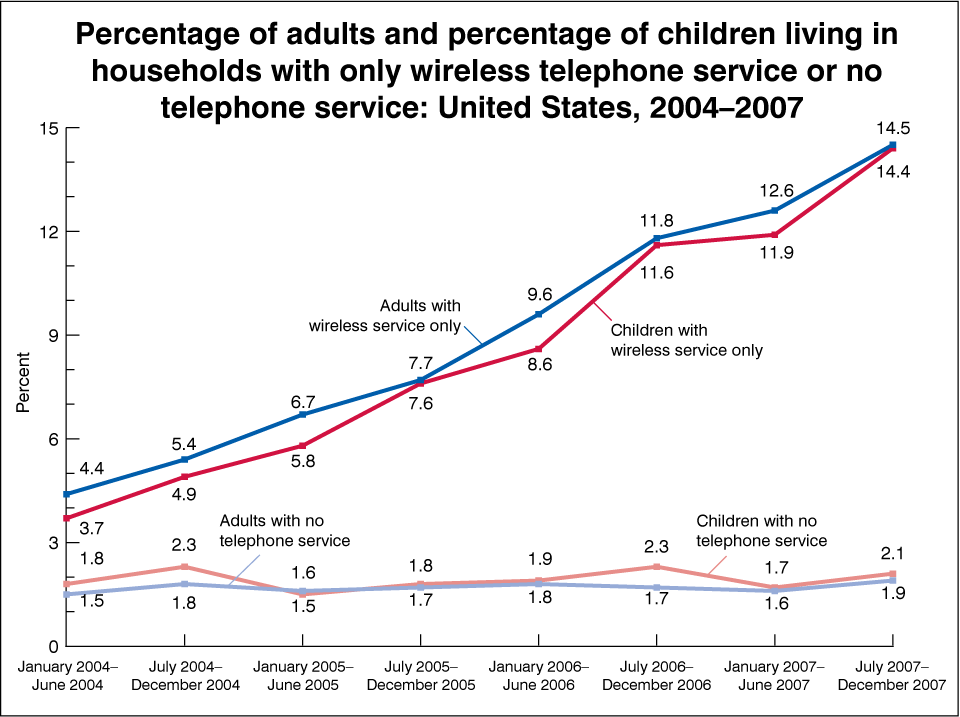
16% of US homes are mobile-only (but this being the US, cable connections are usually considered separately and not considered 'fixed' lines). This number has been increasing consistently.
And another 13% of US homes receive most calls via mobile, even though they have a PSTN line.
And 2% have no phone service at all.
But the most interesting facts are in the demographic analysis. Perhaps unsurprisingly, shared-adult homes (eg students living in the same household) are very high on the wireless-only scale, compared with families. Similarly (and probably overlapping) renters are more wireless-centric than homeowners. And there is also a preponderance of low-income and ethnic members of this category.
This data looks pretty similar to stats I've seen from Ofcom in the past about the UK.
What it tells me is that despite the hype, "cord cutting" is not really an aspirational thing at all - it's more driven by circumstance (economic or social).
Oh, and I love the statistic that wireless-only users are more than twice as likely to binge-drink than landline customers. Now if only someone had an explanation for cause-and-effect here.... does dealing with mobile customer service agents drive you to drink? Or do people cancel their landline subscription when they're drunk, and wake up in the morning wondering what happened to their dialtone?
Clearly, if femtocell suppliers really want to facilitate FMS, they need to forget about home gateways & instead integrate their modules into one of these.
16% of US homes are mobile-only (but this being the US, cable connections are usually considered separately and not considered 'fixed' lines). This number has been increasing consistently.
And another 13% of US homes receive most calls via mobile, even though they have a PSTN line.
And 2% have no phone service at all.
But the most interesting facts are in the demographic analysis. Perhaps unsurprisingly, shared-adult homes (eg students living in the same household) are very high on the wireless-only scale, compared with families. Similarly (and probably overlapping) renters are more wireless-centric than homeowners. And there is also a preponderance of low-income and ethnic members of this category.
This data looks pretty similar to stats I've seen from Ofcom in the past about the UK.
What it tells me is that despite the hype, "cord cutting" is not really an aspirational thing at all - it's more driven by circumstance (economic or social).
Oh, and I love the statistic that wireless-only users are more than twice as likely to binge-drink than landline customers. Now if only someone had an explanation for cause-and-effect here.... does dealing with mobile customer service agents drive you to drink? Or do people cancel their landline subscription when they're drunk, and wake up in the morning wondering what happened to their dialtone?
Clearly, if femtocell suppliers really want to facilitate FMS, they need to forget about home gateways & instead integrate their modules into one of these.
Wednesday, May 14, 2008
Adding a second carrier in 3G HSPA networks
I'm at Ericsson's Capital Markets & Analyst event in Stockholm today. There's been a huge amount of discussion about mobile broadband, in terms of traffic growth, moves towards HSPA and LTE, and the demand for backhaul capacity.
The CEO of Mobilkom in Austria spoke about that country's huge shift towards HSPA, to the extent that it's starting to catch up with ADSL use in terms of susbcriptions (dongles again...). Austria is a bit of an outlier in adoption of HSPA, with data traffic apparently now 20x outweighing voice on the network, but it's an interesting indicator of what's coming down the line.
In particular, it's indicating that the leading HSPA networks are now having to deploy an extra set of transmitters on the base stations. For those readers who don't follow this area, 3G UMTS networks (including HSPA), use 5MHz spectrum slices. Most operators have allocations of 10, 15, 20MHz or more, but typically haven't been using all of their theoretical capacity thus far.
The interesting thing for me is just how fast this occurs. Now, Austria is unusual, but even if you assume that most countries will take two years from launching flatrate dongle plans, rather than one year, to fill up the first 5MHz, it's an early indicator of demand ramp-up for spectrum (and capacity) over the next few years. This is especially true as end users get used to higher-speed HSPA, as well as increases in the total number of users. Add in some growth in data traffic from phones with decent browsers or video clients, and it starts to look as if the 2.1GHz 3G band is going to fill up very quickly.
This has a number of implications.
Firstly, there's a short term business case for femtocells - if they can work out cheaper than adding a second or third 5MHz carrier on the macro network. On the flipside, some of the calculations I've seen have suggested that femtos substitute for new extra base stations rather than adding extra kit to existing ones. I'm not sure what the comparative costs are, but I guess that bring up a 2nd carrier must be a lot less.
[Not much discussion from Ericsson about femtos for 3G macro-offload (or indeed at all), to be honest. My take is that as well as potentially impacting its overall integrated base station/transmission business model and bringing in new competitors, I get the distinct impression that the Big E is a little skeptical about some of the femto hype on a fundamental basis.]
Secondly, it means that operators will need to get extra spectrum if they're serious about continuing to drive mobile broadband. 2.6GHz is the obvious big chunk, but refarming 900 and 1800MHz GSM starts to take on more urgency ( as well as expediency for coverage reasons).
Lastly, it means that operators are going to be faced with some unpalatable choices in terms of capex for HSPA - having to choose between fulfilling the need for extra 5MHz carriers in high-use areas, versus continuing 3G build out in areas with no coverage at all. I suspect that this is going to drive a lot more emphasis on EDGE - and EDGE Evolved, as an interim coverage solution in marginal areas, as it wring more life out of existing 2G base stations. Interestingly, the GSA has been talking up EDGE today as well.
On the other hand, the company refreshed its overall take on broadband traffic, reiterating what it said this time last year. In a nutshell, even with massive growth in HSPA & LTE, the world's total mobile data traffic will still only be a tiny fraction of fixed-line IP (<5%), even out to 2013. The main driver of fixed-broadband traffic is seen as IPTV, especially on GPON fibre and VDSL access lines.
The CEO of Mobilkom in Austria spoke about that country's huge shift towards HSPA, to the extent that it's starting to catch up with ADSL use in terms of susbcriptions (dongles again...). Austria is a bit of an outlier in adoption of HSPA, with data traffic apparently now 20x outweighing voice on the network, but it's an interesting indicator of what's coming down the line.
In particular, it's indicating that the leading HSPA networks are now having to deploy an extra set of transmitters on the base stations. For those readers who don't follow this area, 3G UMTS networks (including HSPA), use 5MHz spectrum slices. Most operators have allocations of 10, 15, 20MHz or more, but typically haven't been using all of their theoretical capacity thus far.
The interesting thing for me is just how fast this occurs. Now, Austria is unusual, but even if you assume that most countries will take two years from launching flatrate dongle plans, rather than one year, to fill up the first 5MHz, it's an early indicator of demand ramp-up for spectrum (and capacity) over the next few years. This is especially true as end users get used to higher-speed HSPA, as well as increases in the total number of users. Add in some growth in data traffic from phones with decent browsers or video clients, and it starts to look as if the 2.1GHz 3G band is going to fill up very quickly.
This has a number of implications.
Firstly, there's a short term business case for femtocells - if they can work out cheaper than adding a second or third 5MHz carrier on the macro network. On the flipside, some of the calculations I've seen have suggested that femtos substitute for new extra base stations rather than adding extra kit to existing ones. I'm not sure what the comparative costs are, but I guess that bring up a 2nd carrier must be a lot less.
[Not much discussion from Ericsson about femtos for 3G macro-offload (or indeed at all), to be honest. My take is that as well as potentially impacting its overall integrated base station/transmission business model and bringing in new competitors, I get the distinct impression that the Big E is a little skeptical about some of the femto hype on a fundamental basis.]
Secondly, it means that operators will need to get extra spectrum if they're serious about continuing to drive mobile broadband. 2.6GHz is the obvious big chunk, but refarming 900 and 1800MHz GSM starts to take on more urgency ( as well as expediency for coverage reasons).
Lastly, it means that operators are going to be faced with some unpalatable choices in terms of capex for HSPA - having to choose between fulfilling the need for extra 5MHz carriers in high-use areas, versus continuing 3G build out in areas with no coverage at all. I suspect that this is going to drive a lot more emphasis on EDGE - and EDGE Evolved, as an interim coverage solution in marginal areas, as it wring more life out of existing 2G base stations. Interestingly, the GSA has been talking up EDGE today as well.
On the other hand, the company refreshed its overall take on broadband traffic, reiterating what it said this time last year. In a nutshell, even with massive growth in HSPA & LTE, the world's total mobile data traffic will still only be a tiny fraction of fixed-line IP (<5%), even out to 2013. The main driver of fixed-broadband traffic is seen as IPTV, especially on GPON fibre and VDSL access lines.
Metro WiFi - last nail in the coffin
I've been consistently negative about the prospects for metro WiFi. It's been doomed to failure from the start, usually championed by bored local-government IT drones looking for a new bandwagon to waste taxpayers money on.
There's a long list of negatives, but chief among them is that outdoor WiFi doesn't work indoors. It's useless. It's just wireless for traffic wardens.
So the demise of the Philadelphia poster-child network comes as little surprise to me.
I'm a little more open-minded about metro WiMAX (or maybe 3G), but I'm not holding my breath about that either, especially if it's at 3.5GHz - and 2.6GHz might be tricky too.
There's a long list of negatives, but chief among them is that outdoor WiFi doesn't work indoors. It's useless. It's just wireless for traffic wardens.
So the demise of the Philadelphia poster-child network comes as little surprise to me.
I'm a little more open-minded about metro WiMAX (or maybe 3G), but I'm not holding my breath about that either, especially if it's at 3.5GHz - and 2.6GHz might be tricky too.
Monday, May 12, 2008
Over-optimistic femtocell forecasts?
I've seen quite a lot of large numbers and hockey-stick curves recently, all indicating an imminent huge explosion in femto shipments in the next few years.
ip.access' very good femto blog has links to quite a lot of the studies, some of which suggest shipments are going to hit 10's of millions of units as early as 2010-2012. I haven't got copies of my competitors' studies, so I don't know exactly what assumptions, methodologies and caveats they are using.
My current view is rather more pessimistic. We're already in the middle of 2008, with various trials ongoing. I'm expecting to see lots more trials during H2 2008 and H1 2009 with a variety of results being published, both positive and negative. I'd agree with the assertion of one of my peers that 2008 shipments should be in the 100,000 range, although precise numbers are likely to be a little fuzzy in terms of defining "shipments" versus orders, versus paid installations in active users' homes.
I think there will have to be a lot of efforts made during 2009 to fix all the problems these trials throw up - nothing unusual there, just the normal technology deployment cycle. Getting everything right first-time, and immediately flipping the switch on the massive manufacturing plants, seems implausible to me. I can't think of anything else that's ramped up that quickly.
Sure, we'll see some niche deployments - perhaps in certain groups in Japan, or in bits of the US with lousy macro coverage. But are we going to climb to rapid adoption among the addressable market (essentially the world's 400m or so home broadband subscribers)? I'm unconvinced by the business model or demand just yet. It'll come, but there are a lot of prerequisites still not in place, not least of which is a sufficient population of 3G handsets or other devices, and people who actually want to use them for high speed access.
And even at $100 or $50, femto capability is too expensive to put into a home gateway if it's not going to be used. (If it's $5 or $10 like WiFi, it's cheap enough to just put it in the box by default - if the user doesn't switch it on, it's no big deal).
But more importantly, I'm starting to come round to the view that femtos will only become truly massmarket when we get to LTE deployment, and that HSPA and EVDO femtos may only be a starter to 4G's main course. I have various reasons to think this, and I'll have to annoy some readers with a bald assertion that it's about application related issues, and radio/spectrum reasons. I'm intending to publish a report in the next few weeks that will clarify my thinking on some of this, so keep reading.
As a last part of the post, I've taken a punt at some numbers. I'll be absolutely upfront, I haven't done a rigorous model on this at the moment, these are just educated guesses, based on my understanding of mobile, device and broadband markets, and having watched the evolution of picos & femtos for more than 7 years.
I'd currently estimate the number of shipments at maybe:
500k-1m in 2009 [this might be skewed by early large orders that end up in warehouses though]
2-3m in 2010
4-5m in 2011
5-8m in 2012.
In the 2009-H1 2010 period, I'm expecting the market to be driven by a small number of major operator advocates (much like dual-mode WiFi/cellular services today).
After 2013, when LTE starts hitting mainstream devices like phones in a big way, then I can potentially see a much larger uplift. Price points should also enable femto capability to be added to broadband home gateways 'for free', and also by that point we should have resolved issues like multi-operator femtos, and what the business model might be for femtos+prepay mobile.
Edit - as well as LTE triggering femto ramp-up, I'd amend my view to include HSPA *after 3GPP Release 8* as well. We'll probably start to see R8 phones & networks emerging into the real world from end-2010 onwards, ramping up during 2011-13.
Comments are welcome, although if anyone wants to discuss thoughts on the femto market privately, I can be reached at firstname.lastname AT disruptive-analysis.com
ip.access' very good femto blog has links to quite a lot of the studies, some of which suggest shipments are going to hit 10's of millions of units as early as 2010-2012. I haven't got copies of my competitors' studies, so I don't know exactly what assumptions, methodologies and caveats they are using.
My current view is rather more pessimistic. We're already in the middle of 2008, with various trials ongoing. I'm expecting to see lots more trials during H2 2008 and H1 2009 with a variety of results being published, both positive and negative. I'd agree with the assertion of one of my peers that 2008 shipments should be in the 100,000 range, although precise numbers are likely to be a little fuzzy in terms of defining "shipments" versus orders, versus paid installations in active users' homes.
I think there will have to be a lot of efforts made during 2009 to fix all the problems these trials throw up - nothing unusual there, just the normal technology deployment cycle. Getting everything right first-time, and immediately flipping the switch on the massive manufacturing plants, seems implausible to me. I can't think of anything else that's ramped up that quickly.
Sure, we'll see some niche deployments - perhaps in certain groups in Japan, or in bits of the US with lousy macro coverage. But are we going to climb to rapid adoption among the addressable market (essentially the world's 400m or so home broadband subscribers)? I'm unconvinced by the business model or demand just yet. It'll come, but there are a lot of prerequisites still not in place, not least of which is a sufficient population of 3G handsets or other devices, and people who actually want to use them for high speed access.
And even at $100 or $50, femto capability is too expensive to put into a home gateway if it's not going to be used. (If it's $5 or $10 like WiFi, it's cheap enough to just put it in the box by default - if the user doesn't switch it on, it's no big deal).
But more importantly, I'm starting to come round to the view that femtos will only become truly massmarket when we get to LTE deployment, and that HSPA and EVDO femtos may only be a starter to 4G's main course. I have various reasons to think this, and I'll have to annoy some readers with a bald assertion that it's about application related issues, and radio/spectrum reasons. I'm intending to publish a report in the next few weeks that will clarify my thinking on some of this, so keep reading.
As a last part of the post, I've taken a punt at some numbers. I'll be absolutely upfront, I haven't done a rigorous model on this at the moment, these are just educated guesses, based on my understanding of mobile, device and broadband markets, and having watched the evolution of picos & femtos for more than 7 years.
I'd currently estimate the number of shipments at maybe:
500k-1m in 2009 [this might be skewed by early large orders that end up in warehouses though]
2-3m in 2010
4-5m in 2011
5-8m in 2012.
In the 2009-H1 2010 period, I'm expecting the market to be driven by a small number of major operator advocates (much like dual-mode WiFi/cellular services today).
After 2013, when LTE starts hitting mainstream devices like phones in a big way, then I can potentially see a much larger uplift. Price points should also enable femto capability to be added to broadband home gateways 'for free', and also by that point we should have resolved issues like multi-operator femtos, and what the business model might be for femtos+prepay mobile.
Edit - as well as LTE triggering femto ramp-up, I'd amend my view to include HSPA *after 3GPP Release 8* as well. We'll probably start to see R8 phones & networks emerging into the real world from end-2010 onwards, ramping up during 2011-13.
Comments are welcome, although if anyone wants to discuss thoughts on the femto market privately, I can be reached at firstname.lastname AT disruptive-analysis.com
Thursday, May 08, 2008
BT - FMC and VoWLAN for conservative customers
I went to a launch event for BT's new upgraded version of its Total Broadband service yesterday. This is a package the company has offered for some time, which bundles assorted additional capabilities along with the basic (and fairly slow - just 8Mbit/s) ADSL Internet connectivity - online backups, access to BT OpenZone WiFi hotspots, BT Broadband Talk VoIP service and so on. It's centred on BT's Home Hub gateway which also provides WiFi, a DECT handset and remote management.
In the past, the Home Hub also acted as the centrepiece of BT's ill-fated Fusion dual-mode UMA service, which has been quietly interred, after singularly failing to set the world on fire.
But BT has now reincarnated its FMC plans, calling it Total Broadband Anywhere, but binning the 'seamless' UMA rhetoric and focusing more on what I see as a sort of consumer-grade BlackBerry proposition, with a bit of added VoIP when in WiFi coverage. At first sight, I was a bit critical of the offer, which features a couple of fairly humdrum 2G-only HTC phones from yesteryear (especially as it was announced on the same day HTC debuted its shiny new Diamond iPhone-challenger device).
But then I had a think about the demographics of BT's broadband customer base. As BT's ADSL service tends to be at the more expensive end of the market, I reckon it tends to be populated by a few particular constituencies:
In the past, the Home Hub also acted as the centrepiece of BT's ill-fated Fusion dual-mode UMA service, which has been quietly interred, after singularly failing to set the world on fire.
But BT has now reincarnated its FMC plans, calling it Total Broadband Anywhere, but binning the 'seamless' UMA rhetoric and focusing more on what I see as a sort of consumer-grade BlackBerry proposition, with a bit of added VoIP when in WiFi coverage. At first sight, I was a bit critical of the offer, which features a couple of fairly humdrum 2G-only HTC phones from yesteryear (especially as it was announced on the same day HTC debuted its shiny new Diamond iPhone-challenger device).
But then I had a think about the demographics of BT's broadband customer base. As BT's ADSL service tends to be at the more expensive end of the market, I reckon it tends to be populated by a few particular constituencies:
- Conservative life-long BT customers with an aversion to the hassle of switching ISPs and telephone providers
- People who aren't bothered by cable TV & so aren't particularly interested in Sky's or Virgin's 3/4-play bundles.
- Home workers who feel that paying a bit more gives some sort of peace of mind, but who aren't prepared to stump up for a dedicated Business Broadband line. (I'm in this category myself).
I suspect that BT broadband is less popular among younger groups like students who perhaps focus on cheaper or "free" offers and prepay mobiles, or gadget-hungry enthusiasts who want iPhone along with their HDTV. I also suspect the "traditionalists" and their spouses are perhaps less likely to have company-issued BlackBerries. And the device UI seems to be pretty user-friendly, and BT has focused on some fairly simple setup & configuration procedures.
In other words, there's probably a segment of BT's 4m-odd broadband subscribers who could see the benefit in paying an extra £5 a month for an extra email & web device, also usable for BT's VoIP service when in range of home, hotspot or FON WiFi. It's not going to sell in its millions I suspect, but it should help BT maintain its ADSL margins and minimise churn. It's also notable that it's not being positioned as a replacement for users' existing phones, although clearly the company hopes that some users will choose to port numbers and use the device as their primary handset.
However, there are a couple of flies in the ointment. The 10MB data allowance outside of WiFi coverage is meagre, and perhaps reflects BT's ageing MVNO deal with Vodafone needing some renegotiation. The absence of 3G handsets is also bit weak - although of course both iPhone and BlackBerry seem to do pretty well without it. But what I think is a glaring gap is the absence of a consumer 3G dongle for their laptops. And also that the Windows Mobile devices rely on 'pull' rather than 'push' email, and also don't have any dedicated IM capability.
Overall, I'm more positive on this than I was about the original Fusion proposition.
Just one last thing though.... given that the package seems to encourage customers to get another mobile device, and split their calling between that and another phone, perhaps they could have come up with a snappier brand? I reckon that "BT Fission" would have been appropriate.....iPhone non-exclusivity in Italy - it's all about prepaid
There’s much confusion and discussion today about Apple selecting two operators to sell iPhones in Italy – Vodafone and Telecom Italia. Plenty of observers are pointing to a huge shift in Apple’s exclusivity strategy, or debating whether the iPhone is uncompetitive in the Nokia-rich European marketplace.
But in my opinion, there’s a much simpler explanation, especially missed by most of my counterparts on the other side of the Atlantic.
It’s just about prepay.
In the US, prepaid mobile phone services are viewed by many with disdain – they’re for socioeconomically disadvantaged people, or migrants without US bank accounts or who fail credit checks. Americans seem to think that all real mobile users are always happy to be tied into 2-year cast-iron contracts with monthly subscriptions.
I’ve lost count of the number of conversations I’ve had with people from the US who are genuinely amazed that most of the world’s mobile subscribers use prepay. And in many cases this is not because they have to use prepay because of economic circumstances, it’s because they prefer to. Many simply do not want to be “on contract” because they want the flexibility to top-up their account and control their spending. Some like to swap SIMs to play tariff arbitrage. Many want multiple phones and numbers, and not need to maintain ongoing accounts for each. Some want to buy a phone separately to the service component. Or because the contract-based plans don’t meet their needs in terms of bundles. Some just do it because they’re used to it – it seems natural.
Take me for example. As well as a couple of contracts, I have a prepay SIM from H3G because it gives me cheap mobile data on unlocked phones. And I regularly get prepay SIMs to use when I travel - if I'm in Mozambique or Bolivia or wherever, why not spend just $3 for a SIM to make local calls to hotels or restaurants? What's the point in routing calls back via London & paying huge roaming charges for the privilege? I also prepay for travel in London on my Oyster card, and I prepay for beer in the pub, rather than after I've drunk it, or via a monthly subscription. (Hey, now that's an idea...)
But people from the US tend to think there’s some kind of stigma attached to prepay, rather than it just being the way it’s done, no big deal.
It’s similar to the way that the rest of the world looks at the US and is amazed by the preponderance of phones in hip holsters – which in our eyes have an equivalent social stigma. But for people in the US, wearing your phone on a Batman-type utility belt seems as acceptable for a trader on Wall Street or a fashionista on 5th Avenue as it is for the geekiest nerd in the IT department – it’s just the way it’s done, no big deal.
And so to Italy and the iPhone.
Vodafone Italy has 22.8m customers, of whom 91.2% (about 20m) are prepaid customers.
Telecom Italia Mobile has 36.3m subscribers, of whom 85% ( 30.8m) are prepaid.
And many of the contract customers are actually corporate users, or even subscriptions for 3G modems or embedded M2M modules. While plenty of prepay customers have shiny, high-end smartphones.
In other words, the number of individual consumers in Italy who would buy an iPhone, together with an 18/24-month contract, is roughly twelve. Apple has obviously realised that its much-vaunted monthly revenue-share business model isn’t going to work very well in Italy, especially if it only has one carrier as a route to market. And given that prepay top-ups make it is almost impossible to identify which phone they are used with, I can’t see how Apple is going to get a revenue share on prepay that way either. Far better to try and persuade Italian consumers to pay full-whack retail price for the device, and then use it with the prepay SIM from the operator of their choice.
This is also quite possibly why Vodafone’s announcement yesterday was so terse – Apple is probably going to have to reinvent its whole revenue model for the iPhone in prepay-centric markets, and somehow communicate that to its investors. And face down its current contract-based partners wincing about paying Mr Jobs a 10% tax for the privilege of selling his device.
And I’d guess Apple probably wants Vodafone to keep quiet about exactly how this will play out in other prepay markets like India, Egypt, Turkey et al.
But in my opinion, there’s a much simpler explanation, especially missed by most of my counterparts on the other side of the Atlantic.
It’s just about prepay.
In the US, prepaid mobile phone services are viewed by many with disdain – they’re for socioeconomically disadvantaged people, or migrants without US bank accounts or who fail credit checks. Americans seem to think that all real mobile users are always happy to be tied into 2-year cast-iron contracts with monthly subscriptions.
I’ve lost count of the number of conversations I’ve had with people from the US who are genuinely amazed that most of the world’s mobile subscribers use prepay. And in many cases this is not because they have to use prepay because of economic circumstances, it’s because they prefer to. Many simply do not want to be “on contract” because they want the flexibility to top-up their account and control their spending. Some like to swap SIMs to play tariff arbitrage. Many want multiple phones and numbers, and not need to maintain ongoing accounts for each. Some want to buy a phone separately to the service component. Or because the contract-based plans don’t meet their needs in terms of bundles. Some just do it because they’re used to it – it seems natural.
Take me for example. As well as a couple of contracts, I have a prepay SIM from H3G because it gives me cheap mobile data on unlocked phones. And I regularly get prepay SIMs to use when I travel - if I'm in Mozambique or Bolivia or wherever, why not spend just $3 for a SIM to make local calls to hotels or restaurants? What's the point in routing calls back via London & paying huge roaming charges for the privilege? I also prepay for travel in London on my Oyster card, and I prepay for beer in the pub, rather than after I've drunk it, or via a monthly subscription. (Hey, now that's an idea...)
But people from the US tend to think there’s some kind of stigma attached to prepay, rather than it just being the way it’s done, no big deal.
It’s similar to the way that the rest of the world looks at the US and is amazed by the preponderance of phones in hip holsters – which in our eyes have an equivalent social stigma. But for people in the US, wearing your phone on a Batman-type utility belt seems as acceptable for a trader on Wall Street or a fashionista on 5th Avenue as it is for the geekiest nerd in the IT department – it’s just the way it’s done, no big deal.
And so to Italy and the iPhone.
Vodafone Italy has 22.8m customers, of whom 91.2% (about 20m) are prepaid customers.
Telecom Italia Mobile has 36.3m subscribers, of whom 85% ( 30.8m) are prepaid.
And many of the contract customers are actually corporate users, or even subscriptions for 3G modems or embedded M2M modules. While plenty of prepay customers have shiny, high-end smartphones.
In other words, the number of individual consumers in Italy who would buy an iPhone, together with an 18/24-month contract, is roughly twelve. Apple has obviously realised that its much-vaunted monthly revenue-share business model isn’t going to work very well in Italy, especially if it only has one carrier as a route to market. And given that prepay top-ups make it is almost impossible to identify which phone they are used with, I can’t see how Apple is going to get a revenue share on prepay that way either. Far better to try and persuade Italian consumers to pay full-whack retail price for the device, and then use it with the prepay SIM from the operator of their choice.
This is also quite possibly why Vodafone’s announcement yesterday was so terse – Apple is probably going to have to reinvent its whole revenue model for the iPhone in prepay-centric markets, and somehow communicate that to its investors. And face down its current contract-based partners wincing about paying Mr Jobs a 10% tax for the privilege of selling his device.
And I’d guess Apple probably wants Vodafone to keep quiet about exactly how this will play out in other prepay markets like India, Egypt, Turkey et al.
Tuesday, May 06, 2008
Vodafone + iPhone...
I wonder whether there's a deeper story behind Vodafone's remarkably terse announcement this morning that it's going to be selling iPhones in 10 of its national markets.
There is no quote from either Jobs or Sarin - just two abrupt sentences. As I'm writing this (9am in London), the release isn't up on Apple's own site either. No details on pricing, contract length, how Voda will work with (or around) iTunes...
.... and even more importantly, no indication whether "the iPhone" might be a new 3G version.
There is no quote from either Jobs or Sarin - just two abrupt sentences. As I'm writing this (9am in London), the release isn't up on Apple's own site either. No details on pricing, contract length, how Voda will work with (or around) iTunes...
.... and even more importantly, no indication whether "the iPhone" might be a new 3G version.
Monday, April 28, 2008
IMS Rich Communications Suite - Necessary but not sufficient?
OCT 11 2010 NEW REPORT AND BLOG POST ON RCS HERE
At the Informa IMS conference in Paris last week, there was a lot of discussion about the new acronym du jour - RCS, or Rich Communications Suite. I'd had a bit of a heads-up on this at 3GSM in February, but I got to drill a bit deeper, see some demo's, and harass a few of its advocates with awkward questions.
In a nutshell, it's a lowest-common-denominator IMS mobile client, that incorporates a presence-enhanced address book with some IM capabilities and bits of file/image/video-sharing. It's being pushed by a semi-formal alliance of the largest handset vendors and a few of the more IMS-centric operators who share a fairly centralising/walled-garden view of the world. (I talked a bit about Orange & Telefonica as being 'old school' in February, and their central role in RCS just enhances my view - and I'd add TeliaSonera to the list as well).
Interestingly, RCS is being pitched as a lowish-end standardised client suitable for embedding onto featurephone platforms, as well as higher-end smartphones. This makes a huge amount of sense to me: smartphone-only software is of little use for services that require Metcalfe's Law to be exploited (ie value growing with the square of the number of connected users). The chances of everyone in a group of friends or IM buddies having a smartphone any time in the next 5 years are essentially zero.
In a nutshell, it seems like RCS is destined to join the fairly short list of very-standardised set of native applications on most phones:
I'm pretty negative on things like video-sharing, but at least having a standardised solution means that less money is wasted on dozens of individual projects. Filesharing and image-sharing are more worthwhile - I just place a low value on real-time variants like video.
Also a negative is the pointless rhetoric about RCS enabling a "community of 3 billion mobile users". Amusingly, I heard this roughly 48 hours after posting about the misuse of the exact same figure. Nothing I heard suggested that RCS' promoters had actually bothered to understand the sociology of how communities & social networks form and evolve, and to design the software to accommodate this. I strongly suspect that the way in which engineers form networks of friends & contacts differs substantially from the way in which FaceBook, Bebo et al have emerged. As an extreme example, consider the role of the "cool" people who inevitably act as social-network hubs, migrating large groups of their friends en masse. Given that a reasonable chunk of such super-influencers have iPhones or steer their social empires from their PCs, it strikes me that courting them upfront could have disproportionate effect on RCS' success.
There are plenty of other unanswered questions, as not that much information on RCS specs have been released publicly yet. But some more food for thought:
- will operators provide presence data for free to prepay users, in the hope that one day they'll send a message?
- how "realtime" is the presence function if you have 100 buddies?
- will anyone bother to put an RCS client on a "vanilla" handset sold through non-operator channels? How is it configured?
- what happens if an end user wants to use an IMS service provider other than his/her access provider? If I'm an Orange customer but I really like a Telefonica app, how can I get it?
- what happens to people who belong to multiple existing social groups or online communities? Can I get access to my Skype buddies? Or should I just download fring to give me full access?
- is there a developer API? How is it used? Through Java JSR281?
- how well does RCS integrate with "legacy" users who won't have it enabled on their phones at first?
My gut feel is that RCS is primarily being designed as a walled-garden defensive play to protect SMS revenues, by trying to push some form of IM as "SMS v2". I certainly can't see it driving additonal revenues on its own, in its current version, but I'll keep an eye out for future developments.
At the Informa IMS conference in Paris last week, there was a lot of discussion about the new acronym du jour - RCS, or Rich Communications Suite. I'd had a bit of a heads-up on this at 3GSM in February, but I got to drill a bit deeper, see some demo's, and harass a few of its advocates with awkward questions.
In a nutshell, it's a lowest-common-denominator IMS mobile client, that incorporates a presence-enhanced address book with some IM capabilities and bits of file/image/video-sharing. It's being pushed by a semi-formal alliance of the largest handset vendors and a few of the more IMS-centric operators who share a fairly centralising/walled-garden view of the world. (I talked a bit about Orange & Telefonica as being 'old school' in February, and their central role in RCS just enhances my view - and I'd add TeliaSonera to the list as well).
Interestingly, RCS is being pitched as a lowish-end standardised client suitable for embedding onto featurephone platforms, as well as higher-end smartphones. This makes a huge amount of sense to me: smartphone-only software is of little use for services that require Metcalfe's Law to be exploited (ie value growing with the square of the number of connected users). The chances of everyone in a group of friends or IM buddies having a smartphone any time in the next 5 years are essentially zero.
In a nutshell, it seems like RCS is destined to join the fairly short list of very-standardised set of native applications on most phones:
- Phone dialler
- SMS client
- MMS client
- WAP browser
- (on 3G phones) - videotelephony
The more observant reader may recognise that not all of these have been a monumental success. The amount of 3G videotelephony traffic is utterly negligible, and there are no reasons to believe that it's going to change any time soon.
Some of the RCS features like IM are fairly uncontroversial, especially if the operators deploying it are prepared to "play nicely" with existing Internet IM brands. However, the exclusion of those same Internet players from the RCS closed-shop is a major negative. There's also been little involvement of the myriad of smaller IMS-client framework vendors that have been working hard on presence-enabled phonebooks and the like for several years.I'm pretty negative on things like video-sharing, but at least having a standardised solution means that less money is wasted on dozens of individual projects. Filesharing and image-sharing are more worthwhile - I just place a low value on real-time variants like video.
Also a negative is the pointless rhetoric about RCS enabling a "community of 3 billion mobile users". Amusingly, I heard this roughly 48 hours after posting about the misuse of the exact same figure. Nothing I heard suggested that RCS' promoters had actually bothered to understand the sociology of how communities & social networks form and evolve, and to design the software to accommodate this. I strongly suspect that the way in which engineers form networks of friends & contacts differs substantially from the way in which FaceBook, Bebo et al have emerged. As an extreme example, consider the role of the "cool" people who inevitably act as social-network hubs, migrating large groups of their friends en masse. Given that a reasonable chunk of such super-influencers have iPhones or steer their social empires from their PCs, it strikes me that courting them upfront could have disproportionate effect on RCS' success.
There are plenty of other unanswered questions, as not that much information on RCS specs have been released publicly yet. But some more food for thought:
- will operators provide presence data for free to prepay users, in the hope that one day they'll send a message?
- how "realtime" is the presence function if you have 100 buddies?
- will anyone bother to put an RCS client on a "vanilla" handset sold through non-operator channels? How is it configured?
- what happens if an end user wants to use an IMS service provider other than his/her access provider? If I'm an Orange customer but I really like a Telefonica app, how can I get it?
- what happens to people who belong to multiple existing social groups or online communities? Can I get access to my Skype buddies? Or should I just download fring to give me full access?
- is there a developer API? How is it used? Through Java JSR281?
- how well does RCS integrate with "legacy" users who won't have it enabled on their phones at first?
My gut feel is that RCS is primarily being designed as a walled-garden defensive play to protect SMS revenues, by trying to push some form of IM as "SMS v2". I certainly can't see it driving additonal revenues on its own, in its current version, but I'll keep an eye out for future developments.
Saturday, April 26, 2008
More thoughts on green issues & cellular CO2. But will femtos help?
As I mentioned the other day, I was chairing a conference session on "Green" base stations and network on Friday. It had some really fascinating presentations from NSN, Ericsson, Vodafone & T-Mobile, with a lot of detail on a variety of different angles on reducing the environmental impact of mobile - and the opex implications of energy efficiency in the radio network.
One thing that unfortunately came across very clearly, however, was the difficulty of producing & reconciling statistics. The environmental side of industry is a long way behind finance in terms of coming up with consistent, auditable numbers. At the moment, it seems like pretty much anything can be proven or disproven - for example by including various "behind the scenes" factors in terms of CO2 emissions, or possible "savings" elsewhere from giving people better communications tools. None of this is particularly wrong in my view, but it just means that comparisons are nigh-on impossible and some of the headline figures need close scrutiny.
So for example, should we measure CO2 emissions per subscription, per customer, per square mile, per cell site, per transceiver, per volume of data traffic, or 101 other options?
However, as a useful starting point, one of the Ericsson representative's slides gave some useful headline numbers suggesting that 2G cellular accounts for about 24kg of CO2 / sub / year , and 3G is about 29kg. (These figures are "fully loaded" with handset manufacturing, older legacy cellsites and all sorts of other stuff included). As a reference, the average European probably emits 4-5000kg a year in total, based on a quick look on the web, so we're talking about perhaps 0.8% of total, even with multiple device ownership being common.
Another very important factor that was raised is that to make any big differences, the industry needs to focus much more on improving the performance of current "legacy" infrastructure, rather than just on the performance of new designs & shipments. No operator is going to throw away functioning base stations, even for useful-but-small improvements in power efficiency. T-Mobile had a really good statistic that showed that because of typical electricity prices in Europe, a saving of 100W in average power consumed saves about €130 in opex a year - so any capex on improvements really needs to be <€600 - including the cost of an engineer visiting the site.
One other thing that really struck me was the ready availability of some "quick wins" - especially reducing the need for air conditioning in base station enclosures. Apparently a lot of equipment works perfectly well at 40degC, so keeping it all nicely chilled is a complete waste of energy. The idea of switching off a chunk of radio capacity in quiet periods, rather than leaving transmitters powered-up "on standby" also seems like a no-brainer.
There was also a lot of discussion of sites that are "off grid", especially in emerging markets. Solar and wind power were discussed in a lot of depth, and are slowly being rolled out along with efficiency improvements to reduce reliance on diesel being trucked to sites. All in all, there's obviously a lot being done on the radio side of the industry, which accounts for a huge proportion of the total power consumption of cellular. It's an area I'll keep a closer eye on, and potentially write a report later in the year.
One awkward question did occur to me though - do femtocells help or hinder the trend? It's very easy to say "they operate at much lower power than macro sites, so it must be good", but it's more complex than that as they're also probably going to be left switched on but unused for most of the time. They'll also indirectly drive power usage in broadband infrastructure, and typically it's less energy-efficient to have millions of small gadgets rather than a few larger, optimised & centralised ones. When I asked the panel, the opinion seemed to be "we're not sure yet, but it's possible that femtos will increase overall energy used, although obviously from an opex standpoint the mobile operators won't be paying for it as it's plugged into the users' own electricity sockets".
One thing that unfortunately came across very clearly, however, was the difficulty of producing & reconciling statistics. The environmental side of industry is a long way behind finance in terms of coming up with consistent, auditable numbers. At the moment, it seems like pretty much anything can be proven or disproven - for example by including various "behind the scenes" factors in terms of CO2 emissions, or possible "savings" elsewhere from giving people better communications tools. None of this is particularly wrong in my view, but it just means that comparisons are nigh-on impossible and some of the headline figures need close scrutiny.
So for example, should we measure CO2 emissions per subscription, per customer, per square mile, per cell site, per transceiver, per volume of data traffic, or 101 other options?
However, as a useful starting point, one of the Ericsson representative's slides gave some useful headline numbers suggesting that 2G cellular accounts for about 24kg of CO2 / sub / year , and 3G is about 29kg. (These figures are "fully loaded" with handset manufacturing, older legacy cellsites and all sorts of other stuff included). As a reference, the average European probably emits 4-5000kg a year in total, based on a quick look on the web, so we're talking about perhaps 0.8% of total, even with multiple device ownership being common.
Another very important factor that was raised is that to make any big differences, the industry needs to focus much more on improving the performance of current "legacy" infrastructure, rather than just on the performance of new designs & shipments. No operator is going to throw away functioning base stations, even for useful-but-small improvements in power efficiency. T-Mobile had a really good statistic that showed that because of typical electricity prices in Europe, a saving of 100W in average power consumed saves about €130 in opex a year - so any capex on improvements really needs to be <€600 - including the cost of an engineer visiting the site.
One other thing that really struck me was the ready availability of some "quick wins" - especially reducing the need for air conditioning in base station enclosures. Apparently a lot of equipment works perfectly well at 40degC, so keeping it all nicely chilled is a complete waste of energy. The idea of switching off a chunk of radio capacity in quiet periods, rather than leaving transmitters powered-up "on standby" also seems like a no-brainer.
There was also a lot of discussion of sites that are "off grid", especially in emerging markets. Solar and wind power were discussed in a lot of depth, and are slowly being rolled out along with efficiency improvements to reduce reliance on diesel being trucked to sites. All in all, there's obviously a lot being done on the radio side of the industry, which accounts for a huge proportion of the total power consumption of cellular. It's an area I'll keep a closer eye on, and potentially write a report later in the year.
One awkward question did occur to me though - do femtocells help or hinder the trend? It's very easy to say "they operate at much lower power than macro sites, so it must be good", but it's more complex than that as they're also probably going to be left switched on but unused for most of the time. They'll also indirectly drive power usage in broadband infrastructure, and typically it's less energy-efficient to have millions of small gadgets rather than a few larger, optimised & centralised ones. When I asked the panel, the opinion seemed to be "we're not sure yet, but it's possible that femtos will increase overall energy used, although obviously from an opex standpoint the mobile operators won't be paying for it as it's plugged into the users' own electricity sockets".
Tuesday, April 22, 2008
What's in a number? Is 3 billion irrelevant?
The cellular industry is very fond of big numbers - 1 billion phones shipped, 3 billion subscribers, 3 trillion SMSs - I'm sure you recognise them. Obviously, these are all important and impressive achievements and should be applauded.
However, the industry is also very fond of quoting these numbers in contexts in which their relevance is marginal. A typical examples compares 3-4 billion mobile subscriptions with around a tenth of that figure for fixed broadband connections. Another is "Pah, WiMAX will never get the scale economies - there's a billion phones sold a year, how can a measly 50 million or fewer units possibly compete?". Similar examples are used to demonstrate relative importance against TVs, PCs, SMS vs IM or email and so on.
There is a very common theme of comparing apples with oranges here.
If you look at the handset market, a very large chunk is still cheap 2G phones used for nothing other than voice & SMS. There is no obvious sign that this part of cellular marketplace is rapidly evolving to 3G, extensive use of data services, smartphones or other high-end devices. To all intents and purposes, it is a separate market. Interesting from a statistical point of view, but also misleading. Yes, Nokia and Motorola and Samsung get some extra buyer power with their suppliers on components like filters or memory or screens. But hang on a minute, which are the companies developing WiMAX devices as well?
And in fact, the addressable market for the type of high-end products that WiMAX is targetting first (dongles, PC modems, PDAs, game & web consoles etc) is much smaller than 1 billion - and yet it is this consituency that is already driving most of the traffic on HSPA networks - not phones. I'd go as far as saying that 3.5G and 4G networks aren't about 3 billion, they're about perhaps 300 million potential customers, at least in the next 10 years. Including the other 2.7 billion in the discussion obfuscates the argument.
It's notable that the PC / Internet industry doesn't play the "zero's" game as much. It could trumpet 3-billion (approx) ethernet ports or a roughly similar number of USB devices. It could constantly talk up $7 trillion (or whatever this year's number is) in PC-mediated e-commerce. I read recently that foreign exchange trade volumes are in excess of $3 trillion per day, again mostly facilitated by traders with desktop computing hardware. That's a quadrillion dollars a year. But although it's an impressively big number, it's not relevant to most discussions about future technology.
So I'd challenge the mobile industry to be a bit more grown-up about the way it uses its statistics. I'd certainly agree that 3 billion people with access to telephony and messaging is incredibly impressive. A billion devices a year is almost incomprehensible. But don't wheel out the big numbers as PR collateral, just to support arguments that only apply to tiny fraction - it smacks of either insecurity or a lack of knowledge about how an addressable market is really defined.
However, the industry is also very fond of quoting these numbers in contexts in which their relevance is marginal. A typical examples compares 3-4 billion mobile subscriptions with around a tenth of that figure for fixed broadband connections. Another is "Pah, WiMAX will never get the scale economies - there's a billion phones sold a year, how can a measly 50 million or fewer units possibly compete?". Similar examples are used to demonstrate relative importance against TVs, PCs, SMS vs IM or email and so on.
There is a very common theme of comparing apples with oranges here.
If you look at the handset market, a very large chunk is still cheap 2G phones used for nothing other than voice & SMS. There is no obvious sign that this part of cellular marketplace is rapidly evolving to 3G, extensive use of data services, smartphones or other high-end devices. To all intents and purposes, it is a separate market. Interesting from a statistical point of view, but also misleading. Yes, Nokia and Motorola and Samsung get some extra buyer power with their suppliers on components like filters or memory or screens. But hang on a minute, which are the companies developing WiMAX devices as well?
And in fact, the addressable market for the type of high-end products that WiMAX is targetting first (dongles, PC modems, PDAs, game & web consoles etc) is much smaller than 1 billion - and yet it is this consituency that is already driving most of the traffic on HSPA networks - not phones. I'd go as far as saying that 3.5G and 4G networks aren't about 3 billion, they're about perhaps 300 million potential customers, at least in the next 10 years. Including the other 2.7 billion in the discussion obfuscates the argument.
It's notable that the PC / Internet industry doesn't play the "zero's" game as much. It could trumpet 3-billion (approx) ethernet ports or a roughly similar number of USB devices. It could constantly talk up $7 trillion (or whatever this year's number is) in PC-mediated e-commerce. I read recently that foreign exchange trade volumes are in excess of $3 trillion per day, again mostly facilitated by traders with desktop computing hardware. That's a quadrillion dollars a year. But although it's an impressively big number, it's not relevant to most discussions about future technology.
So I'd challenge the mobile industry to be a bit more grown-up about the way it uses its statistics. I'd certainly agree that 3 billion people with access to telephony and messaging is incredibly impressive. A billion devices a year is almost incomprehensible. But don't wheel out the big numbers as PR collateral, just to support arguments that only apply to tiny fraction - it smacks of either insecurity or a lack of knowledge about how an addressable market is really defined.
It's all going Green in wireless
Over the last 6 months there has been a quite spectacular explosion in interest in "greentech" in the mobile industry. I'm chairing a panel session on Friday on Green Base Stations, and numerous vendors have recently pitched me with energy-saving concepts.
Now, some of this is undoubtedly "greenwash" PR spin, and there's also a lot of rampant self-interest driven by spiralling energy costs. If you have a base station off the electricity grid in an emerging country, and you're having painful bills sending truckloads of diesel out to it, I don't think that CO2 is the prime motivation for using solar cells, or at least some more-efficient infrastructure equipment.
But there's also a lot of serious work being done - aiming at tackling both environmental footprint and direct costs. I've seen very persuasive arguments advanced around some "quick wins" in newer variants of 3G base stations, which should drive continued investment despite any economic downturn. The immediate wins in Opex should justify the Capex - even in a recession. Recent discussions I've had with some operator strategists have underscored this.
I'd expect to see a lot more operators following Vodafone's example and declaring intent to cut its CO2 emissions. The specificity of its statements are much to be applauded, and should be a wake-up call to others lagging behind in evaluating their energy usage and its associated tangible & intangible costs.
But I would much prefer others to avoid some of the knee-jerk cliches that the green world often specialises in. Personally, I despise the word "sustainability" - it's a misanthropic and disheartening term, and one which should be expunged from the world's vocabulary. It's also a shame that as an advanced technology company, Vodafone cites just "renewable" energy as a proportion of its total, and fails to take the braver approach and give "renewable+nuclear".
I'm also not a fan of the oft-quoted Mr Jonathon Porritt, whose background in dubious quasi-political & anti-developmental organisations like Friends of the Earth make him a poor choice of bedfellow for a globalised company.
The problem I see is that it's still perceived as very awkward for companies to pitch themselves as advocates of "environmental capitalism". This needs to change.
Now, some of this is undoubtedly "greenwash" PR spin, and there's also a lot of rampant self-interest driven by spiralling energy costs. If you have a base station off the electricity grid in an emerging country, and you're having painful bills sending truckloads of diesel out to it, I don't think that CO2 is the prime motivation for using solar cells, or at least some more-efficient infrastructure equipment.
But there's also a lot of serious work being done - aiming at tackling both environmental footprint and direct costs. I've seen very persuasive arguments advanced around some "quick wins" in newer variants of 3G base stations, which should drive continued investment despite any economic downturn. The immediate wins in Opex should justify the Capex - even in a recession. Recent discussions I've had with some operator strategists have underscored this.
I'd expect to see a lot more operators following Vodafone's example and declaring intent to cut its CO2 emissions. The specificity of its statements are much to be applauded, and should be a wake-up call to others lagging behind in evaluating their energy usage and its associated tangible & intangible costs.
But I would much prefer others to avoid some of the knee-jerk cliches that the green world often specialises in. Personally, I despise the word "sustainability" - it's a misanthropic and disheartening term, and one which should be expunged from the world's vocabulary. It's also a shame that as an advanced technology company, Vodafone cites just "renewable" energy as a proportion of its total, and fails to take the braver approach and give "renewable+nuclear".
I'm also not a fan of the oft-quoted Mr Jonathon Porritt, whose background in dubious quasi-political & anti-developmental organisations like Friends of the Earth make him a poor choice of bedfellow for a globalised company.
The problem I see is that it's still perceived as very awkward for companies to pitch themselves as advocates of "environmental capitalism". This needs to change.
Sunday, April 20, 2008
iPhone + fring = winner
Based on my questioning a very small sample of 2 ardent iPhone users (my cousin and my father), the new early-release fring VoIP client is looking like a major winner. I had a play with it yesterday, and the interface looks impressive, and the voice quality & ease of use on SIP seemed pretty good, although my dad was having glitches getting his SkypeOut working on it.
The downside is that at the moment it's only working on jail-broken iPhones, but given the apparent fervour among Apple-istas for it, I'd hope that Cupertino sees sense and makes sure it gets certified as an official app through its developer programme ASAP.
Apart from a very early Truphone demo last year, this appears to be the first major VoIP release for the iPhone. Will be interesting to see what the other players - Truphone, Skype, the enterprise players like Cisco & Divitas etc - do in response.
The downside is that at the moment it's only working on jail-broken iPhones, but given the apparent fervour among Apple-istas for it, I'd hope that Cupertino sees sense and makes sure it gets certified as an official app through its developer programme ASAP.
Apart from a very early Truphone demo last year, this appears to be the first major VoIP release for the iPhone. Will be interesting to see what the other players - Truphone, Skype, the enterprise players like Cisco & Divitas etc - do in response.
Friday, April 18, 2008
Device multiplicity is driving ARPU, not mobile web
I see that O2 UK is about to launch its 3G dongle service, aiming it primarily at its existing customers, and offering a discounted (but still high, especially for an 18 month contract) price.
This maps onto developments elsewhere, for example by Hutchison 3, which also encourages multi-device and multi-subscription users.
This makes a lot of sense to me. Why try & charge an extra few £ a month for someone accessing the web on their phone.... and possibly have to subsidise a device upgrade to get one with a decent browser... when you can charge £20 a month for a separate (and very cheap) device? Which then connects to the user's existing computing and user-interface platform (the PC), which the operator doesn't need to design or test or subsidise or distribute?
Yes, I know the arguments about bit-pipes and the possibility of selling advertising and assorted mobile-phone centric web apps. But the reality is that nobody is buying them, and the amount of paid-for browsing or data bundles on phones is low, whilst 3G modems & subscriptions are flying off the shelves.
This maps onto developments elsewhere, for example by Hutchison 3, which also encourages multi-device and multi-subscription users.
This makes a lot of sense to me. Why try & charge an extra few £ a month for someone accessing the web on their phone.... and possibly have to subsidise a device upgrade to get one with a decent browser... when you can charge £20 a month for a separate (and very cheap) device? Which then connects to the user's existing computing and user-interface platform (the PC), which the operator doesn't need to design or test or subsidise or distribute?
Yes, I know the arguments about bit-pipes and the possibility of selling advertising and assorted mobile-phone centric web apps. But the reality is that nobody is buying them, and the amount of paid-for browsing or data bundles on phones is low, whilst 3G modems & subscriptions are flying off the shelves.
Thursday, April 17, 2008
Mobile VoIP - nobody's a pure play
Truphone has just raised a new round of financing - against a tough market for speculative investments in VoIP at the moment, it has to be said. However, the wording of the release, coupled with last week's acquisition of SIM4Travel, indicates that VoIP is only a part of the wider mobility story for the company.
This strategy makes intuitive sense. The most likely response to VoIP-based pricing erosion is for the existing mobile operators to cut their prices, offer flat rates and so forth. Most end users won't be prepared to download software clients, swap SIMs all the time, do manual network re-selects, initiate calls from PCs, or jump through any of the hoops that commonly apply in the sector. That said, roaming mobile users are still getting sick of unjustifiably high tariffs, even if the intra-EU situation has improved a bit since last year's regulatory intervention.
Consequently, running a mobile network (with bits of MVNO), issuing SIM cards, and crucially being able to offer a fully-integrated SMS service, makes a lot of sense. It's notable that the term "VoIP" doesn't appear in either of the most recent press releases.
On the other hand, what I suspect may be more difficult will be for the company to integrate other mobile data services onto handsets - I'm not aware of any reseller or MVNO operators in Europe selling 3G cards, or data bundles. However, the current target audience for Truphone probably tends to travel equipped with a laptop, Blackberry or other device anyway.
I'm expecting most of the standalone Mobile VoIP players to start to integrate cellular connectivity into their offerings, offering blends of WiFi, VoIPo3G, call-through and special SIMs, backed by a variety of social networking / Web 2.0 capabilities. Skype (in conjunction with partner iSkoot) is already there, and fring tends to co-exist with handsets' native cellular services (and is usually viewed comparatively benignly compared with the more disruptive models of the others).
This strategy makes intuitive sense. The most likely response to VoIP-based pricing erosion is for the existing mobile operators to cut their prices, offer flat rates and so forth. Most end users won't be prepared to download software clients, swap SIMs all the time, do manual network re-selects, initiate calls from PCs, or jump through any of the hoops that commonly apply in the sector. That said, roaming mobile users are still getting sick of unjustifiably high tariffs, even if the intra-EU situation has improved a bit since last year's regulatory intervention.
Consequently, running a mobile network (with bits of MVNO), issuing SIM cards, and crucially being able to offer a fully-integrated SMS service, makes a lot of sense. It's notable that the term "VoIP" doesn't appear in either of the most recent press releases.
On the other hand, what I suspect may be more difficult will be for the company to integrate other mobile data services onto handsets - I'm not aware of any reseller or MVNO operators in Europe selling 3G cards, or data bundles. However, the current target audience for Truphone probably tends to travel equipped with a laptop, Blackberry or other device anyway.
I'm expecting most of the standalone Mobile VoIP players to start to integrate cellular connectivity into their offerings, offering blends of WiFi, VoIPo3G, call-through and special SIMs, backed by a variety of social networking / Web 2.0 capabilities. Skype (in conjunction with partner iSkoot) is already there, and fring tends to co-exist with handsets' native cellular services (and is usually viewed comparatively benignly compared with the more disruptive models of the others).
Vendors bidding for spectrum - now Qualcomm looking at the UK
One of the interesting developments I've been tracking of late has been the tendency of equipment or silicon vendors to start getting directly involved in spectrum auctions, either through joint ventures, or with the intent to build out wholesale networks themselves.
Probably the most prominent advocates of this approach have been:
Probably the most prominent advocates of this approach have been:
- Intel's WiMAX-related JVs like Pipex/Freedom4 in the UK, and with KDDI in Japan
- Qualcomm's Media Flo network in the US & its recent bids for 700MHz spectrum
- NextWave, which has broad a variety of equipment & spectrum assets
Wednesday, April 16, 2008
Convergence confusion
Still at Telco 2.0, I've just seen a scarily wrong presentation from someone involved in mobile banking & payments. It really shows up how long-lasting some of the more egregious memes can be away from the coalface of mobile technology development.
He gave a 2003-era view of convergence, postulating that a handset would subsume the functions of someone's PC, wallet and even keys. He gave various spurious "solution in search of a problem" mobile applications as alleged proof-points - such as the useless Westminster pay-by-SMS parking meters, or equally pointless handset-based boarding cards for aircraft. And he talked about the likelihood of using videotelephony on a mobile phone to talk to banks' customer service staff about arranging loans or mortgages.
I suppose I shouldn't be surprised that mobile myths and soundbites endure. I also heard an interesting anecdote today from someone who'd personally tracked down the iconic and oft-repeated "African fisherman + SMS for pricing" service and discovered that it was largely rubbish.
On the other hand, on the topic of mobile payments, I was much more convinced by a representative from the GSMA talking about mobile-based overseas money transmission. Apart from anything else, they're working with Western Union, who have a pretty good view of how this actually works in the hands of end-users. The speaker didn't blather on about phones replacing your wallet - he made the reasonable point that if some form of mobile wallet technology becomes more pervasive in handsets, then there may be some new and interesting usage cases.
He gave a 2003-era view of convergence, postulating that a handset would subsume the functions of someone's PC, wallet and even keys. He gave various spurious "solution in search of a problem" mobile applications as alleged proof-points - such as the useless Westminster pay-by-SMS parking meters, or equally pointless handset-based boarding cards for aircraft. And he talked about the likelihood of using videotelephony on a mobile phone to talk to banks' customer service staff about arranging loans or mortgages.
I suppose I shouldn't be surprised that mobile myths and soundbites endure. I also heard an interesting anecdote today from someone who'd personally tracked down the iconic and oft-repeated "African fisherman + SMS for pricing" service and discovered that it was largely rubbish.
On the other hand, on the topic of mobile payments, I was much more convinced by a representative from the GSMA talking about mobile-based overseas money transmission. Apart from anything else, they're working with Western Union, who have a pretty good view of how this actually works in the hands of end-users. The speaker didn't blather on about phones replacing your wallet - he made the reasonable point that if some form of mobile wallet technology becomes more pervasive in handsets, then there may be some new and interesting usage cases.
Why use QoS when you don't need it?
I've just watched a presentation at the Telco 2.0 event by a network vendor. Like many I've seen before, it asserted that the network would increasingly become "application aware" and behave differently according to what type of service a user is trying to obtain.
I've got some sympathy for this view. If you're a quadplay operator with dedicated home gateways, and customised & locked-down phones and set-top boxes, then you should be able to easily spot, and define QoS parameters for (say) IPTV or traffic destined for a femtocell gateway.
But the concept breaks down when devices are open and smart. The network may well be application-aware. But increasingly, the applications are going to be network-aware. This already happens on PCs (your streaming media player can identify the connection type and speed, and self-configure appropriately), and will extend to mobile handsets as well.
Software will be able to access (perhaps from a particular website, or peer-to-peer) information about specific network conditions policies. Or it may be able to measure and deduce them itself
in near real-time. The application will know what network connections are available to it, and will be able to present the options to the end user. It will know what needs to be realtime, and what can afford to be delayed.
So, for example an application might be able to know that at a given time in a given place, best-effort connections are actually good enough. So it can initiate a VoIP call, or a low-latency game, using a cheap & basic connection. But if quality shows signs of degrading, the app could ask for a higher-QoS connection and upgrade on the fly. Or if it reasonably suspects that the network is deliberately blocking or degrading the service, it can advise the user, or look for an alternative method of connectivity. (Or maybe initiate a realtime auction among multiple service providers for its desired connection).
In the real world, in the short term, there will obviously be a balance. People are lazy and often take what they're given - especially if its free or subsidised. They won't configure software, or want to be too intrusive, even if it's telling them about ways to save time or money. Often, people will accept (or have no option but to accept) locked-down devices. But over time, processing capability moves to the edge of the network as a consequence of Moore's Law.
Anyone who thinks that the network will always be able to identify and outsmart applications is naive. Applications will (in some cases, but not all) become able to play the network at its own game and win - and the incentives for creating these game-players evolve in parallel with the networks' intended control platforms.
I've got some sympathy for this view. If you're a quadplay operator with dedicated home gateways, and customised & locked-down phones and set-top boxes, then you should be able to easily spot, and define QoS parameters for (say) IPTV or traffic destined for a femtocell gateway.
But the concept breaks down when devices are open and smart. The network may well be application-aware. But increasingly, the applications are going to be network-aware. This already happens on PCs (your streaming media player can identify the connection type and speed, and self-configure appropriately), and will extend to mobile handsets as well.
Software will be able to access (perhaps from a particular website, or peer-to-peer) information about specific network conditions policies. Or it may be able to measure and deduce them itself
in near real-time. The application will know what network connections are available to it, and will be able to present the options to the end user. It will know what needs to be realtime, and what can afford to be delayed.
So, for example an application might be able to know that at a given time in a given place, best-effort connections are actually good enough. So it can initiate a VoIP call, or a low-latency game, using a cheap & basic connection. But if quality shows signs of degrading, the app could ask for a higher-QoS connection and upgrade on the fly. Or if it reasonably suspects that the network is deliberately blocking or degrading the service, it can advise the user, or look for an alternative method of connectivity. (Or maybe initiate a realtime auction among multiple service providers for its desired connection).
In the real world, in the short term, there will obviously be a balance. People are lazy and often take what they're given - especially if its free or subsidised. They won't configure software, or want to be too intrusive, even if it's telling them about ways to save time or money. Often, people will accept (or have no option but to accept) locked-down devices. But over time, processing capability moves to the edge of the network as a consequence of Moore's Law.
Anyone who thinks that the network will always be able to identify and outsmart applications is naive. Applications will (in some cases, but not all) become able to play the network at its own game and win - and the incentives for creating these game-players evolve in parallel with the networks' intended control platforms.
Tuesday, April 15, 2008
Marketing vs End Users
In the UK fixed-line broadband access market, there is currently a huge controversy among ISPs about a recent innovation called BBC iPlayer, which has ignited a Net Neutrality-type discussion here. iPlayer is the BBC's platform for either streaming, or enabling legal P2P, for its own content - typically enabling "catch up" of the best of the past 7 days' broadcast programmes.
iPlayer has been wildly successful since its launch, and has driven a huge amount of extra traffic onto ISPs' networks. Given the system whereby UK residents have already paid TV licences, we're entitled to BBC content "for free" - undoubtedly a contributory factor in its success, and why it's such a pain point and 'accessible target' for broadband operators' complaints. The BBC's head of technology has been pretty scathing about the complaints though - and has now quit the Beeb to join a firm doing the same thing on a multi-broadcaster basis (details are sketchy but sounds like a UK version of Joost to me).
He even threatened to "name & shame" ISPs that attempted to block, degrade or packet-shape iPlayer - "Content providers, if they find their content being specifically squeezed, shaped, or capped, could start to indicate on their sites which ISPs their content worked best on (and which to avoid). I hope it doesn’t come to this, as I think we (the BBC and the ISPs) are currently working better together than ever."
(Frankly, I think that threats like this expose the risk & absurdity of non-neutrality. Rather than controlling the content over "their pipes", operators are actually going to risk being held hostage by the Internet players - maybe a 2-second latency imposed on Google searches for unfriendly ISPs, or Facebook exhorting customers to switch broadband providers when it detects a particular IP address).
As elsewhere, the whining from UK ISPs derives from the fact that many of them mis-sell their services with eyeball-catching marketing terms like "unlimited". And then complain when customers actually use what they've been sold.
I might have some sympathy had iPlayer come as a bolt from the blue. But it didn't - the fact is that a sudden ramp-up of demand for rich legal video content (probably driven by P2P) has been entirely predictable for at least the last 3 years. And if ISPs were too short-sighted to notice it back then, YouTube's success ought to have been a wake-up call over the past 18 months about what was clearly likely to happen. Frankly, anyone in the ISP business that has been taken by surprise by a sudden growth in traffic obviously isn't very good at business planning. It's not like the BBC has been quiet about its ambitions either - and in any case, it could equally well have been CNN or Joost or high-def YouTube or some random TV startup that tipped the balance. I'm surprised it's taken this long, to be honest.
The problem is that marketing people often think they're smart. "Let's call this 'unlimited', it'll make great catchy adverts! And nobody will ever use it - we've analysed the historic traffic data & extrapolated it". Or "If people use 700MB a month on average then they won't risk just going for the 1GB option, we can offer them 3GB for another £5 a month and improve our margins as usage will stay constant!".
Unfortunately, it's quite common that end-users, and especially developers and hackers, are smarter than marketing people. And they're quite good at spotting cheap excess capacity that's been sold to them in the expectation it wouldn't be used.
And marketing people are often unwilling to look into the future to spot possible flaws in their arguments. That's why one of my larger competitors as a thing called a hype cycle - it's because companies in the telecom industry always focus on here-and-now problems without thinking about what the generally quite predictable second-generation problems will be - or how long they'll take to solve. And if you haven't got the time or broad vision to spot these prospective issues... then find someone else who does. (Subtle hint: cross-technology analysts & consultants....).
Other industries have long been able to predict risks and put policies in place to stop abuse. "All you can eat buffet! Conditions apply: Maximum 1 hour, no sharing, no takeaways, you get charged extra if you don't eat all you have on your plate". And it works - as long as the conditions are stated clearly & upfront, and not buried in a mountain of fine print, the system becomes "ungameable" - the customers know the score as soon as they look at the menu (and the contents of the buffet), and are able to make a judgement about the real value on offer.
But if you design a marketing proposition on the basis that peoples' behaviour won't change, even when they understand why the deal can be made to look so tempting then you're naive. And you'll be out of business.
People like exploiting loopholes and feeling that they've "won" against the system, whether it's taxes, clothing sales, or broadband. There's satisfaction in "putting one over" on those annoyingly smug marketing types who bombard us with adverts in aggressive attempts to part us from our hard-earned cash. And as the world gets "smarter" there's an ever-growing phalanx of software developers around to help us automate our revenge.
I can see the same problem moving to the mobile space over time. There's lots of "unused capacity" sitting around, waiting to be exploited. Flatrate data plans. 'Spare' minutes and SMS's at the end of the month. If you're in a room with 20 people (a cafe, say), there's a very good chance that someone has a month-end coming up on their contract in the next few days.
A simple algorithm could work out the likely amount that the person will use based on past behaviour, plus a "safety margin". So you have a 1GB data cap... you've used 500MB by day 27.... so perhaps you can exploit 250MB. I can think of several ways this might work (contact me if you're interested in exploiting - or preventing - this type of thing).
Bottom line: Marketeers - if you try and "game" your customers into upgrading unnecessarily, spending more to get less, assuming loyalty despite poor service - or you expect them to underuse services compared to "what it says on the tin"..... then expect them to game you back under your own terms and conditions. And win.
iPlayer has been wildly successful since its launch, and has driven a huge amount of extra traffic onto ISPs' networks. Given the system whereby UK residents have already paid TV licences, we're entitled to BBC content "for free" - undoubtedly a contributory factor in its success, and why it's such a pain point and 'accessible target' for broadband operators' complaints. The BBC's head of technology has been pretty scathing about the complaints though - and has now quit the Beeb to join a firm doing the same thing on a multi-broadcaster basis (details are sketchy but sounds like a UK version of Joost to me).
He even threatened to "name & shame" ISPs that attempted to block, degrade or packet-shape iPlayer - "Content providers, if they find their content being specifically squeezed, shaped, or capped, could start to indicate on their sites which ISPs their content worked best on (and which to avoid). I hope it doesn’t come to this, as I think we (the BBC and the ISPs) are currently working better together than ever."
(Frankly, I think that threats like this expose the risk & absurdity of non-neutrality. Rather than controlling the content over "their pipes", operators are actually going to risk being held hostage by the Internet players - maybe a 2-second latency imposed on Google searches for unfriendly ISPs, or Facebook exhorting customers to switch broadband providers when it detects a particular IP address).
As elsewhere, the whining from UK ISPs derives from the fact that many of them mis-sell their services with eyeball-catching marketing terms like "unlimited". And then complain when customers actually use what they've been sold.
I might have some sympathy had iPlayer come as a bolt from the blue. But it didn't - the fact is that a sudden ramp-up of demand for rich legal video content (probably driven by P2P) has been entirely predictable for at least the last 3 years. And if ISPs were too short-sighted to notice it back then, YouTube's success ought to have been a wake-up call over the past 18 months about what was clearly likely to happen. Frankly, anyone in the ISP business that has been taken by surprise by a sudden growth in traffic obviously isn't very good at business planning. It's not like the BBC has been quiet about its ambitions either - and in any case, it could equally well have been CNN or Joost or high-def YouTube or some random TV startup that tipped the balance. I'm surprised it's taken this long, to be honest.
The problem is that marketing people often think they're smart. "Let's call this 'unlimited', it'll make great catchy adverts! And nobody will ever use it - we've analysed the historic traffic data & extrapolated it". Or "If people use 700MB a month on average then they won't risk just going for the 1GB option, we can offer them 3GB for another £5 a month and improve our margins as usage will stay constant!".
Unfortunately, it's quite common that end-users, and especially developers and hackers, are smarter than marketing people. And they're quite good at spotting cheap excess capacity that's been sold to them in the expectation it wouldn't be used.
And marketing people are often unwilling to look into the future to spot possible flaws in their arguments. That's why one of my larger competitors as a thing called a hype cycle - it's because companies in the telecom industry always focus on here-and-now problems without thinking about what the generally quite predictable second-generation problems will be - or how long they'll take to solve. And if you haven't got the time or broad vision to spot these prospective issues... then find someone else who does. (Subtle hint: cross-technology analysts & consultants....).
Other industries have long been able to predict risks and put policies in place to stop abuse. "All you can eat buffet! Conditions apply: Maximum 1 hour, no sharing, no takeaways, you get charged extra if you don't eat all you have on your plate". And it works - as long as the conditions are stated clearly & upfront, and not buried in a mountain of fine print, the system becomes "ungameable" - the customers know the score as soon as they look at the menu (and the contents of the buffet), and are able to make a judgement about the real value on offer.
But if you design a marketing proposition on the basis that peoples' behaviour won't change, even when they understand why the deal can be made to look so tempting then you're naive. And you'll be out of business.
People like exploiting loopholes and feeling that they've "won" against the system, whether it's taxes, clothing sales, or broadband. There's satisfaction in "putting one over" on those annoyingly smug marketing types who bombard us with adverts in aggressive attempts to part us from our hard-earned cash. And as the world gets "smarter" there's an ever-growing phalanx of software developers around to help us automate our revenge.
I can see the same problem moving to the mobile space over time. There's lots of "unused capacity" sitting around, waiting to be exploited. Flatrate data plans. 'Spare' minutes and SMS's at the end of the month. If you're in a room with 20 people (a cafe, say), there's a very good chance that someone has a month-end coming up on their contract in the next few days.
A simple algorithm could work out the likely amount that the person will use based on past behaviour, plus a "safety margin". So you have a 1GB data cap... you've used 500MB by day 27.... so perhaps you can exploit 250MB. I can think of several ways this might work (contact me if you're interested in exploiting - or preventing - this type of thing).
Bottom line: Marketeers - if you try and "game" your customers into upgrading unnecessarily, spending more to get less, assuming loyalty despite poor service - or you expect them to underuse services compared to "what it says on the tin"..... then expect them to game you back under your own terms and conditions. And win.
Monday, April 14, 2008
Carnival #119
Some interesting links from this week's Mobilists' Carnival: my article about comparison-shopping from your phone whilst in-store gets a mention.
LTE IPR agreement - but what about everyone else?
So, Alcatel-Lucent, Ericsson, NEC, NextWave Wireless, Nokia, Nokia Siemens Networks and Sony Ericsson have collectively agreed to a framework which aims to limit LTE patent royalties to single-digit % of handset sales value.
OK, that's clearly a worthy goal.... but it does rather beg the question of what % of the total necessary IPR they own between them. I'd guess it's a fairly good chunk, but there are a few obvious missing representatives, notably all the chipset & RF component suppliers like Qualcomm, TI, Intel, Broadcom and so forth. Then there's the various IPR licencing specialists like Interdigital, plus presumably various of the operators have invented some of the clever stuff in their own labs. Also missing from the roster are Motorola, Nortel, Huawei and most of the other Asian vendors.
This is however definitely a good ploy in term of getting NGMN to further favour LTE over alternative candidate technologies. It will be interesting to see if the WiMAX community does something similar.... and if the WiMAX and LTE groups (which overlap quite a lot) can find it in their hearts to cross-licence things where necessary. I wouldn't hold my breath, though.
OK, that's clearly a worthy goal.... but it does rather beg the question of what % of the total necessary IPR they own between them. I'd guess it's a fairly good chunk, but there are a few obvious missing representatives, notably all the chipset & RF component suppliers like Qualcomm, TI, Intel, Broadcom and so forth. Then there's the various IPR licencing specialists like Interdigital, plus presumably various of the operators have invented some of the clever stuff in their own labs. Also missing from the roster are Motorola, Nortel, Huawei and most of the other Asian vendors.
This is however definitely a good ploy in term of getting NGMN to further favour LTE over alternative candidate technologies. It will be interesting to see if the WiMAX community does something similar.... and if the WiMAX and LTE groups (which overlap quite a lot) can find it in their hearts to cross-licence things where necessary. I wouldn't hold my breath, though.
Saturday, April 12, 2008
At last, a data-only tariff plan for handsets in the UK
It's always irritated me that UK (and many other) operators have missed the opportunity to offer data-only tariffs aimed at handsets, rather than modems.
Quite a number of people have the combination of separate voice phones and data devices - perhaps using the data device only during working hours for email / web etc. And there are also plenty of people like me "in the industry" who want to play around with new mobile apps, but don't want to install them on our primary phone - and there's no point having a full voice+data contract on 'spare' device.
Up until a year ago, T-Mobile used to sell Web'n'Walk on a data-only/data-mostly package, which bundled some minutes in, but which was primarily aimed at Internet access. (I;ve still actually got one of these old tariffs, and I daren't try & change it or I'll end up paying more). They've subsequently changed it so that it's mandatory to buy a Flext voice/SMS bundle and then get the data access as some form of add-on.
Other operators have similar offers - so for example the cheapest contract rate on O2 is the SIM-only O2 Simplicity at £15 a month, but you'd need an extra £7.50 data bolt on.
So I started looking at the various prepay SIM-only tariffs, most of which are now starting to be a bit more data-friendly. The typical pitch is a cap of £1 or £0.50p for a day's "flattish rate". So Vodafone gives you 15MB, H3G gives "Fair use", and so on. And T-Mobile gives a "5-day pass" for £2.50
But the absolute bargain has to be 3's monthly prepay Internet add-on, at £5.
So I just paid £10 for an anonymous SIM, which came with £10 of credit. I've signed up via 3's online portal for the Internet add-on, and so now I have an unlocked phone with flatrate 3G, albeit with a non-specified "fair use" which I suspect is probably around 1GB a month. And even better, the usual 3 roaming policies apply - so no premium when I'm on another 3 network, and £3 / MB elsewhere (which is still expensive but about half the price of the competition). I'm not going to use the phone or SMS, just the data services - primarily Internet access.
To be honest I'd rather have the same £5 / month data-only service on a normal postpaid contract rather than have to re-activate the Internet monthly, but given that it seems to be impossible, I'll stick with this for now.
It's also got to be a fantastic deal if you're travelling to the UK and have a spare unlocked phone or PDA and want to have mobile web access.
Quite a number of people have the combination of separate voice phones and data devices - perhaps using the data device only during working hours for email / web etc. And there are also plenty of people like me "in the industry" who want to play around with new mobile apps, but don't want to install them on our primary phone - and there's no point having a full voice+data contract on 'spare' device.
Up until a year ago, T-Mobile used to sell Web'n'Walk on a data-only/data-mostly package, which bundled some minutes in, but which was primarily aimed at Internet access. (I;ve still actually got one of these old tariffs, and I daren't try & change it or I'll end up paying more). They've subsequently changed it so that it's mandatory to buy a Flext voice/SMS bundle and then get the data access as some form of add-on.
Other operators have similar offers - so for example the cheapest contract rate on O2 is the SIM-only O2 Simplicity at £15 a month, but you'd need an extra £7.50 data bolt on.
So I started looking at the various prepay SIM-only tariffs, most of which are now starting to be a bit more data-friendly. The typical pitch is a cap of £1 or £0.50p for a day's "flattish rate". So Vodafone gives you 15MB, H3G gives "Fair use", and so on. And T-Mobile gives a "5-day pass" for £2.50
But the absolute bargain has to be 3's monthly prepay Internet add-on, at £5.
So I just paid £10 for an anonymous SIM, which came with £10 of credit. I've signed up via 3's online portal for the Internet add-on, and so now I have an unlocked phone with flatrate 3G, albeit with a non-specified "fair use" which I suspect is probably around 1GB a month. And even better, the usual 3 roaming policies apply - so no premium when I'm on another 3 network, and £3 / MB elsewhere (which is still expensive but about half the price of the competition). I'm not going to use the phone or SMS, just the data services - primarily Internet access.
To be honest I'd rather have the same £5 / month data-only service on a normal postpaid contract rather than have to re-activate the Internet monthly, but given that it seems to be impossible, I'll stick with this for now.
It's also got to be a fantastic deal if you're travelling to the UK and have a spare unlocked phone or PDA and want to have mobile web access.
Thursday, April 10, 2008
Is m-commerce about to kill the retail industry?
Interesting post here, about the possibility for shoppers to arbitrage pricing while in-store, by texting a numerical product code to Amazon and seeing if they can get a discount.
Funnily enough, I actually registered a bunch of URLs in 2001 such as mobilecomparisons.com , in the expectation that this type of technology would emerge. I got bored waiting in about 2005, and let them lapse.
I can see some big advantages in this particular case - notably that it's Amazon, with whom many people already have an account via the PC (I can't imagine wanting to set up a new account on the phone), and who are also the masters of the logistical side. It's also good that it bypasses the operator (who would otherwise want to add their own margin to the price, probably negating the benefit). And it's certainly good that it charges to your credit card rather than your mobile bill.
On the other hand, even without any knowledge of the retail industry, I can think of numerous ways that this can be circumvented from the retailer's point of view:
Verizon's C-Block is 2 x 11MHz - and I'll leave it to a more techy-minded reader to work out the likely "Mb/s per square mile" based on density of cell sites, sectors/cell, frequency use & a bunch of other technical innovations like beamforming. But I'm pretty sure it's going to struggle to get to (let's say) an aggregate 1GB/s per square mile, which will then have to service all simultaneous users. Femtocells could help, but probably not in a retail environment.
Sure, mobile web user experience will get a lot better with improved devices/browsers, and 3G/4G/WiMAX/white-space/band-sharing technologies. And I can see evolutions of this technology with barcode (or even just product) photos being interpreted.
But I can't see m-commerce killing retail, even though it may shake it up a bit, in the same fashion that PC-based Amazon already has.
Funnily enough, I actually registered a bunch of URLs in 2001 such as mobilecomparisons.com , in the expectation that this type of technology would emerge. I got bored waiting in about 2005, and let them lapse.
I can see some big advantages in this particular case - notably that it's Amazon, with whom many people already have an account via the PC (I can't imagine wanting to set up a new account on the phone), and who are also the masters of the logistical side. It's also good that it bypasses the operator (who would otherwise want to add their own margin to the price, probably negating the benefit). And it's certainly good that it charges to your credit card rather than your mobile bill.
On the other hand, even without any knowledge of the retail industry, I can think of numerous ways that this can be circumvented from the retailer's point of view:
- Work out an explicit value for "instant gratification" and make sure the Amazon discount doesn't cover it
- Negotiate with your suppliers for slightly customised versions of products that aren't available through other channels, and which therefore have a unique UPC code or barcode that Amazon doesn't have access to
- Put a sticker over the UPC code with a proprietary product tag only recognisable by the checkout system
- Offer different "Get it now!" and "Free delivery tomorrow" prices for goods.
- Offering complex product bundles described on shelves & assessed at checkout ("Price of camera + memory card = $200", or even just "Buy one get one free")
Verizon's C-Block is 2 x 11MHz - and I'll leave it to a more techy-minded reader to work out the likely "Mb/s per square mile" based on density of cell sites, sectors/cell, frequency use & a bunch of other technical innovations like beamforming. But I'm pretty sure it's going to struggle to get to (let's say) an aggregate 1GB/s per square mile, which will then have to service all simultaneous users. Femtocells could help, but probably not in a retail environment.
Sure, mobile web user experience will get a lot better with improved devices/browsers, and 3G/4G/WiMAX/white-space/band-sharing technologies. And I can see evolutions of this technology with barcode (or even just product) photos being interpreted.
But I can't see m-commerce killing retail, even though it may shake it up a bit, in the same fashion that PC-based Amazon already has.
Wednesday, April 09, 2008
Telco 2.0 and Forum Oxford conferences next week
There's a couple of great events next week that I'm attending / participating in, and which I'd recommend to anyone interested in next-gen telecoms strategies, or a more specific analysis of mobile applications.
First off, on the 16th & 17th, is the latest Telco 2.0 brainstorm event. I've chaired/attended various of the previous ones and they are a world away from the usual vendor-led powerpoint onslaught. Martin Geddes & Co usually give some extremely insightful angles on how incumbent & new-entrant operators can work towards valuable new revenue streams, without trying to fight stupid battles against the inevitabilities of the Internet & IP.
(Disclosure: I work collaboratively with the STL / Telco 2.0 guys on various things)
Next up, on the 18th, is the Forum Oxford Future Technologies conference. ForOx is a great online mobile-focused web forum, which is often host to some fascinating debates & insights. The event should be a good (& inexpensive) tour around emerging types of mobile application & service. It also features myself arguing against regular online sparring partner Tomi Ahonen in "The great mobile debate: Will the future of the Internet be shaped by mobile, or is the PC still in control?", which should be a fun session. I'll be contending that the overall structure or usage of the Internet isn't going to be meaningfully changed by people accessing it via mobile phones. I'm not going to give my arguments away in advance, but I'd imagine that words like "dongle", "spectrum", "multi-tasking" and "enterprise" will all crop up at some point.
First off, on the 16th & 17th, is the latest Telco 2.0 brainstorm event. I've chaired/attended various of the previous ones and they are a world away from the usual vendor-led powerpoint onslaught. Martin Geddes & Co usually give some extremely insightful angles on how incumbent & new-entrant operators can work towards valuable new revenue streams, without trying to fight stupid battles against the inevitabilities of the Internet & IP.
(Disclosure: I work collaboratively with the STL / Telco 2.0 guys on various things)
Next up, on the 18th, is the Forum Oxford Future Technologies conference. ForOx is a great online mobile-focused web forum, which is often host to some fascinating debates & insights. The event should be a good (& inexpensive) tour around emerging types of mobile application & service. It also features myself arguing against regular online sparring partner Tomi Ahonen in "The great mobile debate: Will the future of the Internet be shaped by mobile, or is the PC still in control?", which should be a fun session. I'll be contending that the overall structure or usage of the Internet isn't going to be meaningfully changed by people accessing it via mobile phones. I'm not going to give my arguments away in advance, but I'd imagine that words like "dongle", "spectrum", "multi-tasking" and "enterprise" will all crop up at some point.
Is WiMAX losing the battle to 3G for connecting laptops?
I've been looking at the 3G vs WiMAX battle from a number of angles recently, for some work I'm doing about spectrum. And I've also been layering on some analysis about how this fits with the continued explosion in mobile broadband for PCs, especially with HSPA dongles.
The battle seems to boil down to a few sets of variables:
The battle seems to boil down to a few sets of variables:
- Can Intel get integrated, WiMAX-enabled laptops into the market as fast as it did for WiFi?
- Can mobile operators encourage (subsidise?) laptop manufacturers to embed 3G modules instead of (or as well as) WiMAX?
- Is the current laptop installed base going to churn as fast as did (about 3 years) when Centrino was introduced?
- While existing HSPA dongles & inexpensive mobile broadband subscriptions are flying off the shelves, can the networks scale fast enough (in terms of backhaul & maybe extra sites) to avoid worsening user experience?
- What happens when a laptop has both WiMAX and 3G in it/attached to it? How does the connection manager cope and assert preferences?
- Are 3G operators' existing frequency allocations (up until now underused) soon going to be struggling to deliver a decent broadband experience to a massmarket of PC users? What frequencies are available to them, and in paired (FDD) or unpaired (TDD) spectrum?
- How well can different operators deal with supporting pre-paid models for mobile broadband rather than monthly subscriptions?
Clearly, the 3G guys have been a bit rattled by WiMAX's successes in spectrum allocations. This doesn't relate to specific deployments (or delays) like SprintNextel's, but by the strategic success of the lobbying machine when it comes to important decisions like the ITU's acceptance of WiMAX as part of the IMT family of allowable technologies in 3G-designated spectrum. Add to this the recent movement in Europe towards supporting "technology neutrality", especially in 2.6GHz, and the recent endorsement of a report (CEPT #19) permitting national regulators to deviate from the supposedly-harmonised original band plan for 2.6GHz to permit more WiMAX-suitable TDD spectrum to be allocated, at the expense of 3G/LTE-optimised FDD.
Ofcom's new statement on the upcoming 2.6GHz auctions clearly demonstrates that it expects to push ahead with a flexible band-plan approach, and although some other EU regulators (Sweden & Austria) have toed the conservative 3GPP-friendly CEPT 05(05) line, I suspect others will follow Ofcom's path.
Conversely, it looks to me as if the WiMAX community is getting rattled by the seeming success of mobile broadband offers by the HSPA and EVDO operators. The whole 'dongle' phenomenon has sprung up in a narrow window of opportunity before WiMAX-enabled offers start to emerge widely. They're also supported by existing MNOs' huge retail and marketing presence, and arguably are setting price points that are making future new entrants wince as much as incumbents. And there are some early and very smart moves to support prepay for data.
I had a very persuasive briefing call yesterday with a leading WiMAX advocate who felt that existing 3G networks were going to saturate very quickly with the current consumer dongle offers, and felt that without extra capacity the propositions only had a limited shelf-life & appeal. While I think that some extra capacity may come from femtocells I don't see it changing the dynamics fast enough to make a huge difference - I reckon some of the European 3G networks will start to creak by the end of this year. As a side note and possible anecdotal evidence, my HSDPA modem on 3 UK now seems to struggle to get much above 300kbit/s, and it's often much worse.
So where are we? How will laptops be connecting in 3-5 years' time?
The future situation for laptop-suitable WiMAX spectrum is definitely improving, in some places more so than others.
But 3G operators have stolen an early lead in getting devices to market, although there are storm clouds gathering about scalability of their existing networks.
And as I've written about before, 3G-embedded PCs are still going nowhere, although ultra-cheap laptops (subsidisable down to £zero) may make a difference for those operators who have sufficient retail skills to sell & service computers.
And I certainly wouldn't write off WiFi, as it becomes more ubiquitous, easier to use, and increasingly free.
I think that the pivot point will be the perceptions of quality of existing 3G dongle-based service over the next 12 months as the networks fill up - and whether the existing mobile operators are getting sufficiently good margins to make them want to bid big for 2.6GHz spectrum, even in the face of a likely Intel-led onslaught of WiMAX-capable PCs.
Thursday, April 03, 2008
Mobile context firewalls - aggregated mobile membership clubs??
An interesting thought occurred to me about how mobile advertisers hoping to exploit individuals' context might be disrupted. I keep hearing about how the unique personal nature of mobile phones will enable advertisers to target "the segment of one", and to quote Arun Sarin "we know who you are. We know what your age is. We know where you live. We know a lot of things about you".
Now to be fair, Sarin has also said that operators should be responsible about using contextual information, and even reward users for sharing it and opting-in. This is what Blyk does as well - you get free calls in exchange for giving away some element of your privacy.
But I wonder how the boundary will flex, between what is "responsible" and what is desirable by a marketing guy up against the end of the quarter. Knowing the industry's propensities for pushing the boundaries of what is acceptable until forced otherwise (eg on roaming charges, and previously on number portability), it wouldn't surprise me if there is the occasional mismatch in the perception of 'reasonableness' between operator/advertiser and end user.
I'm wondering if one of the best ways for users to collectively protect their privacy, and also get extra benefits (and a greater share of advertising revenue kick-backs) would be to organise into membership organisations for mobile services. Almost like affinity-group MVNOs, but without the need for a wholesale agreement.
Let's say that a Mobile Membership Club is established with 10,000 members. It could then attempt to negotiate discounted group mobile tariffs, similar to an enterprise. It could even potentially get customised handset UIs or applications, administer its own number ranges, perhaps even host its own services.
And it could act as a sort of "context firewall" by not identifying mobile user #7356. Obviously the network would still be able to guess quite a bit, by looking at location, usage patterns etc. But they wouldn't be able to pin the user to a specific name or address or demographic, unless the user or club decided to share that information. Obviously, for legal reasons, they'd have to identify a user to law enforcement officials, in the same way that an enterprise mobile account holder could be forced to identify an employee.
In fact, it may even be possible for the mobile membership club to switch user IDs inside its "private network" so that it would be even more difficult to identify people from outside. A sort of mobile equivalent of the Internet's dynamically-allocated IP addresses, with a NAT (network address translation) unit...
Now let's further wonder what might happen if the aggregator was titled something like "Facebook Users' Wireless Alliance" or "Google Mobile Club".....
(Yes, I know this is all competely speculative & rather difficult to do in practice. But I quite like the notion of disruption and re-intermediation where privacy and context ownership is concerned. If someone wants my context, they ought to pay me - or my agent - for it)
Edit - a bit of digging led me to other examples of consumer-oriented collective purchasing (or "Crowd Clout" as this very interesting page puts it). Apparently it's already happening at a basic level for discounted mobile phones & services in Holland, or the "tuangou" team-purchase philosophy in China. Now let's see if it can be spiced up with a bit more technology akin to one of the enterprise mobility gateways....
Now to be fair, Sarin has also said that operators should be responsible about using contextual information, and even reward users for sharing it and opting-in. This is what Blyk does as well - you get free calls in exchange for giving away some element of your privacy.
But I wonder how the boundary will flex, between what is "responsible" and what is desirable by a marketing guy up against the end of the quarter. Knowing the industry's propensities for pushing the boundaries of what is acceptable until forced otherwise (eg on roaming charges, and previously on number portability), it wouldn't surprise me if there is the occasional mismatch in the perception of 'reasonableness' between operator/advertiser and end user.
I'm wondering if one of the best ways for users to collectively protect their privacy, and also get extra benefits (and a greater share of advertising revenue kick-backs) would be to organise into membership organisations for mobile services. Almost like affinity-group MVNOs, but without the need for a wholesale agreement.
Let's say that a Mobile Membership Club is established with 10,000 members. It could then attempt to negotiate discounted group mobile tariffs, similar to an enterprise. It could even potentially get customised handset UIs or applications, administer its own number ranges, perhaps even host its own services.
And it could act as a sort of "context firewall" by not identifying mobile user #7356. Obviously the network would still be able to guess quite a bit, by looking at location, usage patterns etc. But they wouldn't be able to pin the user to a specific name or address or demographic, unless the user or club decided to share that information. Obviously, for legal reasons, they'd have to identify a user to law enforcement officials, in the same way that an enterprise mobile account holder could be forced to identify an employee.
In fact, it may even be possible for the mobile membership club to switch user IDs inside its "private network" so that it would be even more difficult to identify people from outside. A sort of mobile equivalent of the Internet's dynamically-allocated IP addresses, with a NAT (network address translation) unit...
Now let's further wonder what might happen if the aggregator was titled something like "Facebook Users' Wireless Alliance" or "Google Mobile Club".....
(Yes, I know this is all competely speculative & rather difficult to do in practice. But I quite like the notion of disruption and re-intermediation where privacy and context ownership is concerned. If someone wants my context, they ought to pay me - or my agent - for it)
Edit - a bit of digging led me to other examples of consumer-oriented collective purchasing (or "Crowd Clout" as this very interesting page puts it). Apparently it's already happening at a basic level for discounted mobile phones & services in Holland, or the "tuangou" team-purchase philosophy in China. Now let's see if it can be spiced up with a bit more technology akin to one of the enterprise mobility gateways....
Post #500... so what's changed in 2.5 years?
This is my 500th post on this blog. By coincidence, it is almost exactly 2.5 years to the day since I started on this journey, so I'm averaging 200 posts a year.
It's been ages since I even thought about the stuff I was writing about in 2005, so I thought I'd go back to my very first post and see what's changed, what I'd got right/wrong.
I had a list of Over-hyped wireless technologies:
It's been ages since I even thought about the stuff I was writing about in 2005, so I thought I'd go back to my very first post and see what's changed, what I'd got right/wrong.
I had a list of Over-hyped wireless technologies:
- UMA (unlicenced mobile access) - well, it still hasn't got much traction after another 30 months. Maybe 1.5m subscribers at Orange & T-Mobile US, plus some hopefulness around femtocells. My original forecasts (considered horribly pessimistic at the time) of 5.5m UMA homes at end-2009 now actually look insufficiently pessimistic after all.
- Cellular operator IM - I was spot on. Branded mobile operator IM, with a couple of niche national exceptions, has gone precisely nowhere. Even familiar Internet IM from MSN, ICQ, Y! Messenger has been pretty patchy on mobile to date, albeit a bit more popular in markets like the US where teenagers think that QWERTY phones are socially acceptable.
- Near-term massmarket WiMAX - Sprint's Xohm launch was delayed again yesterday. 'Nuff said.
- Free wireless VoIP - Sure, mobile VoIP still has some buzz, but it's been hit by complexities of handset user interface design, operator obfuscation of key APIs, power consumption issues, unwillingness of users to install 3rd-party applications.... and above all, ever-cheaper mobile circuit phone calls.
- Dual-mode WLAN/cellular phones - Yes, they're still important and the basis of lots of interesting new business models and FMC vendors. But predictions that "all phones would have WiFi" were misguided - most end-users are more prepared to pay for 5MP camera modules or a pink casing than 802.11 on their phones. And even where phones are dual-mode, quite often the WiFi is never or rarely used.
- Wireless presence - It's been overhyped like mobile IM, but more so. Maybe it'll make a return with the eventual rollout of IMS, and things like the rich communications suite. Or perhaps it'll get absorbed into some of the cool Mobile Web 2.0 and social networking applications that are emerging. But there's a lot of outstanding issues - such as whether operators want to subsidise presence capabilities for the mass of youthful prepay users, or whether their often low-end handsets can support it anyway. I still think it's overhyped although it's at least now a bit more feasible.
- Smartphones - I still think the industry cares more about smartness than end users do, although clearly the iPhone, Nokia N95 and assorted Blackberries & WinMob devices have raised the game. On the other hand, on a local trip to my closest Carphone Warehouse store, I counted 9 types of smartphone on the shelf, and 11 types of pinkphone. Hardware is still more important than software to Joe Public.
- "Seamless" roaming - I think Motorola's (tagline "Seamless Mobility") recent problems have perfectly highlighted the ridiculous 2005 hype around "seamlessness". As I've consistently said, seams are important and I see no reason to change my assessment.
And what about the things that I thought were under-hyped?
- Under-estimated- PBX/cellular integration - Certainly, this seems to be the ongoing focus of enterprise FMC these days. Yes, there are still plenty of "bin the PBX and use mobile centrex" announcements, but the story's the same as it was, and there's still virtually zero traction. I don't see it changing.
- Poor indoor performance of 3G, WiMAX and other services - The interest in the recent 700MHz auctions (and digital dividend frequencies in Europe in future) have partly sprung from an awakening awareness that 2GHz+ signals don't go through walls very well. It's also a huge limiting effect on WiMAX (especially at 3.5GHz) and metro-WiFi at 2.4GHz. It seems that the annoyances of basic physics have penetrated a bit further into mobile executives' brain tissue than into buildings.
- Novel in-building wireless coverage solutions - I first mentioned the term femtocell a month after the blog started. At the time it drew blank looks whenever I dropped it in meetings with clients - but now it might be time to transfer it to the list above.
- "Single-mode" (non-cellular) VoWLAN phones. OK, hands up, I got this one mostly wrong. I'd been expecting the price/feature curve to have intersected that of DECT and similar cordless devices by now. It's been very, very slow except for a couple of interesting-but-niche Skype handsets, and a handful of slightly less-clunky enterprise devices.
- Impact of VoIP on cellular pricing. It's difficult to dissect the drivers of flatrate and "big bucket" voice pricing in mobile - competition, regulation and VoIP all play a role in carriers' decisions. But VoIP and call-through is certainly exerting pressure on international tariffs.
- Upgrading cellular network backhaul. In 2005, backhaul was an unloved backwater of the industry. But it's now one of 2008's hottest topics, especially as 3G networks fill up with data from cheap flatrate HSDPA modems.
- Difficulty of integrating & testing new features on mobile handsets. There used to be an assumption that handset software was easy, because devices are small. So many firms have now had their fingers burned trying to get client software user-experiences working across a decent range of phones, that there's been a huge move to "put things in the browser" instead. Certainly, those companies that are doing handset client applications now seem to recognise the magnitude of the task they face. And then there are the prizes awarded by the likes of Apple & Google Android to sweeten the pain for app developers.
- The impact of a lack of "email portability" on FMC business models. My thought here was that many people still use ISP-based email addresses, and wouldn't want to switch broadband providers just to benefit from FMC. But to be honest, there's been so many other problems with consumer FMC propositions that email has been way down the list of pain points.
- The role of "service enabled" home gateways for FMC. In 2005, most home broadband users still had simple broadband modems, often USB-connected. In 2008, there is much greater interest in dedicated and sophisticated end-points like BT's Home Hub and Orange's LiveBox as an entry point to the "digital home". I expect this to continue.
So... where will this blog be when I get in post #1000, perhaps in late 2010?
Will we all be consuming huge amounts of mobile advertising, while talking via VoIP to our IMS-presence enabled buddies on our LTE iPhones running at 2.6GHz on our integrated home femtocell/gateways?
Tuesday, April 01, 2008
Femtocells - too large & clunky. What you need is an Attocell....
Congrats to ip.access on their new invention..... I've heard rumours that their engineering team, lead by CTO Olof Prila, has been hard at work on this for some time.
Subscribe to:
Posts (Atom)