There's about a zillion frequency bands for 3GPP technologies these days - 700MHz, 850, 900, 1800, 2100, 2600, AWS, various Japanese ones, upcoming UHF bands and so on.
But there's some notable absences - unlicenced 2.4GHz and 5GHz bands. The ones that WiFi and Bluetooth and a million other gadgets use.
Sure, its unmanaged, congested, interference-prone.... but for short ranges, who cares? Like, for example, if you had a 2.4GHz HSPA femto at home which you could "roam" onto? (I'm assuming you wouldn't have your own SIM card & HLR).
Why would you want to do this? Different business models - lots of them. And a complete end to the need to put WiFi into phones as well, if you could have a single multi-band chip that supported private cellular as well as operator cellular.
Yes, I know it would have some horrible problems, and I certainly couldn't see the stuffy standards bodies daring to support something so lacking in QoS and control and operator involvement. But if cellular ever wants to stand a chance of competing in homes or enterprise networks, it needs to have an "owned" profile as well as a "service" profile.

Dean Bubley's Disruptive Wireless: Thought-leading wireless industry analysis
Thursday, July 03, 2008


Wednesday, July 02, 2008
Mobile Web 2.0 and Power Management
I've been playing around with some Web 2.0 services (Widsets, Yahoo Go etc) on a Nokia E71, and one thing I've noticed is that they kill the battery, as they keep going online looking for new stuff to pull down. Given that the device has a huge 1500MAh battery, the fact it can be depleted in a day (and gets pretty warm to the touch too) indicates to me that we've got a problem here.
Anyone else experienced this? Obviously the simple answer is to turn off "push" and "background apps" but that sort of misses the point.
The other option is to have something clever in the network, like BlackBerry or the new notifications server bit in the Apple system, which wakes up the phone when necessary, without needing it to keep "polling" the network.
I've also heard stories that power issues can completely derail the "mobile presence" model - particularly if you have a "live" address book with hundreds of contacts.
I haven't had a chance to look in detail at yesterday's announcement by OMTP of their BONDI platform for Web 2.0 on phones (I have a meeting with them scheduled for next week), but hopefully there's something in there which could help solve the problem.
Anyone else experienced this? Obviously the simple answer is to turn off "push" and "background apps" but that sort of misses the point.
The other option is to have something clever in the network, like BlackBerry or the new notifications server bit in the Apple system, which wakes up the phone when necessary, without needing it to keep "polling" the network.
I've also heard stories that power issues can completely derail the "mobile presence" model - particularly if you have a "live" address book with hundreds of contacts.
I haven't had a chance to look in detail at yesterday's announcement by OMTP of their BONDI platform for Web 2.0 on phones (I have a meeting with them scheduled for next week), but hopefully there's something in there which could help solve the problem.
Monday, June 30, 2008
Is Internet offload the next bottleneck for mobile broadband?
This article about H3G Austria implementing a "direct tunnel" for data caught my eye today. It fits into an emerging theme I've been seeing about the need to offload mobile data traffic from transiting core network elements unnecessarily. Given that some stats suggest that 95% of all 3G data is going to/from the Internet, it makes sense to "dump" as much of it straight onto a connection to the web rather than routing it through expensive (and capacity-limited) core nodes like SGSNs that add no value.
I heard much the same story about femtocells last week, and I've also heard it mentioned about UMA-type WiFi services, sometimes called "Split tunnel architecture". It makes particular sense for roaming data traffic from PCs, for which there is zero value in backhauling via the home network (and especially for H3G, which doesn't charge data roaming fees to on-net customers).
Now in theory, much of this capability to provide a "flattened" IP network architecture should arrive with LTE, and more specifically its counterpart the Evolved Packet Core (EPC, formerly SAE, System Architecture Evolution). But given the timelines, it makes sense for the more data-centric operators to move ahead sooner.
I have a strong suspicion that offload / direct or split tunnel / (assorted other similar terms) will become the next "big thing" after the current backhaul bottleneck is fixed for mobile broadband operators. There will probably be a few different architectures, which I guess will dovetail with specific operator instances of local (femto/WiFi) radio offload, and macro transport connectivity (owned / 3rd-party).
I heard much the same story about femtocells last week, and I've also heard it mentioned about UMA-type WiFi services, sometimes called "Split tunnel architecture". It makes particular sense for roaming data traffic from PCs, for which there is zero value in backhauling via the home network (and especially for H3G, which doesn't charge data roaming fees to on-net customers).
Now in theory, much of this capability to provide a "flattened" IP network architecture should arrive with LTE, and more specifically its counterpart the Evolved Packet Core (EPC, formerly SAE, System Architecture Evolution). But given the timelines, it makes sense for the more data-centric operators to move ahead sooner.
I have a strong suspicion that offload / direct or split tunnel / (assorted other similar terms) will become the next "big thing" after the current backhaul bottleneck is fixed for mobile broadband operators. There will probably be a few different architectures, which I guess will dovetail with specific operator instances of local (femto/WiFi) radio offload, and macro transport connectivity (owned / 3rd-party).
Sunday, June 29, 2008
Operator-specific vs. Vanilla handsets
I just had an interesting chat with the sales guys in my local branch of Carphone Warehouse. I was inquiring about the new SonyEricsson C902 phone, and so asked them which networks it was available on. They replied that it was supplied in with either O2 or Orange contracts. (Interestingly, the CPW website also mentions T-Mobile, and it should be noted that the company no longer resells Vodafone).
Now, I'd recently tried out another phone which had a horribly slow and clunky operator-specific UI on top of the usual slick midrange SonyEricsson menu and app software. So I asked the CPW staff "Which version of the phone [Orange or O2] has the better software?". The reply surprised me "They're the same, we supply the phone with the generic software".
Now the reason for this can't be logistics (ie desire to avoid stocking separate versions of each phone) as I'll bet that each one still has physical modifications like operator logos. So I'm wondering instead if there has been some push-back from customers about operator-specific differences between phones. I've thought for a while that the handset review magazines and sites really ought to compare between operator variants of the same phone. And anecdotally, I'm certainly aware that some UK consumers are certainly aware that devices' capabilities and useability differ.
Obviously in instances where operators have exclusive rights to given handsets - or more-material customisations - such comparisons can't be done. And in markets like the US and Japan, it's quite common for many devices to be very-tightly specified by a single carrier.
But for popular devices like many Nokias and S-Es and Samsungs, do the mobile operators really want to compete on whose version of a given device is best? Obviously the quick answer is "Oh no, we'll compete on the services available on our version of the phones". While there may well be specific custom client software (to access custom services), this ignores the more in-your-face changes to top-level menus and UI that some carriers insist upon. It's minor things like populating the home screen with unchangeable links to stuff you don't want, or locking the browser's home page, that customers will be irked by.
There's also another question here - will the generic versions of phones supplied by CPW work well with all of each operator's existing service portfolios?
Now, I'd recently tried out another phone which had a horribly slow and clunky operator-specific UI on top of the usual slick midrange SonyEricsson menu and app software. So I asked the CPW staff "Which version of the phone [Orange or O2] has the better software?". The reply surprised me "They're the same, we supply the phone with the generic software".
Now the reason for this can't be logistics (ie desire to avoid stocking separate versions of each phone) as I'll bet that each one still has physical modifications like operator logos. So I'm wondering instead if there has been some push-back from customers about operator-specific differences between phones. I've thought for a while that the handset review magazines and sites really ought to compare between operator variants of the same phone. And anecdotally, I'm certainly aware that some UK consumers are certainly aware that devices' capabilities and useability differ.
Obviously in instances where operators have exclusive rights to given handsets - or more-material customisations - such comparisons can't be done. And in markets like the US and Japan, it's quite common for many devices to be very-tightly specified by a single carrier.
But for popular devices like many Nokias and S-Es and Samsungs, do the mobile operators really want to compete on whose version of a given device is best? Obviously the quick answer is "Oh no, we'll compete on the services available on our version of the phones". While there may well be specific custom client software (to access custom services), this ignores the more in-your-face changes to top-level menus and UI that some carriers insist upon. It's minor things like populating the home screen with unchangeable links to stuff you don't want, or locking the browser's home page, that customers will be irked by.
There's also another question here - will the generic versions of phones supplied by CPW work well with all of each operator's existing service portfolios?
Thursday, June 26, 2008
Carnival of Mobilists on LBS
While I'm turning into a big believer about location-based capabilities in mobile phones (GPS, maps etc), I'm much less convinced by the argument for monetisable location services.
I can quite imagine buying a Nokia device which comes with 4GB of global maps built in, plus GPS. I can quite imagine continuing to use Google Maps on mobile, with its clever autolocation capability.
But I can't imagine ever wanting "local search", or paying for "where is my nearest X", or trusting any "local" restaurant reviews where the venue has had to pay to be included in a directory. Possibly there may be some geo-specific advertising (step forward Google again), but in terms of actually getting money out of my own pocket for a billable service? No.
Nevertheless, there's a number of very good articles and different opinions courtest of this week's Carnival of the Mobilists, edited this week by Rudy de Waele. (It also references my post from last week about applications on smartphones).
I can quite imagine buying a Nokia device which comes with 4GB of global maps built in, plus GPS. I can quite imagine continuing to use Google Maps on mobile, with its clever autolocation capability.
But I can't imagine ever wanting "local search", or paying for "where is my nearest X", or trusting any "local" restaurant reviews where the venue has had to pay to be included in a directory. Possibly there may be some geo-specific advertising (step forward Google again), but in terms of actually getting money out of my own pocket for a billable service? No.
Nevertheless, there's a number of very good articles and different opinions courtest of this week's Carnival of the Mobilists, edited this week by Rudy de Waele. (It also references my post from last week about applications on smartphones).
Wednesday, June 25, 2008
Will broadband providers throttle femto backhaul traffic?
I've heard a couple of suggestions at the Avren Femtocell conference in London over the last 2 days that a key part of the business model is that "the customer pays for their own backhaul". I've also heard various suggestions that laptop 3G traffic (dongle or embedded) might be offloaded onto the femtocell & fixed broadband.
Where this falls down is in situations where the broadband provider and the femtocell provider are different companies. So perhaps Orange femtos linked to BT ADSL, or AT&T femtos on Comcast cable.
There are two issues here:
The competitive argument is a trickier one, and will vary according to markets. In countries where all the main operators have both fixed and mobile arms, any attempt by one to unilaterally block (or charge for) another's femto traffic could lead to a nuclear-style "mutually assured destruction" scenario.
But in other markets where there are dominant ADSL or cable providers that don't have mobile arms, I'd expect some to become pretty aggressive about their femto traffic-management policies. It's not as if it's hard to spot femto backhaul traffic on the network, as it goes to a fixed IP address of the gateway & will have a recognisable profile.
We may see some broadband ISPs attempt to negotiate with mobile operators to guarantee QoS on their lines, for a a price. Some may even return some proportion of cash to the end user, so they don't end up "paying the operator's backhaul costs".
Where this falls down is in situations where the broadband provider and the femtocell provider are different companies. So perhaps Orange femtos linked to BT ADSL, or AT&T femtos on Comcast cable.
There are two issues here:
- Extra traffic load for the ISP
- Competitive or net-neutrality arguments about value transiting "my pipes".
(a third issue - how the mobile operator gets QoS on 3rd-party broadband, is also involved).
Now if the femto traffic is just "best efforts" mobile voice being offloaded, I wouldn't expect most of the broadband providers to worry about the incremental traffic load. But if it's 3GB a month of "dongle" traffic from a PC, going to a mobile broadband provider, that's a different issue. In that case, I'd expect to see traffic-shaping being used, perhaps throttling femto traffic to 100kbit/s or whatever level is applied to other bandwidth-hogging services like BitTorrent.The competitive argument is a trickier one, and will vary according to markets. In countries where all the main operators have both fixed and mobile arms, any attempt by one to unilaterally block (or charge for) another's femto traffic could lead to a nuclear-style "mutually assured destruction" scenario.
But in other markets where there are dominant ADSL or cable providers that don't have mobile arms, I'd expect some to become pretty aggressive about their femto traffic-management policies. It's not as if it's hard to spot femto backhaul traffic on the network, as it goes to a fixed IP address of the gateway & will have a recognisable profile.
We may see some broadband ISPs attempt to negotiate with mobile operators to guarantee QoS on their lines, for a a price. Some may even return some proportion of cash to the end user, so they don't end up "paying the operator's backhaul costs".
Less than 1% 3G traffic from smartphones
A month back we got the stats from Finland that showed that 92% of 3G data traffic was generated by PCs, 4% from Symbian smartphones and 4% from all other sources.
I've got some more anecdotal data today from another advanced cellular operator (from someone who manages the 3G radio network). He said that his traffic was made up of:
- c70% HSDPA / HSUPA cards & USB dongles in PCs
- c20% older WCDMA 3G cards in PCs
- 8% from fixed-wireless 3G terminals (routers & wireless backup etc)
<1% from all handsets
Now presumably this excludes a bit of 2G data from Blackberries & unlocked iPhones and ordinary WAP phones, but it still points to the fact that from a radio network (and therefore capex investment & spectrum & dimensioning point of view), operators should care about 2 main things:
- Circuit voice & SMS traffic from phones
- Packet data traffic from PCs
I had an argument with vendor yesterday about whether this picture will change as people adopt more smartphones, but I really can't see it migrating much for several years, especially given that 3G dongles are still just at an early phase of growth. I reckon that a small number of PCs & iPhone-type devices generate enough traffic to absolutely swamp everything else for some considerable time.
I'll draw a graphic when I get a chance, but basically there's an inverted pyramid with 10% of devices generating 90% of the traffic - and I think that the skew is likely to get worse, before it maybe evens out in a few years' time with the adoption of more iPhone-grade devices.
I've got some more anecdotal data today from another advanced cellular operator (from someone who manages the 3G radio network). He said that his traffic was made up of:
- c70% HSDPA / HSUPA cards & USB dongles in PCs
- c20% older WCDMA 3G cards in PCs
- 8% from fixed-wireless 3G terminals (routers & wireless backup etc)
<1% from all handsets
Now presumably this excludes a bit of 2G data from Blackberries & unlocked iPhones and ordinary WAP phones, but it still points to the fact that from a radio network (and therefore capex investment & spectrum & dimensioning point of view), operators should care about 2 main things:
- Circuit voice & SMS traffic from phones
- Packet data traffic from PCs
I had an argument with vendor yesterday about whether this picture will change as people adopt more smartphones, but I really can't see it migrating much for several years, especially given that 3G dongles are still just at an early phase of growth. I reckon that a small number of PCs & iPhone-type devices generate enough traffic to absolutely swamp everything else for some considerable time.
I'll draw a graphic when I get a chance, but basically there's an inverted pyramid with 10% of devices generating 90% of the traffic - and I think that the skew is likely to get worse, before it maybe evens out in a few years' time with the adoption of more iPhone-grade devices.
Tuesday, June 24, 2008
Airvana touting Femto-aware devices
Just saw an interesting presentation from Airvana, which was talking about "hybrid networks", whereby both devices and macro networks are "aware" of femtocells and collaborate to maximise capacity and minimise interference.
It's the first public conference presentation I've seen (apart from my own) which has used the term "Femto-Aware Handset". The speaker was suggesting that these should become important after 2010.
However, while I'm impressed with Airvana's forethought about devices, I was conscious that the debate around femto-aware "phones" may get mired in discussions about interference management and 3GPP R8 tweaks to the interfaces involved.
But following on from my last post, I'm now convinced that the majority of data traffic on femtos will come from devices which also have WiFi. 3G dongles, iPhones, top-end smartphones, MIDs and so on.
Although the Airvana representative thought the balance would shift to non-WiFi devices, I disagree. While I don't think that more than a small fraction (maybe 10-20%) of mobile devices will have WiFi in them, I expect those to be the devices that will generate vastly disproportionate amounts of traffic - almost certainly above 80% of total 3G usage, and in many cases 90%+.
This will mean that simple changes to the handset chipset and protocol stack will not be enough. There will need to be higher-level software adaptations to manage "policy" - when to use femtos, when to use WiFi, when to use macro networks and so on. This will need to reside in the handset OS, probably in the Connection Manager. Some applications (eg operator, QoS-managed services) will work best on the femto, while others (eg straight-to-Internet vanilla access) will work better on WiFi. Both sorts might need to be run simultaneously on the same device.
This sort of issue needs to be considered now. I cover it in depth in my new report, and it's also something I've been discussing with advisory clients of mine. Please contact me on firstname.lastname AT disruptive-analysis.com if this area is of interest.
It's the first public conference presentation I've seen (apart from my own) which has used the term "Femto-Aware Handset". The speaker was suggesting that these should become important after 2010.
However, while I'm impressed with Airvana's forethought about devices, I was conscious that the debate around femto-aware "phones" may get mired in discussions about interference management and 3GPP R8 tweaks to the interfaces involved.
But following on from my last post, I'm now convinced that the majority of data traffic on femtos will come from devices which also have WiFi. 3G dongles, iPhones, top-end smartphones, MIDs and so on.
Although the Airvana representative thought the balance would shift to non-WiFi devices, I disagree. While I don't think that more than a small fraction (maybe 10-20%) of mobile devices will have WiFi in them, I expect those to be the devices that will generate vastly disproportionate amounts of traffic - almost certainly above 80% of total 3G usage, and in many cases 90%+.
This will mean that simple changes to the handset chipset and protocol stack will not be enough. There will need to be higher-level software adaptations to manage "policy" - when to use femtos, when to use WiFi, when to use macro networks and so on. This will need to reside in the handset OS, probably in the Connection Manager. Some applications (eg operator, QoS-managed services) will work best on the femto, while others (eg straight-to-Internet vanilla access) will work better on WiFi. Both sorts might need to be run simultaneously on the same device.
This sort of issue needs to be considered now. I cover it in depth in my new report, and it's also something I've been discussing with advisory clients of mine. Please contact me on firstname.lastname AT disruptive-analysis.com if this area is of interest.
Femtocells and 3G dongles - a paradox?
I'm at the big Femto conference in London this morning. I'll write up more during the event, but a thought just struck me.
We now know that the largest amount of data on 3G networks emanates from PCs, not phones. Dongles are causing the macro load, plus a few high-end devices like iPhones. So it therefore follows that if femtos are being used for offloading data traffic from the (expensive & congested) macro network, then the majority of that offload data should also be PC/dongle-related.
But if the mobile broadband hype-merchants are to be believed, then 3G (or LTE or WiMAX) broadband will substitute for fixed broadband in the home. In which case, exactly what is the femto going to be attached to?
Or if someone does have ADSL or cable at home... what's the justification for the extra cost of a femto to connect the PC, rather than using cheap and simple (and faster) WiFi, integrated into the router or even wired ethernet? The devices generating all the data traffic in the home home - PCs, iPhones, top-end Windows Mobile or Symbian devices - all now have evolved & usable WiFi.
We now know that the largest amount of data on 3G networks emanates from PCs, not phones. Dongles are causing the macro load, plus a few high-end devices like iPhones. So it therefore follows that if femtos are being used for offloading data traffic from the (expensive & congested) macro network, then the majority of that offload data should also be PC/dongle-related.
But if the mobile broadband hype-merchants are to be believed, then 3G (or LTE or WiMAX) broadband will substitute for fixed broadband in the home. In which case, exactly what is the femto going to be attached to?
Or if someone does have ADSL or cable at home... what's the justification for the extra cost of a femto to connect the PC, rather than using cheap and simple (and faster) WiFi, integrated into the router or even wired ethernet? The devices generating all the data traffic in the home home - PCs, iPhones, top-end Windows Mobile or Symbian devices - all now have evolved & usable WiFi.
Sunday, June 22, 2008
HSDPA on the fringes of coverage
There's a lot of talk about whether 3G dongles with flatrate data represent direct like-for-like competition against home DSL or cable broadband. My view is that at some levels this is true - especially for people unable or unwilling to take out long contracts for fixed-line connections, eg students or people moving home regularly. There are also segments of the market that want both fixed & mobile connections for different reasons, and a zillion sub-segments with unique requirements of their own.
That's all well and good, but discussion recently about fixed-line broadband (in the UK at least), has highlighted a lot of unhappiness about headline advertised data rates ("8MB Broadband!", "Superfast 20MB cable"), where the figures quoted (usually with "up to" in small print) don't match the reality. In those cases, it's usually a limitation imposed by the length/quality of the copper, so that if you're living 4km from the local exchange, you get a lousy speed. Although obviously there's a lot more to it around contention rates, backhaul and so on, there is at least a chance that you could be given a "guaranteed" data rate rather than a hypothetical one.
My experience with HSDPA recently has been a little patchy. In particular, I'm becoming increasingly aware of one of the limitations of the technology - the way it dishes out much more capacity to those people in the best radio conditions. It's not just that the signal degrades with distance / indoor penetration (ie the equivalent of DSL line length), but the fact that the system deliberately biases itself towards people with better radio reception.
This exacerbates the difference between the best and worst grades of service - to a greater degree than happens in the fixed world. On ADSL, you'd have to be pretty unlucky not to get 2-3Mbit/s on a supposed 8M service (ie maybe 70% less than headline rate). But on HSDPA, it's quite possible to get a 90% or more reduction in speed when you're on the fringes of coverage, versus when you have 5 bars on the signal meter.
I notice this regularly - I have 2 branches of Starbucks near me on Baker St in London, perhaps only 200-300 metres apart. One has seating in the basement, the other at ground level. Sitting in one of them, I'll regularly get 1Mbit/s+ with high reliability & low latency (this is on Hutchison 3, and I haven't got above 2Mbit/s at all). But in the other, I'm often lucky to get 100kbit/s, and often the network will just seem to 'hang' for 20-30 seconds. I'm not sure if they're both in the same cell, but the difference between 1-bar signal and 5-bars is at least a 10x change in throughput.
Does anyone else experience something similar? Or is this an issue that's going to cause customer service issues, or perhaps drive the need for femtos, or 900MHz 3G? In either case, it strikes me that any regulatory approach to selling "What you pay for is what you get" broadband is really going to struggle with mobile.
That's all well and good, but discussion recently about fixed-line broadband (in the UK at least), has highlighted a lot of unhappiness about headline advertised data rates ("8MB Broadband!", "Superfast 20MB cable"), where the figures quoted (usually with "up to" in small print) don't match the reality. In those cases, it's usually a limitation imposed by the length/quality of the copper, so that if you're living 4km from the local exchange, you get a lousy speed. Although obviously there's a lot more to it around contention rates, backhaul and so on, there is at least a chance that you could be given a "guaranteed" data rate rather than a hypothetical one.
My experience with HSDPA recently has been a little patchy. In particular, I'm becoming increasingly aware of one of the limitations of the technology - the way it dishes out much more capacity to those people in the best radio conditions. It's not just that the signal degrades with distance / indoor penetration (ie the equivalent of DSL line length), but the fact that the system deliberately biases itself towards people with better radio reception.
This exacerbates the difference between the best and worst grades of service - to a greater degree than happens in the fixed world. On ADSL, you'd have to be pretty unlucky not to get 2-3Mbit/s on a supposed 8M service (ie maybe 70% less than headline rate). But on HSDPA, it's quite possible to get a 90% or more reduction in speed when you're on the fringes of coverage, versus when you have 5 bars on the signal meter.
I notice this regularly - I have 2 branches of Starbucks near me on Baker St in London, perhaps only 200-300 metres apart. One has seating in the basement, the other at ground level. Sitting in one of them, I'll regularly get 1Mbit/s+ with high reliability & low latency (this is on Hutchison 3, and I haven't got above 2Mbit/s at all). But in the other, I'm often lucky to get 100kbit/s, and often the network will just seem to 'hang' for 20-30 seconds. I'm not sure if they're both in the same cell, but the difference between 1-bar signal and 5-bars is at least a 10x change in throughput.
Does anyone else experience something similar? Or is this an issue that's going to cause customer service issues, or perhaps drive the need for femtos, or 900MHz 3G? In either case, it strikes me that any regulatory approach to selling "What you pay for is what you get" broadband is really going to struggle with mobile.
Friday, June 20, 2008
2 events next week: Femtocells & Billing/Pricing
I'm going to be participating in a couple of interesting industry events next week.
The first is the industry conference for Femtocells, run by Avren Events. I went to the one last year and it was literally standing room only. It's colocated with the Femto Forum Plenary so all the great & the good should be there.
I'm around on Tuesday & Wed, and will be taking part in a panel on low-cost femtocells. If you're there, I'll be easy to spot, as I'll be the one wearing body armour in case anyone violently disagrees with my stance on the need for femto-optimised handsets. Or indeed, if anyone takes exception to the fact my femto market forecasts are a lot less bullish than other analysts - I'm expecting a baseline of 8m shipments in 2012, with the chance of a bigger ramp-up thereafter if all goes well.
The other event is totally different, but also should be very interesting. Run by billing vendor Highdeal & moderated by myself, it's a roundtable on the evening of Weds 25th. It will be comparing Billing & Pricing strategies across multiple different industries - telecoms (especially mobile), finance, and transportation. Although these industries all overlap, there are some interesting parallels to be drawn, and lessons to be understood.
The event is mostly aimed at journalists & other analysts but others may attend as well. The invitation form & info is here.
The first is the industry conference for Femtocells, run by Avren Events. I went to the one last year and it was literally standing room only. It's colocated with the Femto Forum Plenary so all the great & the good should be there.
I'm around on Tuesday & Wed, and will be taking part in a panel on low-cost femtocells. If you're there, I'll be easy to spot, as I'll be the one wearing body armour in case anyone violently disagrees with my stance on the need for femto-optimised handsets. Or indeed, if anyone takes exception to the fact my femto market forecasts are a lot less bullish than other analysts - I'm expecting a baseline of 8m shipments in 2012, with the chance of a bigger ramp-up thereafter if all goes well.
The other event is totally different, but also should be very interesting. Run by billing vendor Highdeal & moderated by myself, it's a roundtable on the evening of Weds 25th. It will be comparing Billing & Pricing strategies across multiple different industries - telecoms (especially mobile), finance, and transportation. Although these industries all overlap, there are some interesting parallels to be drawn, and lessons to be understood.
The event is mostly aimed at journalists & other analysts but others may attend as well. The invitation form & info is here.
Thursday, June 19, 2008
Blending UnNP and femtocells
Interesting video demo of some femto applications here, courtesy of ip.access. They use a couple of different devices (Nokia N95 and a Samsung Windows Mobile smartphone) via the femto to control either a home media server, or a SlingBox.
One of the interesting aspects is the adaptation of UPnP to work over 3G (Universal Plug'n'Play, as specified as part of the DLNA standard for home networks). Having asked about some more details, I found it interesting that getting the UPnP demo working over 3G is not currently possible on the N95, as the client software in that phone assumes it can only work over WiFi.
Now, wouldn't it be useful to have a handset OS connection manager that could tell the application about the availability of a UPnP-suitable 3G connection (ie via the femto when the user is at home)? And wouldn't it be good to get UPnP support in non-WiFi handsets?
(Of course, if the phone has both WiFi and 3G, the "policy management" of in-home networking gets a bit more complicated as well).
These are some other types of subtle "femto optimisation" approaches to mobile phones. DLNA and full-featured connection managers are both covered in the "Femtocell-Aware Handsets Report", published yesterday by Disruptive Analysis. More details & contents pages are now available here.
One of the interesting aspects is the adaptation of UPnP to work over 3G (Universal Plug'n'Play, as specified as part of the DLNA standard for home networks). Having asked about some more details, I found it interesting that getting the UPnP demo working over 3G is not currently possible on the N95, as the client software in that phone assumes it can only work over WiFi.
Now, wouldn't it be useful to have a handset OS connection manager that could tell the application about the availability of a UPnP-suitable 3G connection (ie via the femto when the user is at home)? And wouldn't it be good to get UPnP support in non-WiFi handsets?
(Of course, if the phone has both WiFi and 3G, the "policy management" of in-home networking gets a bit more complicated as well).
These are some other types of subtle "femto optimisation" approaches to mobile phones. DLNA and full-featured connection managers are both covered in the "Femtocell-Aware Handsets Report", published yesterday by Disruptive Analysis. More details & contents pages are now available here.
Received party pays for mobile in Europe?
Some interesting comments being reported by various media this morning, suggesting that the European Commission might be open to the idea of some mobile operators moving to a "receiver-pays" model - perhaps akin to the US.
This would get around some of the complexities emerging around interconnect & call termination fees, as we move towards FMC and various hybrid technologies like femtocells & dual-mode WiFi.
Put simply, in the past in Europe there has been a fairly reasonable justification for higher fees charged by mobile operators to terminate inbound calls - the extra costs of spectrum and radio network. This has been reflected in separate number ranges for mobile, and regulator-specified termination charges that can be 10x that charged by fixed operators.
But now, the gap in termination *costs* to the operators is narrowing. As fixed calls move to mobile, the underlying expense in running the network is shared between fewer minutes of use, while the opposite is true in mobile. Further, some supposedly "mobile-terminated" calls actually terminate (via a mobile number) on WiFi, femtocells, fixed-VoIP softphones, or voicemail boxes. There is no reason for the termination fees in these cases to be the same as that terminated on the expensive cellular macro network.
Unsurprisingly, the mobile operators are a bit unhappy about this, with various comments about how this might "distort the market" or "confuse consumers".
But by a strange twist of irony, I've been presented this morning by the most egregious "distortion" of the current caller-pays/mobile-termination fee model. I am participating in a 7-way conference call tomorrow, hosted by a mobile operator. There's only one participant from the operator involved, and some of the other participants will probably be outside the UK. Yet the dial-in number is a UK mobile number (obviously, one of the operator's own). Not a freephone number, not a fixed number that can be called at fractions of a penny per minute, not even a list of international mobile dial-in numbers. So 6 people will each be paying extortionate amounts against one mobile-terminated leg of the call. Cost-based? Yeah, right.
That sort of abuse of mobile numbering has got to be the best single argument for receiving-party-pays I've come across yet. Maybe the European Commission's got this one right. Or maybe I should get myself an 09xxx premium-rate number and insist that any future briefing calls from mobile operators have to use that.
Edit: apparently the mobile dial-in conference call service is being positioned as a value-add service, along the lines of the fixed-line "free to set up" conference services that use semi-premium number ranges like 0870 in the UK. That's sort of fair enough for occasional ad-hoc confcalls among friends or small businesses, but I would have thought that a large company (especially a telecom company!) would be able to have a cheaper & more efficient platform based either "in the cloud" or (shhh!) on a PBX. And even the 0870 conference guys have options for international dial-ins or even Skype access.
This would get around some of the complexities emerging around interconnect & call termination fees, as we move towards FMC and various hybrid technologies like femtocells & dual-mode WiFi.
Put simply, in the past in Europe there has been a fairly reasonable justification for higher fees charged by mobile operators to terminate inbound calls - the extra costs of spectrum and radio network. This has been reflected in separate number ranges for mobile, and regulator-specified termination charges that can be 10x that charged by fixed operators.
But now, the gap in termination *costs* to the operators is narrowing. As fixed calls move to mobile, the underlying expense in running the network is shared between fewer minutes of use, while the opposite is true in mobile. Further, some supposedly "mobile-terminated" calls actually terminate (via a mobile number) on WiFi, femtocells, fixed-VoIP softphones, or voicemail boxes. There is no reason for the termination fees in these cases to be the same as that terminated on the expensive cellular macro network.
Unsurprisingly, the mobile operators are a bit unhappy about this, with various comments about how this might "distort the market" or "confuse consumers".
But by a strange twist of irony, I've been presented this morning by the most egregious "distortion" of the current caller-pays/mobile-termination fee model. I am participating in a 7-way conference call tomorrow, hosted by a mobile operator. There's only one participant from the operator involved, and some of the other participants will probably be outside the UK. Yet the dial-in number is a UK mobile number (obviously, one of the operator's own). Not a freephone number, not a fixed number that can be called at fractions of a penny per minute, not even a list of international mobile dial-in numbers. So 6 people will each be paying extortionate amounts against one mobile-terminated leg of the call. Cost-based? Yeah, right.
That sort of abuse of mobile numbering has got to be the best single argument for receiving-party-pays I've come across yet. Maybe the European Commission's got this one right. Or maybe I should get myself an 09xxx premium-rate number and insist that any future briefing calls from mobile operators have to use that.
Edit: apparently the mobile dial-in conference call service is being positioned as a value-add service, along the lines of the fixed-line "free to set up" conference services that use semi-premium number ranges like 0870 in the UK. That's sort of fair enough for occasional ad-hoc confcalls among friends or small businesses, but I would have thought that a large company (especially a telecom company!) would be able to have a cheaper & more efficient platform based either "in the cloud" or (shhh!) on a PBX. And even the 0870 conference guys have options for international dial-ins or even Skype access.
Wednesday, June 18, 2008
New Report: The Case For Femtocell-Aware Handsets
I mentioned a couple of weeks ago that I was working on a report assessing whether or not femtocells might, in fact, require the use of revised mobile phones.
The full research report is now available from Disruptive Analysis, titled "Femtocell-aware Mobile Handsets: Will cellphones need to be optimised to support future massmarket femtocell business models?"
The report is an in-depth analysis of what should be changed in handsets, to make them perform better with femtos. Please contact: information AT@ disruptive-analysis.com for more details. (Journalist enquiries are also welcome). A table of contents is here.
Before I get a hitman from the Femto Forum knocking on my door, I should be clear upfront that for early, basic deployments of femtos, handset upgrades shouldn't be needed (as long as the user's existing 'legacy' phones are 3G-capable).
My view is that the femtocell industry is currently focusing on the short term – getting initial trials in place, developing standards, and securing commitments for early commercial deployment. These are all critical to validate the market, raise the profile of the femto concept, and stimulate finance and investment. One of the central marketing propositions is that femtocells can work with normal 3G handsets.
But while focus is good – and the industry does not want unnecessary distractions – there is a risk of medium-term disappointment if certain future problems are not addressed early enough, even if this muddies the waters of the short-term marketing message. Handset development cycles are so long that works needs to start now. Already, femto proponents are talking up massmarket business models that go beyond simple indoor coverage and macro-network offload. They are talking about 10’s of millions of subscribers, and new “in-home” services for users, that exploit fast and cheap local mobile connectivity.
(Disruptive Analysis' forecasts in the report are less bullish than some - an installed base of around 30m femtos at end-2013)
As the market gets beyond "Femto 1.0" business models, handset innovations become more important. In part, this relates to complexities in managing the radio environment and mobility between femtocell and macrocell networks. Various optimisations are desirable, especially when dense deployments of femtos occurs. These drive changes in areas such as the way the phone “selects” cells on which to register. There may also need to be ways to offer provisioning and “guest access” on femtocells. Some of these changes to handsets are being enshrined in 3GPP's Release 8 specifications for what it calls "Home NodeB's".
But the medium-term hopes of the industry are also that people will use their cellphones differently when in range of femtos. There will be different applications and different behavioural patterns when people are at home – perhaps content backups, podcasts or even advertiser-sponsored TV programming. The mobile phone may need to linked to TV, PC, HiFi or other items of domestic technology.
This report argues that if the phone will be used differently, it needs to be designed differently as well. Standard phones can work with femtocells, but they are not optimised. Certain applications may only work when the phone is within femto range – but they need to know when that is. Yes, some services can be notified by the core network that the user is “at home”, but that approach doesn’t scale to a wide base of operators, application developers and handset/OS vendors. The phone needs to be “aware” of the femtocell, ideally both in the radio and the application platform. Elements like the IP networking "connection manager" in the phone are key. Other aspects like memory allocation and power management may need to be revisited too - even perhaps the phsyical design of the device.
Changing such elements is not quick. The handset industry is much more complex and slow-moving than many in the wider wireless business understand. The mobile industry habitually trips up on these issues. Phones - both hardware and software - are extremely difficult, time-consuming and expensive to get right. It often takes 2-3 years for changes in handset architecture to reach commercially-sold handsets, and another 2-3 years to reach a broad range of devices and reasonable penetration within the user base. And there are huge challenges in getting the user-facing applications and useability right - the network interfaces are much easier to standardise and develop than the user interface.
In recent years, other mobile network innovations such as UMA and IMS have faced delay & lack of market acceptance, in part because of a lack of early focus on the practicalities of getting handsets ready. The fact that the network protocols are in place does not mean the whole proposition works in the hands of the user. I remember talking to an IMS advocate a couple of years ago - and pointing out that many of his suggested use cases for IMS implied a multitasking OS on the phone - something that even today is far from ubiquitous.
Disruptive Analysis believes that the femtocell industry needs to be much more open-minded about the need for modifying and optimising handsets – and to be alert to the huge time and effort it will take to achieve. It is necessary to look at everything from physical design, to network protocols, to testing, to the phone OS, to femto-specific applications. Although many femto advocates fear distractions could delay immediate market acceptance, early consideration of these “2nd order” problems is necessary for longer-term success.
The report predicts a demand for at least 50m femto-optimised phones by 2013. And that number could be much higher still (100m+) if there is widespread use of "shared" femtocells, or if some of the more optimistic observers' baseline femto shipment forecasts hold true.
The "Femtocell-Aware Mobile Handsets" report is about 85 pages in length, and is priced starting from £1500 / US$3000 / €1950 for a 1-5 user licence. For sales and additional details, please contact: information AT disruptive-analysis.com
The full research report is now available from Disruptive Analysis, titled "Femtocell-aware Mobile Handsets: Will cellphones need to be optimised to support future massmarket femtocell business models?"
The report is an in-depth analysis of what should be changed in handsets, to make them perform better with femtos. Please contact: information AT@ disruptive-analysis.com for more details. (Journalist enquiries are also welcome). A table of contents is here.
Before I get a hitman from the Femto Forum knocking on my door, I should be clear upfront that for early, basic deployments of femtos, handset upgrades shouldn't be needed (as long as the user's existing 'legacy' phones are 3G-capable).
My view is that the femtocell industry is currently focusing on the short term – getting initial trials in place, developing standards, and securing commitments for early commercial deployment. These are all critical to validate the market, raise the profile of the femto concept, and stimulate finance and investment. One of the central marketing propositions is that femtocells can work with normal 3G handsets.
But while focus is good – and the industry does not want unnecessary distractions – there is a risk of medium-term disappointment if certain future problems are not addressed early enough, even if this muddies the waters of the short-term marketing message. Handset development cycles are so long that works needs to start now. Already, femto proponents are talking up massmarket business models that go beyond simple indoor coverage and macro-network offload. They are talking about 10’s of millions of subscribers, and new “in-home” services for users, that exploit fast and cheap local mobile connectivity.
(Disruptive Analysis' forecasts in the report are less bullish than some - an installed base of around 30m femtos at end-2013)
As the market gets beyond "Femto 1.0" business models, handset innovations become more important. In part, this relates to complexities in managing the radio environment and mobility between femtocell and macrocell networks. Various optimisations are desirable, especially when dense deployments of femtos occurs. These drive changes in areas such as the way the phone “selects” cells on which to register. There may also need to be ways to offer provisioning and “guest access” on femtocells. Some of these changes to handsets are being enshrined in 3GPP's Release 8 specifications for what it calls "Home NodeB's".
But the medium-term hopes of the industry are also that people will use their cellphones differently when in range of femtos. There will be different applications and different behavioural patterns when people are at home – perhaps content backups, podcasts or even advertiser-sponsored TV programming. The mobile phone may need to linked to TV, PC, HiFi or other items of domestic technology.
This report argues that if the phone will be used differently, it needs to be designed differently as well. Standard phones can work with femtocells, but they are not optimised. Certain applications may only work when the phone is within femto range – but they need to know when that is. Yes, some services can be notified by the core network that the user is “at home”, but that approach doesn’t scale to a wide base of operators, application developers and handset/OS vendors. The phone needs to be “aware” of the femtocell, ideally both in the radio and the application platform. Elements like the IP networking "connection manager" in the phone are key. Other aspects like memory allocation and power management may need to be revisited too - even perhaps the phsyical design of the device.
Changing such elements is not quick. The handset industry is much more complex and slow-moving than many in the wider wireless business understand. The mobile industry habitually trips up on these issues. Phones - both hardware and software - are extremely difficult, time-consuming and expensive to get right. It often takes 2-3 years for changes in handset architecture to reach commercially-sold handsets, and another 2-3 years to reach a broad range of devices and reasonable penetration within the user base. And there are huge challenges in getting the user-facing applications and useability right - the network interfaces are much easier to standardise and develop than the user interface.
In recent years, other mobile network innovations such as UMA and IMS have faced delay & lack of market acceptance, in part because of a lack of early focus on the practicalities of getting handsets ready. The fact that the network protocols are in place does not mean the whole proposition works in the hands of the user. I remember talking to an IMS advocate a couple of years ago - and pointing out that many of his suggested use cases for IMS implied a multitasking OS on the phone - something that even today is far from ubiquitous.
Disruptive Analysis believes that the femtocell industry needs to be much more open-minded about the need for modifying and optimising handsets – and to be alert to the huge time and effort it will take to achieve. It is necessary to look at everything from physical design, to network protocols, to testing, to the phone OS, to femto-specific applications. Although many femto advocates fear distractions could delay immediate market acceptance, early consideration of these “2nd order” problems is necessary for longer-term success.
The report predicts a demand for at least 50m femto-optimised phones by 2013. And that number could be much higher still (100m+) if there is widespread use of "shared" femtocells, or if some of the more optimistic observers' baseline femto shipment forecasts hold true.
The "Femtocell-Aware Mobile Handsets" report is about 85 pages in length, and is priced starting from £1500 / US$3000 / €1950 for a 1-5 user licence. For sales and additional details, please contact: information AT disruptive-analysis.com
Sunday, June 15, 2008
Hotel WiFi - a tale of two conferences
I was at two conferences last week - the Informa Handset World event in Berlin, and the Osney Media Mobile Web 2.0 show in London. I'll comment on the two events' outcomes in separate posts, but one quick observation:
- The Berlin event was held at the Berlin Palace Hotel. There was no delegate WiFi, and Swisscom charged a hideous €22 per day for its supposed "business grade" service. It was slow and unreliable - lots of "404" errors on normal website like Yahoo & the BBC - (I think the DNS server was based on an abacus). It needed me to reboot my PC after I moved between conference rooms. and access points. As a joke, a slightly cheaper €17 "economy" 256kbit/s version was available, although without signing up it wasn't clear exactly what it blocked - eg Skype, IM, email attachements etc. Unsurprisingly, given it was Swisscom, there wasn't an economic option for Informa to have provided delegate access for free.
- The London event was run at the very impressive Mayfair Hotel - which is part of the Radisson chain. And which provides free WiFi at all its European properties. It worked flawlessly.
I pity hoteliers who decided, maybe 4-5 years ago, and before the growth of WiFi, to sign up for long exclusive contracts - especially with Swisscom, which I think I'd single out as the greatest villain of the European WiFi industry. It's experiences like mine that will make people stop using WiFi in favour of 3G modems, as roaming prices come down.
I'd exhort hotel chains to look at renegotiating their WiFi contracts, as otherwise it will start to cost them lucrative conference business. And I'd recommend to the cellular operators that they start renting out 3G-backhauled WiFi AP's to conference organisers and hotels.
I'd recommend that conference organisers specifically try to avoid venues with "legacy" WiFi providers that have locked in the hapless site owners to 10-year contracts.
And lastly I'd recommend to enterprises that they watch out for 3G modem tariff plans that give free or flatrate roaming (Voda has one, and 3's dongles are totally free on its partner networks). A recent trip to Stockholm cost me the princely sum of £zero for 2 day's fast access - and has earned 3 UK a boatload of referrals from me for new customers.
It's a shame really, as WiFi when done right is excellent for laptop connectivity. But €22 per day for a lousy service makes a mockery of the whole industry, and makes some recent predictions of its demise as a public service (which I generally disagree with) more likely to become reality.
Apps on smartphones = Geek. Apps on Facebook = Fun. Why?
I'm listened to a panel session at Handsets World last week about device personalisation. One of the panellists was convinced that it's all about adding applications to make the phone "your own".
However this runs completely counter to most "Normobs"' worldview. Normal people think that downloading anything to a phone (except a ringtone or Java game) is utterly geeky. Yes, among small groups of people this has changed somewhat - perhaps iPhone owners (although many of those are geeks anyway), or teenagers using a Java messaging app to avoid paying for SMS. But mainstream users? No way.
But another speaker made the very insightful point that many people who would recoil in horror at installing smartphone apps are entirely happy to stuff their FaceBook pages with all sorts of random plug-ins.
It made me think a bit about what the differences are behind this divergent attitudes.
The most obvious is platform. People have grown up installing applications on PCs, from the minute they take them out the box, through to the familiarity of the Installshield process and frequent updates to OS and various client applications. Conversely, people have grown up using phones, as, well, phones, or maybe MP3 players or cameras. It takes a long time for attitudes to change - and especially when people don't think of things as "programmable". There's no reason you couldn't install aps on a camera, or a car, or even a toaster, but it would feel weird. People don't think of these items as using software at all. I remember the weird looks I got when I told people that my car's electric windows had a software bug that meant it had to go back to the dealer.
The second difference is in virality. On mobile, you can't really recommend installable apps to friends or acquaintances. You don't know what phone they have, if there are any operator customisations to the UI, or even whether their networks' policies permit the app's use. It's no use saying "everyone with an iPhone / Symbian / Java MIDP3 device can get it" - most people neither know nor care what devices & contracts their friends have. On FaceBook, or on a PC generally, you can be pretty sure that everyone you forward a recommendation to can benefit from it. Until there's a reliable "vector" for viral adoption of mobile apps, it'll remain a minority sport for enthusiasts only.
Thirdly - and specifically with regard to FaceBook - it's a web service, not a downloaded app. Yes, you have to agree to assorted permissions and access privileges. But there's no "are you sure you want to install this?" trauma. It's interesting to see the push towards browser-based web services and platforms like Nokia Ovi, which should take the pain out of driving handset usage by avoiding the need to install device-side software.
My question to the Personalisation panel was about the realities that I see in the marketplace, rather than wishful thinking. To my mind personalisation is still about exterior of the device (shape, colour, style) and also the combinations of multiple devices. Having a red BlackBerry as well as a black N95 says more about you than any amount of software installed on an iPhone.
Amusingly, as I got off the plane on the way back from Berlin, I saw a girl in the row behind me - she had two (inexpensive) pink phones - a Moto KRZR and a small Samsung, I think. And a pink portable CD player. Now that's personalised.
However this runs completely counter to most "Normobs"' worldview. Normal people think that downloading anything to a phone (except a ringtone or Java game) is utterly geeky. Yes, among small groups of people this has changed somewhat - perhaps iPhone owners (although many of those are geeks anyway), or teenagers using a Java messaging app to avoid paying for SMS. But mainstream users? No way.
But another speaker made the very insightful point that many people who would recoil in horror at installing smartphone apps are entirely happy to stuff their FaceBook pages with all sorts of random plug-ins.
It made me think a bit about what the differences are behind this divergent attitudes.
The most obvious is platform. People have grown up installing applications on PCs, from the minute they take them out the box, through to the familiarity of the Installshield process and frequent updates to OS and various client applications. Conversely, people have grown up using phones, as, well, phones, or maybe MP3 players or cameras. It takes a long time for attitudes to change - and especially when people don't think of things as "programmable". There's no reason you couldn't install aps on a camera, or a car, or even a toaster, but it would feel weird. People don't think of these items as using software at all. I remember the weird looks I got when I told people that my car's electric windows had a software bug that meant it had to go back to the dealer.
The second difference is in virality. On mobile, you can't really recommend installable apps to friends or acquaintances. You don't know what phone they have, if there are any operator customisations to the UI, or even whether their networks' policies permit the app's use. It's no use saying "everyone with an iPhone / Symbian / Java MIDP3 device can get it" - most people neither know nor care what devices & contracts their friends have. On FaceBook, or on a PC generally, you can be pretty sure that everyone you forward a recommendation to can benefit from it. Until there's a reliable "vector" for viral adoption of mobile apps, it'll remain a minority sport for enthusiasts only.
Thirdly - and specifically with regard to FaceBook - it's a web service, not a downloaded app. Yes, you have to agree to assorted permissions and access privileges. But there's no "are you sure you want to install this?" trauma. It's interesting to see the push towards browser-based web services and platforms like Nokia Ovi, which should take the pain out of driving handset usage by avoiding the need to install device-side software.
My question to the Personalisation panel was about the realities that I see in the marketplace, rather than wishful thinking. To my mind personalisation is still about exterior of the device (shape, colour, style) and also the combinations of multiple devices. Having a red BlackBerry as well as a black N95 says more about you than any amount of software installed on an iPhone.
Amusingly, as I got off the plane on the way back from Berlin, I saw a girl in the row behind me - she had two (inexpensive) pink phones - a Moto KRZR and a small Samsung, I think. And a pink portable CD player. Now that's personalised.
Tuesday, June 10, 2008
Tip of the hat to Carnival of the Mobilists
Thanks to Bena Roberts for linking through to my 900MHz refarming article from last week.
Some other interesting posts on the list too. This one is good on sources of mobile stats.
Although I vehemently disagree with the "local search" concept reheated on this post. No, I don't ever foresee asking my phone "what pizza restaurants are nearby?". As I've said before, mobile search is a red herring. Search on mobile, yes, but local search or this fatuous notion that "mobile users want to find, not search". Please. It's just wishful thinking from people jealous of Google.
Some other interesting posts on the list too. This one is good on sources of mobile stats.
Although I vehemently disagree with the "local search" concept reheated on this post. No, I don't ever foresee asking my phone "what pizza restaurants are nearby?". As I've said before, mobile search is a red herring. Search on mobile, yes, but local search or this fatuous notion that "mobile users want to find, not search". Please. It's just wishful thinking from people jealous of Google.
iPhone 3G - what's Apple got against cameras?
Has Steve Jobs lost the plot? Although details are vague, it seems like the new iPhone has the same sub-grade 2MP camera as the original one. That was already obsolete a year ago, when most top-end phones already had 3MP cameras. Now, most mid-top tier devices have 5MP and many have xenon flashes.
This isn't just me talking either - a Nokia keynote speaker at the Handset World conference this morning from singled out camera capability as *the* most important purchase decision criterion for many customers.
GPS is a nice-to-have. WiFi is a nice-to-have. A decent camera is a must-have.
So, I've reluctantly already added the device to my list of also-rans of phones that look good, but fall down on a deal-breaker element. It doesn't make the grade as a potential day-to-day "personal" phone for me, although it might be good business device.
This isn't just me talking either - a Nokia keynote speaker at the Handset World conference this morning from singled out camera capability as *the* most important purchase decision criterion for many customers.
GPS is a nice-to-have. WiFi is a nice-to-have. A decent camera is a must-have.
So, I've reluctantly already added the device to my list of also-rans of phones that look good, but fall down on a deal-breaker element. It doesn't make the grade as a potential day-to-day "personal" phone for me, although it might be good business device.
Sunday, June 08, 2008
At Handsets World & Mobile Web 2.0 this week
I'm at events in Berlin & London this week - Mon-Weds at Informa's Handset World, where I'm chairing a session on Handset IP Connectivity, Power Management & Storage. And I'll be dropping a few hints about the femto-aware handset issue I mentioned the other day. And on Thurs I'm at Osney Media's Mobile Web 2.0 Summit.
I should be pretty vocal & visible at both, so please come & say "hi" if you're there.
I should be pretty vocal & visible at both, so please come & say "hi" if you're there.
Thursday, June 05, 2008
So... you think that femtocell users won't need new handsets?
There's been much joy in the femtocell industry this week, as 3GPP has decided on a standard architecture for connecting HSPA femtos (they call them Home NodeB's) into the network. This should make life an awful lot easier, given that there have been assorted proprietary and semi-standard approaches suggested up until now. The consensus among operators is that standardisation is mandatory for widespread large-scale deployments.
The output is a hybrid of the UMA/GAN approach advocated by Kineto, and some of the other "RAN Gateway" approaches advocated by the likes of ip.access, NSN and others. It's called the Iuh interface, and it's pretty much kicked the IMS/SIP approach into the long grass for the medium term, at least for 3GPP networks - although that architecture is more likely to be adopted by CDMA operators.
This is in the latest version of 3GPP's specifications, Release 8.
So far, so good for the femtocell proposition.
But unfortunately, the picture is likely to get a little murkier. I've been working for some time on what's going to be a rather controversial report. This post is a bit of a teaser before its publication in the next week or two.
In a nutshell, I think that one of the fundamental assumptions about femtocell business models has serious flaws.
Although existing "legacy" 3G handsets can work with femtocells, they are not optimised for them. There are some enhancements also likely to be in 3GPP Release 8.... and quite a lot of other considerations outside R8's scope that the vendors, and the standards and requirement-setting bodies haven't considered yet.
I have.
If you're interested in getting a heads-up on "The Argument for Femtocell-Optimised Handsets", keep an eye on this blog. And if you pre-register your interest via email at information AT disruptive-analysis DOT com, I'll let you know as soon as the full report is published.
The output is a hybrid of the UMA/GAN approach advocated by Kineto, and some of the other "RAN Gateway" approaches advocated by the likes of ip.access, NSN and others. It's called the Iuh interface, and it's pretty much kicked the IMS/SIP approach into the long grass for the medium term, at least for 3GPP networks - although that architecture is more likely to be adopted by CDMA operators.
This is in the latest version of 3GPP's specifications, Release 8.
So far, so good for the femtocell proposition.
But unfortunately, the picture is likely to get a little murkier. I've been working for some time on what's going to be a rather controversial report. This post is a bit of a teaser before its publication in the next week or two.
In a nutshell, I think that one of the fundamental assumptions about femtocell business models has serious flaws.
Although existing "legacy" 3G handsets can work with femtocells, they are not optimised for them. There are some enhancements also likely to be in 3GPP Release 8.... and quite a lot of other considerations outside R8's scope that the vendors, and the standards and requirement-setting bodies haven't considered yet.
I have.
If you're interested in getting a heads-up on "The Argument for Femtocell-Optimised Handsets", keep an eye on this blog. And if you pre-register your interest via email at information AT disruptive-analysis DOT com, I'll let you know as soon as the full report is published.
Wednesday, June 04, 2008
Handsets, handsets everywhere. Yet not a single one I want.
Maybe June will be the month I finally replace my main personal phone. I've been utterly exasperated over the last 11 months that there has not been a single phone that's ticked all the boxes. I'm still using the SonyEricsson K800i I got from O2 almost two whole years ago (despite being on a 12 month contract....).
Sure, lots of phones have come out in the meantime that are superficially attractive, but they've all fallen down on one ground or another.
My wishlist for a new personal handset (not a work device):
5MP cameraphone with a proper flash
HSDPA
GPS (this has come up my list of wants recently. Not sure about aGPS though)
Looks quite cool aesthetically
Comfortable to hold & use
Decent browser
No horrible operator-customised menus
Preferably candy-bar, or maybe slider
Preferably WLAN - although it's got to be fully open if it's there
Preferably no full OS like Symbian or Windows (Fine for a work device but not personal)
Preferably keypad (not QWERTY, and only a touchscreen if it's excellent)
Extras like big memory & high-end music player are an added bonus.
Phones I'd thought about all lost out one way or another:
SonyEricsson K850i - nasty semi-touchpad screen for softkeys, no GPS
iPhone -2MP camera, no GPS, no 3G (I'd probably live with the touchscreen) & too expensive
Nokia N95 - clunky and I really don't like S60 on my main device
Nokia N82 - huge, S60 and awful keypad
Nokia N78 - OK size, but even worse keypad & 3MP camera
LG Viewty - no keypad, no GPS
Assorted HTCs - OK as a work device, but no 5MP cameras & I don't want Windows on my personal phone
Samsung Soul - getting closer but no GPS
LG Secret - same story as the Soul
Motorola - not been tempted by Z8 or Z10
Blackberries - camera limitations & operator-locked WiFi and connectivity
But maybe, just maybe I'll find something over the next month or so, although I think I might have to compromise a bit. It's starting to get embarassing going to mobile conferences with a battered-looking 2-year old phone.....
SonyEricsson C902 - looks OK but has no GPS
SonyEricsson C702 - aGPS but only 3MP camera
Nokia N96 - maybe I'll grit my teeth over the UI. Looks a lot better than the N95.
HTC Diamond - maybe I'll grit my teeth again... the UI looks better than normal WinMob
Nokia 6220 Classic - looks promising
.... although if some of the rumours are true, I might end up with a 3G iPhone.
Or maybe I'll just keep the K800i for another year.....
Sure, lots of phones have come out in the meantime that are superficially attractive, but they've all fallen down on one ground or another.
My wishlist for a new personal handset (not a work device):
5MP cameraphone with a proper flash
HSDPA
GPS (this has come up my list of wants recently. Not sure about aGPS though)
Looks quite cool aesthetically
Comfortable to hold & use
Decent browser
No horrible operator-customised menus
Preferably candy-bar, or maybe slider
Preferably WLAN - although it's got to be fully open if it's there
Preferably no full OS like Symbian or Windows (Fine for a work device but not personal)
Preferably keypad (not QWERTY, and only a touchscreen if it's excellent)
Extras like big memory & high-end music player are an added bonus.
Phones I'd thought about all lost out one way or another:
SonyEricsson K850i - nasty semi-touchpad screen for softkeys, no GPS
iPhone -2MP camera, no GPS, no 3G (I'd probably live with the touchscreen) & too expensive
Nokia N95 - clunky and I really don't like S60 on my main device
Nokia N82 - huge, S60 and awful keypad
Nokia N78 - OK size, but even worse keypad & 3MP camera
LG Viewty - no keypad, no GPS
Assorted HTCs - OK as a work device, but no 5MP cameras & I don't want Windows on my personal phone
Samsung Soul - getting closer but no GPS
LG Secret - same story as the Soul
Motorola - not been tempted by Z8 or Z10
Blackberries - camera limitations & operator-locked WiFi and connectivity
But maybe, just maybe I'll find something over the next month or so, although I think I might have to compromise a bit. It's starting to get embarassing going to mobile conferences with a battered-looking 2-year old phone.....
SonyEricsson C902 - looks OK but has no GPS
SonyEricsson C702 - aGPS but only 3MP camera
Nokia N96 - maybe I'll grit my teeth over the UI. Looks a lot better than the N95.
HTC Diamond - maybe I'll grit my teeth again... the UI looks better than normal WinMob
Nokia 6220 Classic - looks promising
.... although if some of the rumours are true, I might end up with a 3G iPhone.
Or maybe I'll just keep the K800i for another year.....
Tuesday, June 03, 2008
UMTS at 900MHz becoming a reality
With all the recent focus on the US 700MHz auctions, and the ongoing 2.5/2.6GHz band auctions, it is worth catching up with another less glamorous trend in spectrum (OK, I'll admit that radio frequencies aren't that glamorous to begin with, but you'll get the point).
According to the GSA there are now 3 active UMTS900 networks, and 7 capable devices. That's Elisa in both Finland and Estonia, and now also AIS in Thailand. Various other operators have announced intentions to roll out the technology, and there are ongoing consultations in many parts of Europe.
(The UK's is mired in dispute - unsurprising with 2 incumbent GSM900 licence holders and 3 more large 1800/2100 operators each hoping to get a slice. It's a bit of a nightmare for the industry to sort out.... and made even more complex because of T-Mobile's reported threatened legal action to delay the 2.6GHz auction until it's resolved).
Interestingly, some consulting work I did about a year ago basically suggested that most handset manufacturers and their silicon/RF suppliers thought that UMTS900 was an inevitable "done deal", while only few had progressed that far on UMTS2600/LTE2600.
UMTS900 is ideal for operators needing to meet 3G coverage obligations, and it should also get much better indoor penetration than 2.1GHz. Currently announced devices with UMTS900 support include Nokia 6121 and N96, the HTC Diamond and assorted others. Interestingly, it seems to be being supported in quite a lot of phones first rather than just modems/dongles - reflecting its suitability for coverage rather than capacity.
It will also be very interesting to see whether operators deploying UMTS900 are as aggressive on alternative options like WiFI dual-mode and femtocells for enhancing indoor coverage.
According to the GSA there are now 3 active UMTS900 networks, and 7 capable devices. That's Elisa in both Finland and Estonia, and now also AIS in Thailand. Various other operators have announced intentions to roll out the technology, and there are ongoing consultations in many parts of Europe.
(The UK's is mired in dispute - unsurprising with 2 incumbent GSM900 licence holders and 3 more large 1800/2100 operators each hoping to get a slice. It's a bit of a nightmare for the industry to sort out.... and made even more complex because of T-Mobile's reported threatened legal action to delay the 2.6GHz auction until it's resolved).
Interestingly, some consulting work I did about a year ago basically suggested that most handset manufacturers and their silicon/RF suppliers thought that UMTS900 was an inevitable "done deal", while only few had progressed that far on UMTS2600/LTE2600.
UMTS900 is ideal for operators needing to meet 3G coverage obligations, and it should also get much better indoor penetration than 2.1GHz. Currently announced devices with UMTS900 support include Nokia 6121 and N96, the HTC Diamond and assorted others. Interestingly, it seems to be being supported in quite a lot of phones first rather than just modems/dongles - reflecting its suitability for coverage rather than capacity.
It will also be very interesting to see whether operators deploying UMTS900 are as aggressive on alternative options like WiFI dual-mode and femtocells for enhancing indoor coverage.
Monday, June 02, 2008
DoCoMo dual-mode consumer VoWLAN launches
DoCoMo actually launched the first operator-based dual-mode WiFi/cellular service several years ago in 2004 - based on SIP and aimed at enterprises. It was called Passage Duple and was based on the NEC N901iL handset, and has subsequently been followed up with a replacement N902iL.
However, Japan has been pretty slow about extending dual-mode into the consumer arena. This changes with the introduction of the new N906iL "onefone" and a new service called Home U. It's not immediately obvious what the architecture behind it is, but given the previous SIP approach, I suspect it's some sort of pre-standard VCC rather than UMA.
However, Japan has been pretty slow about extending dual-mode into the consumer arena. This changes with the introduction of the new N906iL "onefone" and a new service called Home U. It's not immediately obvious what the architecture behind it is, but given the previous SIP approach, I suspect it's some sort of pre-standard VCC rather than UMA.
Sunday, June 01, 2008
Extending mobile presence - the need for context and device state information
I speak to a broad variety of vendors and operators about presence in a mobile context. It crops up repeatedly both for operator-centric developments like IMS and RCS, and also for independent applications like mobile VoIP and corporate unified comms.
In theory, mobile phones ought to be good platforms for presence information - both rudimentary connection details (online, offline, idle etc) and some personalised state or emotional content as well ("Dean is currently thinking about lunch" and so on).
In addition, the network is sometimes able to add some extra information about the user - maybe location cell ID, whether the user is on a call, whether they are connected via fixed or mobile and so forth.
All this is useful, and currently highly under-exploited. There is a lot of work needed just to prove the current user experience and gain adoption. Although I can't see anyone actually paying for presence directly, it potentially enhances other services, and could also generate increased traffic and call completion.
But at the same time, I think the mobile presence industry is missing a trick. The presence client on a phone ought to be able to pick up a lot more information about the device's - and the user's - context. In particular, it would be fantastic if it could pick up details from the underlying phone APIs, and enable that data to be exploited by clever applications in the network, or directly by a contact. So for example - whether the phone is on charge, or is running low on battery. Or whether the user is using a Bluetooth headset. Or that the accelerometer can detect motion that looks like walking or driving. Or that the memory for SMS's is almost full.
These are just some ideas, but you get the picture. There are all sorts of clever things that could be achieved with this approach.
(Yes, clearly privacy is a huge concern here, but let's assume that we can simultaneously invent some form of reasonably-effective permissioning system - perhaps an easier version of that seen on sites like Facebook)
Now clearly a fundamental issue is that phones differ in many of these regards. I don't think there's a standardised API for % battery remaining for example, and the SMS memory may be split between phone, SIM and memory card. Different OS's and models of phone have very different capabilities which would make creating "common denominators" extremely difficult.
But maybe we could start with a couple of basic aspects - perhaps standardised by OMTP or OMA - and then incrementally add more features over time.
Unfortunately, there seems to be no easy way to catalyse development of this type of concept. Bodies like the 3GPP shy away from dependency on mobile phone-resident software, often naively believing that everything of value can be done from the network core. It may be that we will need to rely either on operator-customised handset platforms (DoCoMo, maybe?) , or third-party software providers, probably from VoIP or IM backgrounds (Truphone? Skype? social networking clients?). We're getting there first with location context (Loopt, fring and others do this), but that still not providing data at the level of "device state".
On the other hand, one of the downsides of any extensions to current mobile presence technology would be the amount of extra signalling traffic involved. I'm already hearing that the IMS-centric view of a "presence enabled phonebook" is running into scaling problems. If you have 100 entries in a contact list, and you expect all of them to be continually updated, this causes a huge amount of (typically SIP) traffic. It also requires presence clients to be running continually in the background on devices, with consequent implications for power consumption.
In theory, mobile phones ought to be good platforms for presence information - both rudimentary connection details (online, offline, idle etc) and some personalised state or emotional content as well ("Dean is currently thinking about lunch" and so on).
In addition, the network is sometimes able to add some extra information about the user - maybe location cell ID, whether the user is on a call, whether they are connected via fixed or mobile and so forth.
All this is useful, and currently highly under-exploited. There is a lot of work needed just to prove the current user experience and gain adoption. Although I can't see anyone actually paying for presence directly, it potentially enhances other services, and could also generate increased traffic and call completion.
But at the same time, I think the mobile presence industry is missing a trick. The presence client on a phone ought to be able to pick up a lot more information about the device's - and the user's - context. In particular, it would be fantastic if it could pick up details from the underlying phone APIs, and enable that data to be exploited by clever applications in the network, or directly by a contact. So for example - whether the phone is on charge, or is running low on battery. Or whether the user is using a Bluetooth headset. Or that the accelerometer can detect motion that looks like walking or driving. Or that the memory for SMS's is almost full.
These are just some ideas, but you get the picture. There are all sorts of clever things that could be achieved with this approach.
(Yes, clearly privacy is a huge concern here, but let's assume that we can simultaneously invent some form of reasonably-effective permissioning system - perhaps an easier version of that seen on sites like Facebook)
Now clearly a fundamental issue is that phones differ in many of these regards. I don't think there's a standardised API for % battery remaining for example, and the SMS memory may be split between phone, SIM and memory card. Different OS's and models of phone have very different capabilities which would make creating "common denominators" extremely difficult.
But maybe we could start with a couple of basic aspects - perhaps standardised by OMTP or OMA - and then incrementally add more features over time.
Unfortunately, there seems to be no easy way to catalyse development of this type of concept. Bodies like the 3GPP shy away from dependency on mobile phone-resident software, often naively believing that everything of value can be done from the network core. It may be that we will need to rely either on operator-customised handset platforms (DoCoMo, maybe?) , or third-party software providers, probably from VoIP or IM backgrounds (Truphone? Skype? social networking clients?). We're getting there first with location context (Loopt, fring and others do this), but that still not providing data at the level of "device state".
On the other hand, one of the downsides of any extensions to current mobile presence technology would be the amount of extra signalling traffic involved. I'm already hearing that the IMS-centric view of a "presence enabled phonebook" is running into scaling problems. If you have 100 entries in a contact list, and you expect all of them to be continually updated, this causes a huge amount of (typically SIP) traffic. It also requires presence clients to be running continually in the background on devices, with consequent implications for power consumption.
Friday, May 30, 2008
Get your tinfoil hats... this is what distance learning is all about
Nice to know that the UK's finest educational minds are thinking ahead.
Apparently children will be able to beam lessons directly into their skulls in future, as:
"It's a very short route from wireless technology to actually getting the electrical connections in your brain to absorb that knowledge."
May be neuroscience has leapt ahead in the last couple of weeks, since I last read an article describing how far we were from even a basic understanding of how human cognition & memory works....
Just in case though, I'm patenting the idea of a SIM card slot that goes behind your ear.
Apparently children will be able to beam lessons directly into their skulls in future, as:
"It's a very short route from wireless technology to actually getting the electrical connections in your brain to absorb that knowledge."
May be neuroscience has leapt ahead in the last couple of weeks, since I last read an article describing how far we were from even a basic understanding of how human cognition & memory works....
Just in case though, I'm patenting the idea of a SIM card slot that goes behind your ear.
Some more thoughts on mobile advertising
Since I posted the item about Google and mobile advertising yesterday, I've been giving the matter some more thought.
By coincidence, I had a pre-arranged briefing this morning with the CEO of a company (BuzzCity) doing mobile advertising, especially in emerging economies. They specialise in "Tier 2" users - essentially the emerging middle class in developing countries, plus some blue-collar workers in more mature markets. Interestingly, the base includes quite a lot of the elusive "mobile-only Internet users" I crossed swords with Tomi Ahonen about earlier this year. They have around 3m users in total.
The BuzzCity CEO came at my question of the realistic per-use revenues from a different angle - instead, taking a top-down view about the "share of total advertising" in a given country. He suggested that mobile might get to 5-10% of the total, on a 5-10 year view (this is in developing countries like Thailand or Indonesia).
I also tried to work out some metrics along the lines of my previous post. Based on some other numbers I got about the business model, I'm estimating that they're doing perhaps $0.20-$0.30 per active user per month, based on primarily WAP-site text and banner ads on low-mid-range phones. That's actually pretty good - and it could be argued that as the market matures, that should increase... although competition will probably push down prices, and I suspect they've got a lot of early-adopter advertisers still experimenting with pricing.
One thing that did come out though was that it appears that there are now a lot more cheap/easy prepay-friendly data plans coming out in some countries in the developing world. He cited examples of new tariffs (often per-time rather than per-MB) that massively increase mobile data access in some emerging markets.
Bottom line - mobile advertising is starting to grow quite healthily. But I'm still utterly unconvinced that Google's view of it overtaking fixed-Internet ads is at all probable.
By coincidence, I had a pre-arranged briefing this morning with the CEO of a company (BuzzCity) doing mobile advertising, especially in emerging economies. They specialise in "Tier 2" users - essentially the emerging middle class in developing countries, plus some blue-collar workers in more mature markets. Interestingly, the base includes quite a lot of the elusive "mobile-only Internet users" I crossed swords with Tomi Ahonen about earlier this year. They have around 3m users in total.
The BuzzCity CEO came at my question of the realistic per-use revenues from a different angle - instead, taking a top-down view about the "share of total advertising" in a given country. He suggested that mobile might get to 5-10% of the total, on a 5-10 year view (this is in developing countries like Thailand or Indonesia).
I also tried to work out some metrics along the lines of my previous post. Based on some other numbers I got about the business model, I'm estimating that they're doing perhaps $0.20-$0.30 per active user per month, based on primarily WAP-site text and banner ads on low-mid-range phones. That's actually pretty good - and it could be argued that as the market matures, that should increase... although competition will probably push down prices, and I suspect they've got a lot of early-adopter advertisers still experimenting with pricing.
One thing that did come out though was that it appears that there are now a lot more cheap/easy prepay-friendly data plans coming out in some countries in the developing world. He cited examples of new tariffs (often per-time rather than per-MB) that massively increase mobile data access in some emerging markets.
Bottom line - mobile advertising is starting to grow quite healthily. But I'm still utterly unconvinced that Google's view of it overtaking fixed-Internet ads is at all probable.
Thursday, May 29, 2008
Google CEO on mobile advertising: Golden Goose or Dead Duck?
Based on this article, it appears that Google's CEO Eric Schmidt does actually appear to believe that mobile advertising will be larger than that on the PC Web. I'd heard various people quote him before, but I'd dismissed that as out-of-context rhetoric.
The question in my mind is how can this really become true?
The current online advertising market is c$50bn - ie about $40 per Internet user per year (there's about 1.3 billion users), or $3 per user per month. That will continue to grow even as mobile ads are introduced, so realistically by the time of any cross-over, it's likely to be at least $5, $6 or greater, per user per month.
Now obviously at the moment mobile has a greater number of total users (2.7-3.0bn, depending on how you deal with multiple devices, non-phone devices etc). But a lot of those will be inaccessible to anything but *very* primitive adverts for a long time to come.
Probably a billion or more are on $10 ARPU or less, with 2G handsets and no likelihood of getting data access any time soon - basically SMS ads only, or perhaps voice-insertion messages. Another big group have OK handsets, perhaps $10-20 ARPU, but also mostly prepay with limited use of data, except occasional browser use. (The future "next" billion to get mobile devices will probably be on <$5 ARPU, so for all intents & purposes I think advertising will be a near irrelevance). Even looking out to say 2012 or 2013, the number of people with iPhone-grade browsers on their handsets, ideally with 3G and flatrate data, is going to struggle to get much beyond 500m I would have thought. And even then it's likely that not all of them will be *active users* of mobile web access. And as the mobile search people are so fond of mentioning, "people don't browse on the mobile web" - ie session times are much lower, albeit more frequent. And there's less screen real-estate, so fewer ads can be seen per minute or per session. Another issue is that PC online ads include both B2C and B2B. I don't know the split (does anyone?) but I have to believe that B2B mobile advertising will be much harder than B2C, ironically, because of the "personal" nature of the medium. So mobile B2C will need to outstrip fixed B2B+B2C for Schmidt's prediction to become true.
And I think that a lot of things that are currently advertised on PC-web will be difficult to translate directly to mobile-web, because they are complex purchases rather than the sort of instant-response or brand-recognition ads that work best on phones. Who's going to want to fill in 100 data fields for a car-insurance quote on phone? Or find jet engine maintenance services?
Sure, there will be things that are *easier* to advertise on phones, and there may be different ways to advertise that overcome the limitations. But I think it will be quite a while yet before we go down the learning curve. Another good thought-experiment is if anyone would ever administer their own Google AdWords account on a phone rather than on a PC.
Let's be very generous and say that there will be 1bn "full mobile web" active & regular users by 2013, with maybe 1hr or 20+ sessions per week. (I reckon 3-400m is more plausible, but let's go for the big round number). Then there will be a long tail of maybe another billion getting text ads, occasional browser ads and so forth, but realistically that's not going to add on a huge extra chunk of revenue compared with all-singing-all-dancing, high-response clickthrough mobile web ads, especially as many of the next bunch will be anonymous prepay users.
And by that time, PC Web advertising should be heading towards $100bn, I would have thought.
So for mobile to catch up, it'll have to be hitting $100 per "full" user per year, or $8 per user per month.
Does Schmidt honestly believe this?
I'm certainly not professing to be an advertising expert, but this just appears to be far too much of a tall order to me. Sure, response rates should be better, but I'd be wary of extrapolating from 100k early handpicked Blyk users to a billion mainstream punters. Especially as, even if m-commerce grows incredibly quickly, it's not going to catch up with PC-mediated e-commerce. (Which as we all know, is a quadrillion dollars per year).
In other words, most of that $8 is going to have to be recouped by people buying products through channels not based on the phone (ie on PC or "in real life"), making tracking of advertising effectiveness horribly difficult to measure. Nobody is going to be buying a car on their handset... and can you imagine the fun politics of tracking churn, when you're changing phone & operator based on an advert seen on another operator's device?
Personally, I think that Schmidt is either deliberately overstating the market to drum up excitement.... or he's about to make a horrible strategic mistake.
The worrying thing for me is that most of the Google folk I've met or heard at conferences appear to have a very narrow view of the mobile industry, heavily coloured by the US market viewpoint (no prepay, people deliberately buy 'smartphones' and are willing to download apps, people want a single device, that 'normal' people actually want the Internet on phones etc). I'm singularly unconvinced by Android based on what I've heard so far.
In fact, if he's staking the company's future revenue growth on this, I wonder if we've just seen the big G hit the high-water mark, and it's all downhill from here.
The question in my mind is how can this really become true?
The current online advertising market is c$50bn - ie about $40 per Internet user per year (there's about 1.3 billion users), or $3 per user per month. That will continue to grow even as mobile ads are introduced, so realistically by the time of any cross-over, it's likely to be at least $5, $6 or greater, per user per month.
Now obviously at the moment mobile has a greater number of total users (2.7-3.0bn, depending on how you deal with multiple devices, non-phone devices etc). But a lot of those will be inaccessible to anything but *very* primitive adverts for a long time to come.
Probably a billion or more are on $10 ARPU or less, with 2G handsets and no likelihood of getting data access any time soon - basically SMS ads only, or perhaps voice-insertion messages. Another big group have OK handsets, perhaps $10-20 ARPU, but also mostly prepay with limited use of data, except occasional browser use. (The future "next" billion to get mobile devices will probably be on <$5 ARPU, so for all intents & purposes I think advertising will be a near irrelevance). Even looking out to say 2012 or 2013, the number of people with iPhone-grade browsers on their handsets, ideally with 3G and flatrate data, is going to struggle to get much beyond 500m I would have thought. And even then it's likely that not all of them will be *active users* of mobile web access. And as the mobile search people are so fond of mentioning, "people don't browse on the mobile web" - ie session times are much lower, albeit more frequent. And there's less screen real-estate, so fewer ads can be seen per minute or per session. Another issue is that PC online ads include both B2C and B2B. I don't know the split (does anyone?) but I have to believe that B2B mobile advertising will be much harder than B2C, ironically, because of the "personal" nature of the medium. So mobile B2C will need to outstrip fixed B2B+B2C for Schmidt's prediction to become true.
And I think that a lot of things that are currently advertised on PC-web will be difficult to translate directly to mobile-web, because they are complex purchases rather than the sort of instant-response or brand-recognition ads that work best on phones. Who's going to want to fill in 100 data fields for a car-insurance quote on phone? Or find jet engine maintenance services?
Sure, there will be things that are *easier* to advertise on phones, and there may be different ways to advertise that overcome the limitations. But I think it will be quite a while yet before we go down the learning curve. Another good thought-experiment is if anyone would ever administer their own Google AdWords account on a phone rather than on a PC.
Let's be very generous and say that there will be 1bn "full mobile web" active & regular users by 2013, with maybe 1hr or 20+ sessions per week. (I reckon 3-400m is more plausible, but let's go for the big round number). Then there will be a long tail of maybe another billion getting text ads, occasional browser ads and so forth, but realistically that's not going to add on a huge extra chunk of revenue compared with all-singing-all-dancing, high-response clickthrough mobile web ads, especially as many of the next bunch will be anonymous prepay users.
And by that time, PC Web advertising should be heading towards $100bn, I would have thought.
So for mobile to catch up, it'll have to be hitting $100 per "full" user per year, or $8 per user per month.
Does Schmidt honestly believe this?
I'm certainly not professing to be an advertising expert, but this just appears to be far too much of a tall order to me. Sure, response rates should be better, but I'd be wary of extrapolating from 100k early handpicked Blyk users to a billion mainstream punters. Especially as, even if m-commerce grows incredibly quickly, it's not going to catch up with PC-mediated e-commerce. (Which as we all know, is a quadrillion dollars per year).
In other words, most of that $8 is going to have to be recouped by people buying products through channels not based on the phone (ie on PC or "in real life"), making tracking of advertising effectiveness horribly difficult to measure. Nobody is going to be buying a car on their handset... and can you imagine the fun politics of tracking churn, when you're changing phone & operator based on an advert seen on another operator's device?
Personally, I think that Schmidt is either deliberately overstating the market to drum up excitement.... or he's about to make a horrible strategic mistake.
The worrying thing for me is that most of the Google folk I've met or heard at conferences appear to have a very narrow view of the mobile industry, heavily coloured by the US market viewpoint (no prepay, people deliberately buy 'smartphones' and are willing to download apps, people want a single device, that 'normal' people actually want the Internet on phones etc). I'm singularly unconvinced by Android based on what I've heard so far.
In fact, if he's staking the company's future revenue growth on this, I wonder if we've just seen the big G hit the high-water mark, and it's all downhill from here.
Blending mobile VoIP and call-through
I see that Truphone has launched a call-through add-on to its service. This is a bit like iSkoot with Skype, or various other pseudo-mobile-VoIP services like Jajah and Mobivox.
This makes a lot of sense. I expect quite a few of the players in the space to attempt to bundle together:
This makes a lot of sense. I expect quite a few of the players in the space to attempt to bundle together:
- VoWLAN from home or hotspot
- VoIPo3G when 3G coverage & flatrate data is available
- Call-through which exploit users' bundled GSM minutes
- A PC client as well as handset-based calling
Tuesday, May 27, 2008
Vodafone: consumer FMC - and VoIPo3G? - in Italy
Now this is a very interesting announcement from Vodafone Italy. Due for launch in the summer, it seems that Voda is launching a really clever combined ADSL Gateway + detachable HSPA Dongle product and broadband service. Apparently the box has been developed in collaboration with Huawei.
Some more details, and a picture of the Huawei box are here, and a video of the detachable dongle is here.
So, clever part #1 is that this combines an ADSL home broadband connection with an HSPA mobile broadband connection. I've been commenting for a whole that many users of 3G dongles also have home broadband, although some might view it as a substitute. This is the neatest offer I've seen that combines the two, although both O2 has a bundle offering as well.
And clever part #2 is that the box starts working in advance of ADSL being provisioned, by using the 3G dongle as an alternative wireless access for the gateway. In the past Voda has sold a Linksys box with a slot for a 3G data card, but that was mainly aimed at businesses wanting a portable 3G-backhauled WiFi access point.
And #3 is that it supports voice, over both ADSL and HSPA, from both phone or PC. I'm waiting to get full details, but it appears that this must be VoIP, unless they've somehow got a circuit-switched voice client on the PC, coupled to the dongle. Now perhaps the idea is to offer basic OK-quality VoIPo3G on the gateway until ADSL is provisioned. But it will be really interesting to see if the dongle also supports full VoIPo3G from the PC when connected remotely.
EDIT, 29 May: I've got a clarification and it turns out that it's not quite as clever as I thought.... unfortunately, it's not VoIPo3G.
You can make voice calls via the circuit-switched capability in the HSPA dongle, with a traditional analogue phone plugged into the voice port on the box. Apparently voice isn't supported when the dongle is used on a PC. Looks like the wording in the press release was a little ambiguous. VoIP is supported when it's in DSL mode.
Some more details, and a picture of the Huawei box are here, and a video of the detachable dongle is here.
So, clever part #1 is that this combines an ADSL home broadband connection with an HSPA mobile broadband connection. I've been commenting for a whole that many users of 3G dongles also have home broadband, although some might view it as a substitute. This is the neatest offer I've seen that combines the two, although both O2 has a bundle offering as well.
And clever part #2 is that the box starts working in advance of ADSL being provisioned, by using the 3G dongle as an alternative wireless access for the gateway. In the past Voda has sold a Linksys box with a slot for a 3G data card, but that was mainly aimed at businesses wanting a portable 3G-backhauled WiFi access point.
And #3 is that it supports voice, over both ADSL and HSPA, from both phone or PC. I'm waiting to get full details, but it appears that this must be VoIP, unless they've somehow got a circuit-switched voice client on the PC, coupled to the dongle. Now perhaps the idea is to offer basic OK-quality VoIPo3G on the gateway until ADSL is provisioned. But it will be really interesting to see if the dongle also supports full VoIPo3G from the PC when connected remotely.
EDIT, 29 May: I've got a clarification and it turns out that it's not quite as clever as I thought.... unfortunately, it's not VoIPo3G.
You can make voice calls via the circuit-switched capability in the HSPA dongle, with a traditional analogue phone plugged into the voice port on the box. Apparently voice isn't supported when the dongle is used on a PC. Looks like the wording in the press release was a little ambiguous. VoIP is supported when it's in DSL mode.
Vodafone results - a couple of observations
I'm sure there will be a barrage of comments today on Vodafone's results, and Arun Sarin's announcement that he is stepping down. So I'm just going to pick out a couple of items that caught my eye.
Firstly, it's worth getting a reality-check on 3G.
In W Europe, Vodafone now has 24m 3G subscribers out of a total of 111m. I'd guess around 3.5m-4m of the 3G devices are dongles & other modems. (Voda says it has 5.8m total modems and Blackberry-type email devices).
In its EMAPA region (E Europe, MidEast, Asia & Pacific) it has just 3m of its 119m subscribers using 3G.
It's sometimes tempting to think that 3G's march through the user base is a "done deal" and we're all moving on inevitably to LTE in short order. Walking through central London, you'd imagine that everyone has a Nokia N95 or SonyEricsson K800/850i. But these figures highlights just how slowly the real world moves - there's still plenty of GSM out there, and it's not changing very quickly (and, indeed, it's still growing hard in places like India).
In fact, it must be rather confounding for the mobile industry's "establishment" that Vodafone's impressively strong growth has been based on the growth of 3 things:
Lastly, a plug for my company, Disruptive Analysis.
I'm going to let myself be a bit smug and say "I told you so". It was 2 years ago that I wrote about my analysis of Voda's data revenues indicated it being dominated by Blackberry and 3G modems. At the time, that was against a backdrop of sustained noisy wishful thinking about Live! and other content/inhouse data services. Many other analysts were exhorting mobile operators to avoid flatrate data plans like the plague, pointing to a horrible "bitpipe" future.
And yet now:
"Over the year, data revenue has increased by 40.6% on an organic basis to £2.2 billion, principally driven by continued strong growth in business email and PC connectivity devices, which in total nearly doubled to 5.8 million. We have seen strong take up this year of USB modems"
I've been consistently saying that is has been an inevitability. "Many seem uncertain about deploying IMS, worrying that it could open the floodgates to 3rd-party IP applications. What they don't realise is that it's going to happen anyway, and that opening the floodgates is the only way to avoid drowning in the flood."
I've been privately advising some of my consulting clients about contrarian and anti-consensus views like these, just as I have been counselling them to dismiss many of the rose-tinted surveys and forecasts about mobile content/applications that don't bear close scrutiny. There are plenty of ways to sell, enhance and monetise "pipes". And there are some next-gen service opportunities that are probable winners.
If you are interested in hard-hitting viewpoints that challenge "perceived wisdom", get in touch. Disruptive Analysis provides workshops, forecasts, reports and presentations on topics such as these. Please email consultancy *AT* disruptive-analysis.com for details.
Firstly, it's worth getting a reality-check on 3G.
In W Europe, Vodafone now has 24m 3G subscribers out of a total of 111m. I'd guess around 3.5m-4m of the 3G devices are dongles & other modems. (Voda says it has 5.8m total modems and Blackberry-type email devices).
In its EMAPA region (E Europe, MidEast, Asia & Pacific) it has just 3m of its 119m subscribers using 3G.
It's sometimes tempting to think that 3G's march through the user base is a "done deal" and we're all moving on inevitably to LTE in short order. Walking through central London, you'd imagine that everyone has a Nokia N95 or SonyEricsson K800/850i. But these figures highlights just how slowly the real world moves - there's still plenty of GSM out there, and it's not changing very quickly (and, indeed, it's still growing hard in places like India).
In fact, it must be rather confounding for the mobile industry's "establishment" that Vodafone's impressively strong growth has been based on the growth of 3 things:
- Low end voice-centric subscribers in emerging markets
- Continued growth in SMS traffic & value
- Data pipes
Do a search for the word "content" in the results, and you get two mentions. In Germany, it says it has seen "a 10.1% reduction in other direct costs, mainly from fewer handset sales to third party distributors and lower content costs". In the UK it says "The 7.1% increase in other direct costs was due to cost of sales associated with the growing managed solutions business and investment in content based data services".
It seems that mobile content has moved from being seen as a revenue source, to being a cost.
Not directly quoted in the results, it's also interesting to see that Voda's German head has been quoted today as (I'm paraphrasing) saying that subscription-paid Mobile TV is dead. He's pointing the finger at phones capable of receiving free-to-air terrestrial digital TV, although to my mind that's just a convenient get-out clause as the whole Mobile TV proposition is inherently flaky.Lastly, a plug for my company, Disruptive Analysis.
I'm going to let myself be a bit smug and say "I told you so". It was 2 years ago that I wrote about my analysis of Voda's data revenues indicated it being dominated by Blackberry and 3G modems. At the time, that was against a backdrop of sustained noisy wishful thinking about Live! and other content/inhouse data services. Many other analysts were exhorting mobile operators to avoid flatrate data plans like the plague, pointing to a horrible "bitpipe" future.
And yet now:
"Over the year, data revenue has increased by 40.6% on an organic basis to £2.2 billion, principally driven by continued strong growth in business email and PC connectivity devices, which in total nearly doubled to 5.8 million. We have seen strong take up this year of USB modems"
I've been consistently saying that is has been an inevitability. "Many seem uncertain about deploying IMS, worrying that it could open the floodgates to 3rd-party IP applications. What they don't realise is that it's going to happen anyway, and that opening the floodgates is the only way to avoid drowning in the flood."
I've been privately advising some of my consulting clients about contrarian and anti-consensus views like these, just as I have been counselling them to dismiss many of the rose-tinted surveys and forecasts about mobile content/applications that don't bear close scrutiny. There are plenty of ways to sell, enhance and monetise "pipes". And there are some next-gen service opportunities that are probable winners.
If you are interested in hard-hitting viewpoints that challenge "perceived wisdom", get in touch. Disruptive Analysis provides workshops, forecasts, reports and presentations on topics such as these. Please email consultancy *AT* disruptive-analysis.com for details.
Friday, May 23, 2008
92% of Finnish mobile data traffic emanates from PCs, not phones
Huge thanks to Sami Makelainen, who's posted a fascinating link on Forum Oxford. It's a presentation done by someone at the Helsinki University of Technology, about mobile data usage in Finland, based on an analysis of 4m users' traffic patterns.
Slide 17 jumps out at me.
92% of mobile packet data traffic comes from PCs
Now I've been saying for some time that I was expecting that in 2008, most developed-market operators would see PC-based traffic become more important than that from handsets. And I've written before about the growth of 3G dongles in places like Austria and Sweden (where, unlike Finland, the most popular devices are apparently now Huawei dongles, not Nokia phones).
But I hadn't realised how far this had already gone. And this data is from Sep/Oct 07, and in the last 6 months the real growth in 3G modems has taken place.
This has huge ramifications for how operators buy spectrum, design their networks, think about femtocells and so on. It also means that 3G "mobile networks" are being used mainly for fixed/nomadic purposes. I wonder if that should impact the relative importance and value of IPR around "mobility" vs. "bandwidth".....
One other data point worth noting is that traffic to/from the Internet is 95% of the total. Is it really worth bothering about all that complex QoS, prioritisation, differential pricing, IMS etc for the remaining 5%?
Slide 17 jumps out at me.
92% of mobile packet data traffic comes from PCs
Now I've been saying for some time that I was expecting that in 2008, most developed-market operators would see PC-based traffic become more important than that from handsets. And I've written before about the growth of 3G dongles in places like Austria and Sweden (where, unlike Finland, the most popular devices are apparently now Huawei dongles, not Nokia phones).
But I hadn't realised how far this had already gone. And this data is from Sep/Oct 07, and in the last 6 months the real growth in 3G modems has taken place.
This has huge ramifications for how operators buy spectrum, design their networks, think about femtocells and so on. It also means that 3G "mobile networks" are being used mainly for fixed/nomadic purposes. I wonder if that should impact the relative importance and value of IPR around "mobility" vs. "bandwidth".....
One other data point worth noting is that traffic to/from the Internet is 95% of the total. Is it really worth bothering about all that complex QoS, prioritisation, differential pricing, IMS etc for the remaining 5%?
Why RIM likes UMA
It's not up on the UMAtoday.com website yet, but I got an interesting email from them quoting RIM's CEO at a recent investor conference:
Speaking at RIM's 2008 Capital Markets Day on May 12, Jim Balsillie, co-CEO of Research in Motion (RIM), took the opportunity to acknowledge the tremendous progress UMA has made in the market. “Wi-Fi UMA is going remarkably well," he remarked. "It’s very compelling...This is happening, and it's happening fast."
....
"Some [carriers]saw it as a threat. I saw it as an enabler, an inevitability. In a sense, its hard to find a carrier that isn’t excited about it now." And he went on: "I think it’s just so compelling and so inevitable.”
The key word here is "carrier". RIM's entire business model is based on the concept of the carrier always being in control (albeit with RIM's network ops guys sitting behind them). RIM does not sell "vanilla" smartphone devices direct to end-users, like Nokia or HTC.
So although RIM puts WiFi into its devices, it only permits its use at the carrier's discretion. It's not possible for a company to buy 1000 unlocked BlackBerries from a distributor, configure the WiFi to work with their Cisco IP-PBX with an FMC client, and then source 1000 SIM cards from whoever they like.
Nokia takes the view that this approach is as valid as selling via the operators. RIM only plays one half of the market - and although obviously the carriers like this philosophy, it isn't the whole story.
This is why RIM likes UMA - it is perfect for devices which only feature "operator-controlled" WiFi. It is very far from perfect for those that sell devices that an allow direct WiFi control by the end user.
Speaking at RIM's 2008 Capital Markets Day on May 12, Jim Balsillie, co-CEO of Research in Motion (RIM), took the opportunity to acknowledge the tremendous progress UMA has made in the market. “Wi-Fi UMA is going remarkably well," he remarked. "It’s very compelling...This is happening, and it's happening fast."
....
"Some [carriers]saw it as a threat. I saw it as an enabler, an inevitability. In a sense, its hard to find a carrier that isn’t excited about it now." And he went on: "I think it’s just so compelling and so inevitable.”
The key word here is "carrier". RIM's entire business model is based on the concept of the carrier always being in control (albeit with RIM's network ops guys sitting behind them). RIM does not sell "vanilla" smartphone devices direct to end-users, like Nokia or HTC.
So although RIM puts WiFi into its devices, it only permits its use at the carrier's discretion. It's not possible for a company to buy 1000 unlocked BlackBerries from a distributor, configure the WiFi to work with their Cisco IP-PBX with an FMC client, and then source 1000 SIM cards from whoever they like.
Nokia takes the view that this approach is as valid as selling via the operators. RIM only plays one half of the market - and although obviously the carriers like this philosophy, it isn't the whole story.
This is why RIM likes UMA - it is perfect for devices which only feature "operator-controlled" WiFi. It is very far from perfect for those that sell devices that an allow direct WiFi control by the end user.
Wednesday, May 21, 2008
Qualcomm - investments in Femtocells and Spectrum
Qualcomm's had a busy week in the UK.
First off, it paid £8m for 40MHz of "L-Band" spectrum at 1452MHz, suitable for.... well, who knows, but possibly a MediaFlo mobile TV network. As it's unpaired, it's not usable by conventional CDMA technologies or its ill-fated UMB system.
And this morning, it's been announced that it's taking a strategic stake in pico/femto specialist ip.access. Given that it's also got Intel on its investor roster, that should make for some interesting board meetings.
Whenever I've raised the issue of femtos with the big Q in the past, I've essentially got a shrug and a "nothing to do with us really, but it's all radio coverage, so generally a good thing". So I have to say this is a little surprising - although certainly no more so than Google's investment in Ubiquisys.
It could be to encourage ip.access to develop CDMA femtos as well as 3GPP ones, I suppose.
Or.....I wonder what you could do if you put a MediaFlo chip into a femtocell... either for receiving signals to create the equivalent of a parallel digital terrestrial network. Or for sending them at lower power to distribute TV around a house, a bit like Ruckus does with WiFi.
First off, it paid £8m for 40MHz of "L-Band" spectrum at 1452MHz, suitable for.... well, who knows, but possibly a MediaFlo mobile TV network. As it's unpaired, it's not usable by conventional CDMA technologies or its ill-fated UMB system.
And this morning, it's been announced that it's taking a strategic stake in pico/femto specialist ip.access. Given that it's also got Intel on its investor roster, that should make for some interesting board meetings.
Whenever I've raised the issue of femtos with the big Q in the past, I've essentially got a shrug and a "nothing to do with us really, but it's all radio coverage, so generally a good thing". So I have to say this is a little surprising - although certainly no more so than Google's investment in Ubiquisys.
It could be to encourage ip.access to develop CDMA femtos as well as 3GPP ones, I suppose.
Or.....I wonder what you could do if you put a MediaFlo chip into a femtocell... either for receiving signals to create the equivalent of a parallel digital terrestrial network. Or for sending them at lower power to distribute TV around a house, a bit like Ruckus does with WiFi.
Tuesday, May 20, 2008
The UK Government's proposed Big Brother database of phone calls & emails
First off, let me say that I like feeling secure, and living slap back in the middle of central London I'm acutely aware of the risks of terrorism.
But the proposals being considered by the UK government to build a central database of of phone calls and emails are as scary, as they are ridiculous. Now I suspect that (initially) the main task will just be collecting call-detail records and IP addresses & email headers, rather than the full content of voice calls and email bodies & attachments.
I don't have a problem with police accessing call records, or cell tower locations, in order to investigate crime. I don't mind them tapping the calls of suspects, or even applying some sort of pattern-recognition algorithms to suspicious-looking "networks" of people. They probably do this already, and within reason I don't mind the process being made more efficient.
But frankly, on this occasion I trust the telecom operators to be more secure with the data than the UK's clueless and hapless Home Office. Given recent data losses, and evidence of abuses of the existing powers to examine electronic records for petty bureaucratic reasons, the current administration's record on these matters is execrable.
The excuse that this is just a way to implement the EU's rules on harmonised record-keeping are a cop-out as well.
While I recognise that there is useful security information to be gleaned from aggregate data sets like this, this needs to be set against the negatives of untrustworthy and sometimes downright malicious oversight of that data. And in any case, any serious terrorist is able to use 101 techniques to circumvent this - from encryption to steganography to anonymous remailers, and a bunch of other things I'm not going to write about on a public blog. Yes, some patterns might emerge after an event, enabling associates to be traced more quickly. But even that doesn't offset the much greater risks from information misuse.
I'm personally willing to accept a modicum more risk to my safety, set against a much greater risk to my liberty.
The current UK Government is one of the world's worst offenders in assuming that "risk management" is the same as "risk minimisation", and that its citizens will accept any tyrannical methods proposed in the name of security. I'm looking forward to it getting its well-deserved kicking in upcoming elections.
But the proposals being considered by the UK government to build a central database of of phone calls and emails are as scary, as they are ridiculous. Now I suspect that (initially) the main task will just be collecting call-detail records and IP addresses & email headers, rather than the full content of voice calls and email bodies & attachments.
I don't have a problem with police accessing call records, or cell tower locations, in order to investigate crime. I don't mind them tapping the calls of suspects, or even applying some sort of pattern-recognition algorithms to suspicious-looking "networks" of people. They probably do this already, and within reason I don't mind the process being made more efficient.
But frankly, on this occasion I trust the telecom operators to be more secure with the data than the UK's clueless and hapless Home Office. Given recent data losses, and evidence of abuses of the existing powers to examine electronic records for petty bureaucratic reasons, the current administration's record on these matters is execrable.
The excuse that this is just a way to implement the EU's rules on harmonised record-keeping are a cop-out as well.
While I recognise that there is useful security information to be gleaned from aggregate data sets like this, this needs to be set against the negatives of untrustworthy and sometimes downright malicious oversight of that data. And in any case, any serious terrorist is able to use 101 techniques to circumvent this - from encryption to steganography to anonymous remailers, and a bunch of other things I'm not going to write about on a public blog. Yes, some patterns might emerge after an event, enabling associates to be traced more quickly. But even that doesn't offset the much greater risks from information misuse.
I'm personally willing to accept a modicum more risk to my safety, set against a much greater risk to my liberty.
The current UK Government is one of the world's worst offenders in assuming that "risk management" is the same as "risk minimisation", and that its citizens will accept any tyrannical methods proposed in the name of security. I'm looking forward to it getting its well-deserved kicking in upcoming elections.
Flattening Symbian shipments - user apathy about smartphones becoming apparent?
I've written before that I had my doubts about the supposed conversion of the world's mobile population to smartphones. And in particular, that many supposed "smartphone shipment" graphs include the use of locked-down smartphone OS's in places like Japan, and smartphones bought just because the user liked the looks of a device, rather than caring about the software.
(Note to US readers: many people buy smartphones in Europe because they're Nokia's or high-end SonyEricssons and have nice design / camera / music functions - but neither know nor care that they're "smart". Many Nokia N95 owners would rather eat their own shoes than look for and downloads apps to their phone). Michael Mace's coruscating post about Nokia's weird attempts to stimulate interest in downloadable apps for handsets in the US is right on the money).
So there's only a small proportion of mobile enthusiasts/geeks who actually WANT smartphones because of applications. Obviously there are people who want (or are given) a particular capability for business use (step forward BlackBerry and some Windows devices), or who buy iPhones because, well, they're iPhones.
So against that backdrop it's interesting to scrutinise Symbian's sales, which look pretty lacklustre to me. It's latest results press release talks up its cumulative 200m deployments, but that hides a less pretty picture looking at shipments:
Q108 - 18.5m
Q407 - 22.4m
Q307 - 20.4m
Q207 - 18.7m
Q107 - 15.9m
Q406 - 14.6m
In other words, sales are down not just seasonally since Xmas, but are even below the level of mid-2007. Against continued shipment growth of the overall market to above 1.1bn phones a year, that's not looking too promising for some observers' expectations of 30% penetration of smartphones in a few years' time.
My personal expectation is that a ceiling of 15%-ish is probably more realistic, with some grey-area definitional fuzziness around what exactly constitutes a smartphone - for example, if it's got a Linux kernel buried down in the guts of the device.
What's behind the fall? I suspect a number of factors. The Wow factor of the iPhone is one. The shift by European operators to 18 month contracts is almost certainly another. I'm not sure on shifts in the mix of OS's in DoCoMo's sales recently. But the main answer has to be that Nokia doesn't seem to be pushing the open OS harder down into the mid-tier. Put simply, customers would rather have that extra $4 of software spent instead on a better camera, or more memory.
(Note to US readers: many people buy smartphones in Europe because they're Nokia's or high-end SonyEricssons and have nice design / camera / music functions - but neither know nor care that they're "smart". Many Nokia N95 owners would rather eat their own shoes than look for and downloads apps to their phone). Michael Mace's coruscating post about Nokia's weird attempts to stimulate interest in downloadable apps for handsets in the US is right on the money).
So there's only a small proportion of mobile enthusiasts/geeks who actually WANT smartphones because of applications. Obviously there are people who want (or are given) a particular capability for business use (step forward BlackBerry and some Windows devices), or who buy iPhones because, well, they're iPhones.
So against that backdrop it's interesting to scrutinise Symbian's sales, which look pretty lacklustre to me. It's latest results press release talks up its cumulative 200m deployments, but that hides a less pretty picture looking at shipments:
Q108 - 18.5m
Q407 - 22.4m
Q307 - 20.4m
Q207 - 18.7m
Q107 - 15.9m
Q406 - 14.6m
In other words, sales are down not just seasonally since Xmas, but are even below the level of mid-2007. Against continued shipment growth of the overall market to above 1.1bn phones a year, that's not looking too promising for some observers' expectations of 30% penetration of smartphones in a few years' time.
My personal expectation is that a ceiling of 15%-ish is probably more realistic, with some grey-area definitional fuzziness around what exactly constitutes a smartphone - for example, if it's got a Linux kernel buried down in the guts of the device.
What's behind the fall? I suspect a number of factors. The Wow factor of the iPhone is one. The shift by European operators to 18 month contracts is almost certainly another. I'm not sure on shifts in the mix of OS's in DoCoMo's sales recently. But the main answer has to be that Nokia doesn't seem to be pushing the open OS harder down into the mid-tier. Put simply, customers would rather have that extra $4 of software spent instead on a better camera, or more memory.
Thursday, May 15, 2008
Don't ditch your landline if you're teetotal
Most of the commentary I see about fixed-mobile substitution tends to be highly partisan - usually sponsored by companies with something to prove. So it's quite refreshing to see a genuinely independent piece of research from an unlike source - the US Center for Disease Control, which asked about phone use in its ongoing health surveys, I guess primarily to ensure that emergency calls can be dealt with appropriately.
16% of US homes are mobile-only (but this being the US, cable connections are usually considered separately and not considered 'fixed' lines). This number has been increasing consistently.
And another 13% of US homes receive most calls via mobile, even though they have a PSTN line.
And 2% have no phone service at all.
But the most interesting facts are in the demographic analysis. Perhaps unsurprisingly, shared-adult homes (eg students living in the same household) are very high on the wireless-only scale, compared with families. Similarly (and probably overlapping) renters are more wireless-centric than homeowners. And there is also a preponderance of low-income and ethnic members of this category.
This data looks pretty similar to stats I've seen from Ofcom in the past about the UK.
What it tells me is that despite the hype, "cord cutting" is not really an aspirational thing at all - it's more driven by circumstance (economic or social).
Oh, and I love the statistic that wireless-only users are more than twice as likely to binge-drink than landline customers. Now if only someone had an explanation for cause-and-effect here.... does dealing with mobile customer service agents drive you to drink? Or do people cancel their landline subscription when they're drunk, and wake up in the morning wondering what happened to their dialtone?
Clearly, if femtocell suppliers really want to facilitate FMS, they need to forget about home gateways & instead integrate their modules into one of these.
16% of US homes are mobile-only (but this being the US, cable connections are usually considered separately and not considered 'fixed' lines). This number has been increasing consistently.
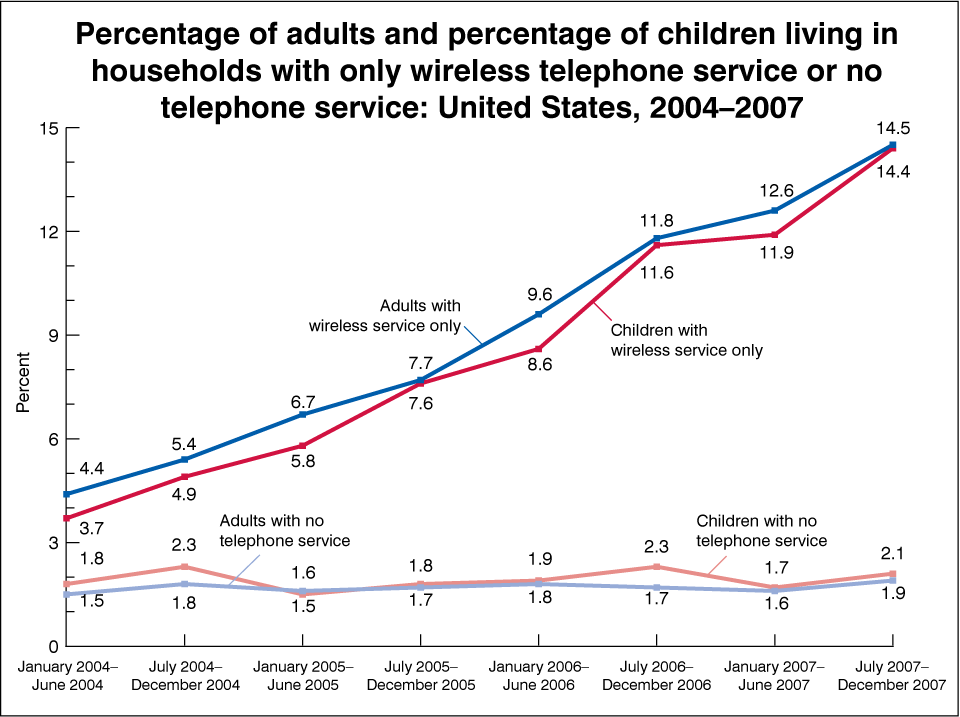
And another 13% of US homes receive most calls via mobile, even though they have a PSTN line.
And 2% have no phone service at all.
But the most interesting facts are in the demographic analysis. Perhaps unsurprisingly, shared-adult homes (eg students living in the same household) are very high on the wireless-only scale, compared with families. Similarly (and probably overlapping) renters are more wireless-centric than homeowners. And there is also a preponderance of low-income and ethnic members of this category.
This data looks pretty similar to stats I've seen from Ofcom in the past about the UK.
What it tells me is that despite the hype, "cord cutting" is not really an aspirational thing at all - it's more driven by circumstance (economic or social).
Oh, and I love the statistic that wireless-only users are more than twice as likely to binge-drink than landline customers. Now if only someone had an explanation for cause-and-effect here.... does dealing with mobile customer service agents drive you to drink? Or do people cancel their landline subscription when they're drunk, and wake up in the morning wondering what happened to their dialtone?
Clearly, if femtocell suppliers really want to facilitate FMS, they need to forget about home gateways & instead integrate their modules into one of these.
Wednesday, May 14, 2008
Adding a second carrier in 3G HSPA networks
I'm at Ericsson's Capital Markets & Analyst event in Stockholm today. There's been a huge amount of discussion about mobile broadband, in terms of traffic growth, moves towards HSPA and LTE, and the demand for backhaul capacity.
The CEO of Mobilkom in Austria spoke about that country's huge shift towards HSPA, to the extent that it's starting to catch up with ADSL use in terms of susbcriptions (dongles again...). Austria is a bit of an outlier in adoption of HSPA, with data traffic apparently now 20x outweighing voice on the network, but it's an interesting indicator of what's coming down the line.
In particular, it's indicating that the leading HSPA networks are now having to deploy an extra set of transmitters on the base stations. For those readers who don't follow this area, 3G UMTS networks (including HSPA), use 5MHz spectrum slices. Most operators have allocations of 10, 15, 20MHz or more, but typically haven't been using all of their theoretical capacity thus far.
The interesting thing for me is just how fast this occurs. Now, Austria is unusual, but even if you assume that most countries will take two years from launching flatrate dongle plans, rather than one year, to fill up the first 5MHz, it's an early indicator of demand ramp-up for spectrum (and capacity) over the next few years. This is especially true as end users get used to higher-speed HSPA, as well as increases in the total number of users. Add in some growth in data traffic from phones with decent browsers or video clients, and it starts to look as if the 2.1GHz 3G band is going to fill up very quickly.
This has a number of implications.
Firstly, there's a short term business case for femtocells - if they can work out cheaper than adding a second or third 5MHz carrier on the macro network. On the flipside, some of the calculations I've seen have suggested that femtos substitute for new extra base stations rather than adding extra kit to existing ones. I'm not sure what the comparative costs are, but I guess that bring up a 2nd carrier must be a lot less.
[Not much discussion from Ericsson about femtos for 3G macro-offload (or indeed at all), to be honest. My take is that as well as potentially impacting its overall integrated base station/transmission business model and bringing in new competitors, I get the distinct impression that the Big E is a little skeptical about some of the femto hype on a fundamental basis.]
Secondly, it means that operators will need to get extra spectrum if they're serious about continuing to drive mobile broadband. 2.6GHz is the obvious big chunk, but refarming 900 and 1800MHz GSM starts to take on more urgency ( as well as expediency for coverage reasons).
Lastly, it means that operators are going to be faced with some unpalatable choices in terms of capex for HSPA - having to choose between fulfilling the need for extra 5MHz carriers in high-use areas, versus continuing 3G build out in areas with no coverage at all. I suspect that this is going to drive a lot more emphasis on EDGE - and EDGE Evolved, as an interim coverage solution in marginal areas, as it wring more life out of existing 2G base stations. Interestingly, the GSA has been talking up EDGE today as well.
On the other hand, the company refreshed its overall take on broadband traffic, reiterating what it said this time last year. In a nutshell, even with massive growth in HSPA & LTE, the world's total mobile data traffic will still only be a tiny fraction of fixed-line IP (<5%), even out to 2013. The main driver of fixed-broadband traffic is seen as IPTV, especially on GPON fibre and VDSL access lines.
The CEO of Mobilkom in Austria spoke about that country's huge shift towards HSPA, to the extent that it's starting to catch up with ADSL use in terms of susbcriptions (dongles again...). Austria is a bit of an outlier in adoption of HSPA, with data traffic apparently now 20x outweighing voice on the network, but it's an interesting indicator of what's coming down the line.
In particular, it's indicating that the leading HSPA networks are now having to deploy an extra set of transmitters on the base stations. For those readers who don't follow this area, 3G UMTS networks (including HSPA), use 5MHz spectrum slices. Most operators have allocations of 10, 15, 20MHz or more, but typically haven't been using all of their theoretical capacity thus far.
The interesting thing for me is just how fast this occurs. Now, Austria is unusual, but even if you assume that most countries will take two years from launching flatrate dongle plans, rather than one year, to fill up the first 5MHz, it's an early indicator of demand ramp-up for spectrum (and capacity) over the next few years. This is especially true as end users get used to higher-speed HSPA, as well as increases in the total number of users. Add in some growth in data traffic from phones with decent browsers or video clients, and it starts to look as if the 2.1GHz 3G band is going to fill up very quickly.
This has a number of implications.
Firstly, there's a short term business case for femtocells - if they can work out cheaper than adding a second or third 5MHz carrier on the macro network. On the flipside, some of the calculations I've seen have suggested that femtos substitute for new extra base stations rather than adding extra kit to existing ones. I'm not sure what the comparative costs are, but I guess that bring up a 2nd carrier must be a lot less.
[Not much discussion from Ericsson about femtos for 3G macro-offload (or indeed at all), to be honest. My take is that as well as potentially impacting its overall integrated base station/transmission business model and bringing in new competitors, I get the distinct impression that the Big E is a little skeptical about some of the femto hype on a fundamental basis.]
Secondly, it means that operators will need to get extra spectrum if they're serious about continuing to drive mobile broadband. 2.6GHz is the obvious big chunk, but refarming 900 and 1800MHz GSM starts to take on more urgency ( as well as expediency for coverage reasons).
Lastly, it means that operators are going to be faced with some unpalatable choices in terms of capex for HSPA - having to choose between fulfilling the need for extra 5MHz carriers in high-use areas, versus continuing 3G build out in areas with no coverage at all. I suspect that this is going to drive a lot more emphasis on EDGE - and EDGE Evolved, as an interim coverage solution in marginal areas, as it wring more life out of existing 2G base stations. Interestingly, the GSA has been talking up EDGE today as well.
On the other hand, the company refreshed its overall take on broadband traffic, reiterating what it said this time last year. In a nutshell, even with massive growth in HSPA & LTE, the world's total mobile data traffic will still only be a tiny fraction of fixed-line IP (<5%), even out to 2013. The main driver of fixed-broadband traffic is seen as IPTV, especially on GPON fibre and VDSL access lines.
Metro WiFi - last nail in the coffin
I've been consistently negative about the prospects for metro WiFi. It's been doomed to failure from the start, usually championed by bored local-government IT drones looking for a new bandwagon to waste taxpayers money on.
There's a long list of negatives, but chief among them is that outdoor WiFi doesn't work indoors. It's useless. It's just wireless for traffic wardens.
So the demise of the Philadelphia poster-child network comes as little surprise to me.
I'm a little more open-minded about metro WiMAX (or maybe 3G), but I'm not holding my breath about that either, especially if it's at 3.5GHz - and 2.6GHz might be tricky too.
There's a long list of negatives, but chief among them is that outdoor WiFi doesn't work indoors. It's useless. It's just wireless for traffic wardens.
So the demise of the Philadelphia poster-child network comes as little surprise to me.
I'm a little more open-minded about metro WiMAX (or maybe 3G), but I'm not holding my breath about that either, especially if it's at 3.5GHz - and 2.6GHz might be tricky too.
Monday, May 12, 2008
Over-optimistic femtocell forecasts?
I've seen quite a lot of large numbers and hockey-stick curves recently, all indicating an imminent huge explosion in femto shipments in the next few years.
ip.access' very good femto blog has links to quite a lot of the studies, some of which suggest shipments are going to hit 10's of millions of units as early as 2010-2012. I haven't got copies of my competitors' studies, so I don't know exactly what assumptions, methodologies and caveats they are using.
My current view is rather more pessimistic. We're already in the middle of 2008, with various trials ongoing. I'm expecting to see lots more trials during H2 2008 and H1 2009 with a variety of results being published, both positive and negative. I'd agree with the assertion of one of my peers that 2008 shipments should be in the 100,000 range, although precise numbers are likely to be a little fuzzy in terms of defining "shipments" versus orders, versus paid installations in active users' homes.
I think there will have to be a lot of efforts made during 2009 to fix all the problems these trials throw up - nothing unusual there, just the normal technology deployment cycle. Getting everything right first-time, and immediately flipping the switch on the massive manufacturing plants, seems implausible to me. I can't think of anything else that's ramped up that quickly.
Sure, we'll see some niche deployments - perhaps in certain groups in Japan, or in bits of the US with lousy macro coverage. But are we going to climb to rapid adoption among the addressable market (essentially the world's 400m or so home broadband subscribers)? I'm unconvinced by the business model or demand just yet. It'll come, but there are a lot of prerequisites still not in place, not least of which is a sufficient population of 3G handsets or other devices, and people who actually want to use them for high speed access.
And even at $100 or $50, femto capability is too expensive to put into a home gateway if it's not going to be used. (If it's $5 or $10 like WiFi, it's cheap enough to just put it in the box by default - if the user doesn't switch it on, it's no big deal).
But more importantly, I'm starting to come round to the view that femtos will only become truly massmarket when we get to LTE deployment, and that HSPA and EVDO femtos may only be a starter to 4G's main course. I have various reasons to think this, and I'll have to annoy some readers with a bald assertion that it's about application related issues, and radio/spectrum reasons. I'm intending to publish a report in the next few weeks that will clarify my thinking on some of this, so keep reading.
As a last part of the post, I've taken a punt at some numbers. I'll be absolutely upfront, I haven't done a rigorous model on this at the moment, these are just educated guesses, based on my understanding of mobile, device and broadband markets, and having watched the evolution of picos & femtos for more than 7 years.
I'd currently estimate the number of shipments at maybe:
500k-1m in 2009 [this might be skewed by early large orders that end up in warehouses though]
2-3m in 2010
4-5m in 2011
5-8m in 2012.
In the 2009-H1 2010 period, I'm expecting the market to be driven by a small number of major operator advocates (much like dual-mode WiFi/cellular services today).
After 2013, when LTE starts hitting mainstream devices like phones in a big way, then I can potentially see a much larger uplift. Price points should also enable femto capability to be added to broadband home gateways 'for free', and also by that point we should have resolved issues like multi-operator femtos, and what the business model might be for femtos+prepay mobile.
Edit - as well as LTE triggering femto ramp-up, I'd amend my view to include HSPA *after 3GPP Release 8* as well. We'll probably start to see R8 phones & networks emerging into the real world from end-2010 onwards, ramping up during 2011-13.
Comments are welcome, although if anyone wants to discuss thoughts on the femto market privately, I can be reached at firstname.lastname AT disruptive-analysis.com
ip.access' very good femto blog has links to quite a lot of the studies, some of which suggest shipments are going to hit 10's of millions of units as early as 2010-2012. I haven't got copies of my competitors' studies, so I don't know exactly what assumptions, methodologies and caveats they are using.
My current view is rather more pessimistic. We're already in the middle of 2008, with various trials ongoing. I'm expecting to see lots more trials during H2 2008 and H1 2009 with a variety of results being published, both positive and negative. I'd agree with the assertion of one of my peers that 2008 shipments should be in the 100,000 range, although precise numbers are likely to be a little fuzzy in terms of defining "shipments" versus orders, versus paid installations in active users' homes.
I think there will have to be a lot of efforts made during 2009 to fix all the problems these trials throw up - nothing unusual there, just the normal technology deployment cycle. Getting everything right first-time, and immediately flipping the switch on the massive manufacturing plants, seems implausible to me. I can't think of anything else that's ramped up that quickly.
Sure, we'll see some niche deployments - perhaps in certain groups in Japan, or in bits of the US with lousy macro coverage. But are we going to climb to rapid adoption among the addressable market (essentially the world's 400m or so home broadband subscribers)? I'm unconvinced by the business model or demand just yet. It'll come, but there are a lot of prerequisites still not in place, not least of which is a sufficient population of 3G handsets or other devices, and people who actually want to use them for high speed access.
And even at $100 or $50, femto capability is too expensive to put into a home gateway if it's not going to be used. (If it's $5 or $10 like WiFi, it's cheap enough to just put it in the box by default - if the user doesn't switch it on, it's no big deal).
But more importantly, I'm starting to come round to the view that femtos will only become truly massmarket when we get to LTE deployment, and that HSPA and EVDO femtos may only be a starter to 4G's main course. I have various reasons to think this, and I'll have to annoy some readers with a bald assertion that it's about application related issues, and radio/spectrum reasons. I'm intending to publish a report in the next few weeks that will clarify my thinking on some of this, so keep reading.
As a last part of the post, I've taken a punt at some numbers. I'll be absolutely upfront, I haven't done a rigorous model on this at the moment, these are just educated guesses, based on my understanding of mobile, device and broadband markets, and having watched the evolution of picos & femtos for more than 7 years.
I'd currently estimate the number of shipments at maybe:
500k-1m in 2009 [this might be skewed by early large orders that end up in warehouses though]
2-3m in 2010
4-5m in 2011
5-8m in 2012.
In the 2009-H1 2010 period, I'm expecting the market to be driven by a small number of major operator advocates (much like dual-mode WiFi/cellular services today).
After 2013, when LTE starts hitting mainstream devices like phones in a big way, then I can potentially see a much larger uplift. Price points should also enable femto capability to be added to broadband home gateways 'for free', and also by that point we should have resolved issues like multi-operator femtos, and what the business model might be for femtos+prepay mobile.
Edit - as well as LTE triggering femto ramp-up, I'd amend my view to include HSPA *after 3GPP Release 8* as well. We'll probably start to see R8 phones & networks emerging into the real world from end-2010 onwards, ramping up during 2011-13.
Comments are welcome, although if anyone wants to discuss thoughts on the femto market privately, I can be reached at firstname.lastname AT disruptive-analysis.com
Thursday, May 08, 2008
BT - FMC and VoWLAN for conservative customers
I went to a launch event for BT's new upgraded version of its Total Broadband service yesterday. This is a package the company has offered for some time, which bundles assorted additional capabilities along with the basic (and fairly slow - just 8Mbit/s) ADSL Internet connectivity - online backups, access to BT OpenZone WiFi hotspots, BT Broadband Talk VoIP service and so on. It's centred on BT's Home Hub gateway which also provides WiFi, a DECT handset and remote management.
In the past, the Home Hub also acted as the centrepiece of BT's ill-fated Fusion dual-mode UMA service, which has been quietly interred, after singularly failing to set the world on fire.
But BT has now reincarnated its FMC plans, calling it Total Broadband Anywhere, but binning the 'seamless' UMA rhetoric and focusing more on what I see as a sort of consumer-grade BlackBerry proposition, with a bit of added VoIP when in WiFi coverage. At first sight, I was a bit critical of the offer, which features a couple of fairly humdrum 2G-only HTC phones from yesteryear (especially as it was announced on the same day HTC debuted its shiny new Diamond iPhone-challenger device).
But then I had a think about the demographics of BT's broadband customer base. As BT's ADSL service tends to be at the more expensive end of the market, I reckon it tends to be populated by a few particular constituencies:
In the past, the Home Hub also acted as the centrepiece of BT's ill-fated Fusion dual-mode UMA service, which has been quietly interred, after singularly failing to set the world on fire.
But BT has now reincarnated its FMC plans, calling it Total Broadband Anywhere, but binning the 'seamless' UMA rhetoric and focusing more on what I see as a sort of consumer-grade BlackBerry proposition, with a bit of added VoIP when in WiFi coverage. At first sight, I was a bit critical of the offer, which features a couple of fairly humdrum 2G-only HTC phones from yesteryear (especially as it was announced on the same day HTC debuted its shiny new Diamond iPhone-challenger device).
But then I had a think about the demographics of BT's broadband customer base. As BT's ADSL service tends to be at the more expensive end of the market, I reckon it tends to be populated by a few particular constituencies:
- Conservative life-long BT customers with an aversion to the hassle of switching ISPs and telephone providers
- People who aren't bothered by cable TV & so aren't particularly interested in Sky's or Virgin's 3/4-play bundles.
- Home workers who feel that paying a bit more gives some sort of peace of mind, but who aren't prepared to stump up for a dedicated Business Broadband line. (I'm in this category myself).
I suspect that BT broadband is less popular among younger groups like students who perhaps focus on cheaper or "free" offers and prepay mobiles, or gadget-hungry enthusiasts who want iPhone along with their HDTV. I also suspect the "traditionalists" and their spouses are perhaps less likely to have company-issued BlackBerries. And the device UI seems to be pretty user-friendly, and BT has focused on some fairly simple setup & configuration procedures.
In other words, there's probably a segment of BT's 4m-odd broadband subscribers who could see the benefit in paying an extra £5 a month for an extra email & web device, also usable for BT's VoIP service when in range of home, hotspot or FON WiFi. It's not going to sell in its millions I suspect, but it should help BT maintain its ADSL margins and minimise churn. It's also notable that it's not being positioned as a replacement for users' existing phones, although clearly the company hopes that some users will choose to port numbers and use the device as their primary handset.
However, there are a couple of flies in the ointment. The 10MB data allowance outside of WiFi coverage is meagre, and perhaps reflects BT's ageing MVNO deal with Vodafone needing some renegotiation. The absence of 3G handsets is also bit weak - although of course both iPhone and BlackBerry seem to do pretty well without it. But what I think is a glaring gap is the absence of a consumer 3G dongle for their laptops. And also that the Windows Mobile devices rely on 'pull' rather than 'push' email, and also don't have any dedicated IM capability.
Overall, I'm more positive on this than I was about the original Fusion proposition.
Just one last thing though.... given that the package seems to encourage customers to get another mobile device, and split their calling between that and another phone, perhaps they could have come up with a snappier brand? I reckon that "BT Fission" would have been appropriate.....iPhone non-exclusivity in Italy - it's all about prepaid
There’s much confusion and discussion today about Apple selecting two operators to sell iPhones in Italy – Vodafone and Telecom Italia. Plenty of observers are pointing to a huge shift in Apple’s exclusivity strategy, or debating whether the iPhone is uncompetitive in the Nokia-rich European marketplace.
But in my opinion, there’s a much simpler explanation, especially missed by most of my counterparts on the other side of the Atlantic.
It’s just about prepay.
In the US, prepaid mobile phone services are viewed by many with disdain – they’re for socioeconomically disadvantaged people, or migrants without US bank accounts or who fail credit checks. Americans seem to think that all real mobile users are always happy to be tied into 2-year cast-iron contracts with monthly subscriptions.
I’ve lost count of the number of conversations I’ve had with people from the US who are genuinely amazed that most of the world’s mobile subscribers use prepay. And in many cases this is not because they have to use prepay because of economic circumstances, it’s because they prefer to. Many simply do not want to be “on contract” because they want the flexibility to top-up their account and control their spending. Some like to swap SIMs to play tariff arbitrage. Many want multiple phones and numbers, and not need to maintain ongoing accounts for each. Some want to buy a phone separately to the service component. Or because the contract-based plans don’t meet their needs in terms of bundles. Some just do it because they’re used to it – it seems natural.
Take me for example. As well as a couple of contracts, I have a prepay SIM from H3G because it gives me cheap mobile data on unlocked phones. And I regularly get prepay SIMs to use when I travel - if I'm in Mozambique or Bolivia or wherever, why not spend just $3 for a SIM to make local calls to hotels or restaurants? What's the point in routing calls back via London & paying huge roaming charges for the privilege? I also prepay for travel in London on my Oyster card, and I prepay for beer in the pub, rather than after I've drunk it, or via a monthly subscription. (Hey, now that's an idea...)
But people from the US tend to think there’s some kind of stigma attached to prepay, rather than it just being the way it’s done, no big deal.
It’s similar to the way that the rest of the world looks at the US and is amazed by the preponderance of phones in hip holsters – which in our eyes have an equivalent social stigma. But for people in the US, wearing your phone on a Batman-type utility belt seems as acceptable for a trader on Wall Street or a fashionista on 5th Avenue as it is for the geekiest nerd in the IT department – it’s just the way it’s done, no big deal.
And so to Italy and the iPhone.
Vodafone Italy has 22.8m customers, of whom 91.2% (about 20m) are prepaid customers.
Telecom Italia Mobile has 36.3m subscribers, of whom 85% ( 30.8m) are prepaid.
And many of the contract customers are actually corporate users, or even subscriptions for 3G modems or embedded M2M modules. While plenty of prepay customers have shiny, high-end smartphones.
In other words, the number of individual consumers in Italy who would buy an iPhone, together with an 18/24-month contract, is roughly twelve. Apple has obviously realised that its much-vaunted monthly revenue-share business model isn’t going to work very well in Italy, especially if it only has one carrier as a route to market. And given that prepay top-ups make it is almost impossible to identify which phone they are used with, I can’t see how Apple is going to get a revenue share on prepay that way either. Far better to try and persuade Italian consumers to pay full-whack retail price for the device, and then use it with the prepay SIM from the operator of their choice.
This is also quite possibly why Vodafone’s announcement yesterday was so terse – Apple is probably going to have to reinvent its whole revenue model for the iPhone in prepay-centric markets, and somehow communicate that to its investors. And face down its current contract-based partners wincing about paying Mr Jobs a 10% tax for the privilege of selling his device.
And I’d guess Apple probably wants Vodafone to keep quiet about exactly how this will play out in other prepay markets like India, Egypt, Turkey et al.
But in my opinion, there’s a much simpler explanation, especially missed by most of my counterparts on the other side of the Atlantic.
It’s just about prepay.
In the US, prepaid mobile phone services are viewed by many with disdain – they’re for socioeconomically disadvantaged people, or migrants without US bank accounts or who fail credit checks. Americans seem to think that all real mobile users are always happy to be tied into 2-year cast-iron contracts with monthly subscriptions.
I’ve lost count of the number of conversations I’ve had with people from the US who are genuinely amazed that most of the world’s mobile subscribers use prepay. And in many cases this is not because they have to use prepay because of economic circumstances, it’s because they prefer to. Many simply do not want to be “on contract” because they want the flexibility to top-up their account and control their spending. Some like to swap SIMs to play tariff arbitrage. Many want multiple phones and numbers, and not need to maintain ongoing accounts for each. Some want to buy a phone separately to the service component. Or because the contract-based plans don’t meet their needs in terms of bundles. Some just do it because they’re used to it – it seems natural.
Take me for example. As well as a couple of contracts, I have a prepay SIM from H3G because it gives me cheap mobile data on unlocked phones. And I regularly get prepay SIMs to use when I travel - if I'm in Mozambique or Bolivia or wherever, why not spend just $3 for a SIM to make local calls to hotels or restaurants? What's the point in routing calls back via London & paying huge roaming charges for the privilege? I also prepay for travel in London on my Oyster card, and I prepay for beer in the pub, rather than after I've drunk it, or via a monthly subscription. (Hey, now that's an idea...)
But people from the US tend to think there’s some kind of stigma attached to prepay, rather than it just being the way it’s done, no big deal.
It’s similar to the way that the rest of the world looks at the US and is amazed by the preponderance of phones in hip holsters – which in our eyes have an equivalent social stigma. But for people in the US, wearing your phone on a Batman-type utility belt seems as acceptable for a trader on Wall Street or a fashionista on 5th Avenue as it is for the geekiest nerd in the IT department – it’s just the way it’s done, no big deal.
And so to Italy and the iPhone.
Vodafone Italy has 22.8m customers, of whom 91.2% (about 20m) are prepaid customers.
Telecom Italia Mobile has 36.3m subscribers, of whom 85% ( 30.8m) are prepaid.
And many of the contract customers are actually corporate users, or even subscriptions for 3G modems or embedded M2M modules. While plenty of prepay customers have shiny, high-end smartphones.
In other words, the number of individual consumers in Italy who would buy an iPhone, together with an 18/24-month contract, is roughly twelve. Apple has obviously realised that its much-vaunted monthly revenue-share business model isn’t going to work very well in Italy, especially if it only has one carrier as a route to market. And given that prepay top-ups make it is almost impossible to identify which phone they are used with, I can’t see how Apple is going to get a revenue share on prepay that way either. Far better to try and persuade Italian consumers to pay full-whack retail price for the device, and then use it with the prepay SIM from the operator of their choice.
This is also quite possibly why Vodafone’s announcement yesterday was so terse – Apple is probably going to have to reinvent its whole revenue model for the iPhone in prepay-centric markets, and somehow communicate that to its investors. And face down its current contract-based partners wincing about paying Mr Jobs a 10% tax for the privilege of selling his device.
And I’d guess Apple probably wants Vodafone to keep quiet about exactly how this will play out in other prepay markets like India, Egypt, Turkey et al.
Tuesday, May 06, 2008
Vodafone + iPhone...
I wonder whether there's a deeper story behind Vodafone's remarkably terse announcement this morning that it's going to be selling iPhones in 10 of its national markets.
There is no quote from either Jobs or Sarin - just two abrupt sentences. As I'm writing this (9am in London), the release isn't up on Apple's own site either. No details on pricing, contract length, how Voda will work with (or around) iTunes...
.... and even more importantly, no indication whether "the iPhone" might be a new 3G version.
There is no quote from either Jobs or Sarin - just two abrupt sentences. As I'm writing this (9am in London), the release isn't up on Apple's own site either. No details on pricing, contract length, how Voda will work with (or around) iTunes...
.... and even more importantly, no indication whether "the iPhone" might be a new 3G version.
Subscribe to:
Posts (Atom)